
Portfolio Management
Portfolio Lease Intelligence: How AI Lets You Query Across Hundreds of Leases
Your board presentation is in four days. You need expansion options expiring in 18 months across a 300-lease portfolio. AI transforms that from a three-day analyst project into a 30-second query. But only if your lease data is built to handle it. Learn what makes portfolio querying reliable — and why most platforms fall short.
Key Takeaways
- •A single accurate lease abstract is useful. A portfolio of 500 verified, structured, queryable lease records is a competitive intelligence asset — these are not the same category of deliverable.
- •Reliable portfolio querying requires more than AI. It requires a unified data schema, confidence-scored fields, and source-linked extraction across base leases, amendments, and riders.
- •AI handles extraction and identification of structured lease terms reliably. Questions requiring legal interpretation or business judgment still require qualified attorney review.
- •Approximately 32% of CRE firms report their lease data is too fragmented to effectively support AI querying — making data infrastructure the bottleneck, not the AI platform itself.
- •JLL's 2026 Technology Industry Trends report found that 92% of CRE teams have initiated or plan AI pilots, but only 5% report achieving most of their program objectives — a gap that almost always traces back to data quality, not the AI tool.
What Does AI Lease Portfolio Management Actually Mean?
AI lease portfolio management is the use of artificial intelligence to extract, structure, verify, and query lease data across an entire portfolio — not document by document, but simultaneously across every active lease, amendment, and rider a team holds.
The term gets used loosely. Some vendors mean "AI-assisted abstraction with a reporting dashboard." Others mean full natural language query capability across all portfolio data. These are meaningfully different things, and the distinction matters to anyone evaluating platforms.
At its core, AI lease portfolio management involves three distinct layers:
- 1.Extraction:
AI reads lease documents and pulls structured data across 200+ defined fields — base rent, escalation formulas, critical dates, renewal rights, CAM caps, co-tenancy triggers, and more.
- 2.Verification:
Extracted fields are confidence-scored and linked directly to the source clause in the original PDF. Every field is traceable to its exact origin.
- 3.Querying:
Users pose natural language questions — "Show me all leases expiring in Q3 with base rent above $50,000" — and receive verified, structured answers drawn from the full portfolio's extracted data.
The third layer is where most platforms fall short. Extraction and dashboarding are table stakes in 2026. True portfolio querying — where the system reasons across hundreds of leases simultaneously and returns answers with source citations — requires data infrastructure far more rigorous than most teams currently have in place.
The technology driving this capability includes large language models (LLMs), retrieval-augmented generation (RAG), and optical character recognition (OCR) working in combination. The AI doesn't guess at data — it locates it in source documents, extracts it into structured fields, and makes those fields addressable by natural language queries.
Why Is the Abstract Itself Not the End Goal?
There's a framing problem in how most CRE teams think about lease abstraction. They treat it as the deliverable — a document summarizing a lease, filed and done. The abstract sits in a folder. Someone refers to it when a question comes up.
That framing undersells the actual value by a factor of several hundred.
A single accurate abstract helps the team managing that one property. A portfolio of 500 verified, structured, consistently formatted lease records — queryable in seconds across every field — is a fundamentally different asset. It's not a filing system. It's intelligence infrastructure.
Consider what's possible when that infrastructure exists:
- →Identify, in under 60 seconds, every lease where a tenant holds an unused expansion option expiring within 18 months.
- →Surface all leases expiring in a specific quarter with base rent above any threshold.
- →Flag every lease where CAM reconciliation methodology differs from the portfolio standard — the leases most likely to generate disputes.
- →Cross-reference weighted average lease expiry (WALE) by asset class, geography, or tenant type in real time.
- →Answer investor due diligence questions during the meeting, not after it.
None of this requires future technology. It reflects the current capability of purpose-built AI lease portfolio management platforms. The limiting factor isn't what the AI can do. It's whether the underlying lease data meets the quality bar required for reliable cross-portfolio querying.
The data makes the capability real. Without it, portfolio querying returns impressive-looking results built on uncertain foundations — which is arguably worse than no tool at all.
Property management professionals using AI broadly across core workflows are forecasting 31% portfolio growth in 2026, compared to 12% for those not using AI, according to real estate technology analysts tracking adoption patterns this year. That 19-point gap reflects operational leverage, not marketing copy.
What Technical Requirements Make Portfolio Querying Reliable?
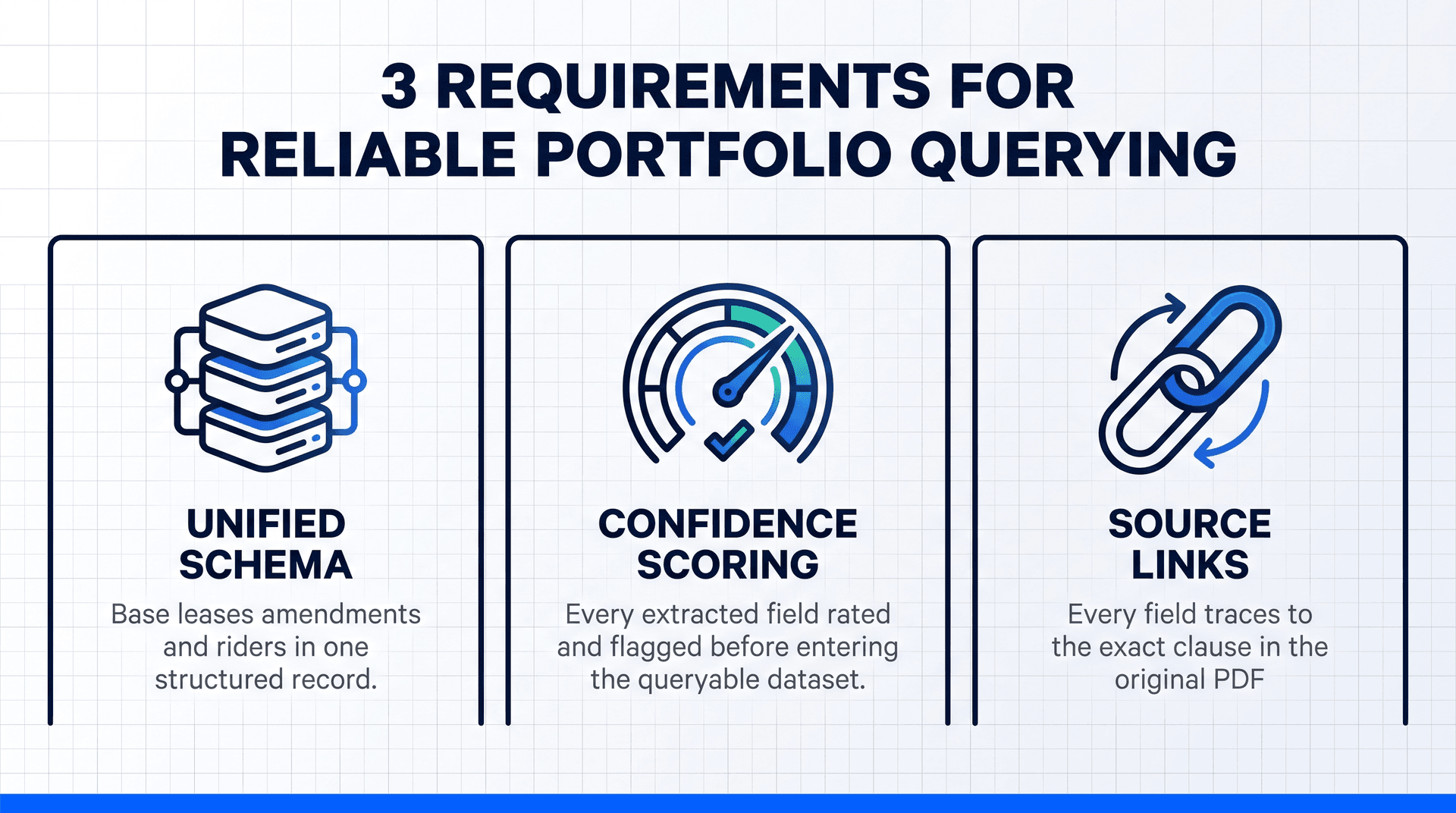
Most lease data fails at the portfolio query layer — not because the extraction was wrong, but because the data was never structured for cross-portfolio use. For portfolio querying to return reliable answers, three technical requirements must be met simultaneously.
A Unified Schema Across All Document Types
Every lease document — base lease, amendment, rider, memorandum of lease, SNDA, side letter — must be extracted into a consistent, unified data schema. If amendments are stored as unstructured text while base lease data sits in structured fields, cross-portfolio queries will miss or misattribute amendment-modified terms.
This sounds basic. Most platforms don't do it. They abstract the base lease into a structured record and treat amendments as attached documents. If a second amendment reduces base rent by $5,000 per month starting in month 19, and that reduction lives in an annotation rather than a structured field update, a query for "all leases with base rent above $50,000" returns the wrong number for that tenant. Multiply that error across a 200-lease portfolio with multiple amendments each, and the query results become unreliable by construction.
Confidence-Scored Fields
Not all extracted fields carry equal certainty. A base rent figure stated identically in three locations across a lease document carries different confidence than a CAM exclusion buried in Exhibit C, cross-referenced by a defined term established in the main body.
Purpose-built platforms should confidence-score each field at extraction time — flagging fields that fall below a certainty threshold for human review before they enter the queryable dataset. Without confidence scoring, portfolio query results blend high-certainty data with uncertain data. The team has no way to distinguish between them, and no way to know which rows in a result warrant manual verification.
Source Links at the Field Level
Every field in the queryable dataset should trace back to the exact clause in the source PDF where the data originated. This is not a convenience feature. It's the mechanism that makes a query result something you can rely on.
When a portfolio query returns "17 leases expiring in Q3 with base rent above $50,000," every row in that result should be clickable to the lease page and clause that established the expiration date and rent figure. If a number is disputed — by a tenant, a lender, or an investor — the answer is one click away, not a two-day re-review of source documents. Platforms that don't provide this level of source traceability aren't providing AI lease portfolio management. They're providing AI-assisted data entry with a dashboard on top.
What Can AI Answer Reliably vs. What Still Needs Attorney Review?
Not every portfolio question belongs in the AI answer column. The CRE teams getting the most value from AI lease portfolio management are the ones with a clear picture of where the line is — what to trust the AI to answer, and what to route to counsel.
Here is a practical breakdown of the current capability boundary:
| Question Type | AI Handles Reliably | Attorney Review Required |
|---|---|---|
| Lease expiration dates by quarter | ✓ | |
| Base rent amounts and scheduled escalations | ✓ | |
| Renewal option exercise windows and notice deadlines | ✓ | |
| Expansion option expiration dates | ✓ | |
| CAM cap structure and applicable base year | ✓ | |
| Co-tenancy clause identification and trigger conditions | ✓ (id) | ✓ (legal effect) |
| Sublease and assignment consent requirement identification | ✓ | |
| SNDA existence, parties, and key obligations | ✓ | |
| Whether a specific clause creates actionable legal liability | ✓ | |
| Negotiation strategy for an upcoming renewal | ✓ | |
| Whether a co-tenancy breach has actually occurred | ✓ | |
| Obligations in cross-referenced non-standard exhibits | Partial | ✓ |
| Handwritten amendment riders with non-standard language | Partial | ✓ |
The pattern is consistent. AI is highly reliable at extraction and identification of structured, defined terms. It becomes unreliable at legal interpretation — determining what a clause means in a specific factual context, whether a condition has been met, and what the practical consequences are.
CRE attorneys who understand this workflow use AI to clear the extraction and identification layer quickly, then apply their time to the clauses that actually require judgment. That's the structural value: AI handles the volume, counsel handles the complexity. Both work faster as a result. The teams that get this wrong are the ones who either trust AI output without verification on legal interpretation questions, or distrust AI entirely and continue doing full manual extraction. Both approaches waste something — either money or accuracy.
How Do Amendments and Riders Break Portfolio Queries?
This is where the majority of portfolio query failures originate — and it's almost never acknowledged in vendor documentation.
Most CRE portfolios accumulate amendments over time. A 10-year retail lease might carry three to five amendments by year seven. Some modify rent. Some add or remove rights. Some alter critical dates. In a large portfolio, the amendment layer is not the exception. It's the operational norm.
The structural problem is how platforms handle these documents. If each amendment is stored as a separate file — rather than as a delta-linked update to the base lease record — portfolio queries run against base data that no longer reflects the actual terms in effect.
A query for "all tenants with active expansion options" may miss three tenants whose options were added in second amendments and never reconciled into the base record. A rent roll query may overstate income from five leases where amendments created temporary abatements that expired, or permanent reductions that were never reflected in the structured base rent field.
A Real Failure Mode
A third amendment adds a co-tenancy protection clause tied to an anchor tenant's continued presence. The amendment is filed as a separate document. The base lease record shows no co-tenancy clause. A portfolio query for "leases with co-tenancy protection language" returns zero results for that property. When the anchor tenant vacates and the protected tenant invokes the clause, the asset manager is blindsided by an obligation that AI lease data analysis should have flagged two years earlier.
The fix is architectural, not procedural. Amendments must be processed as delta-linked updates to base lease records — modifying structured fields in the original record rather than existing as separate documents that are never reconciled against it. That design decision affects every query result downstream from day one.
How Is This Capability Reshaping the Role of Asset Managers?
The conventional asset manager workflow involves a lot of waiting. Waiting for analysts to pull data. Waiting for lease admins to confirm terms. Waiting for outside counsel to interpret a clause before the investor call.
What changes when a portfolio is fully queryable isn't just speed. It's the nature of the work itself.
Asset managers operating with a reliable CRE portfolio AI intelligence layer describe a consistent shift: the job changes from retrieving answers to using them. The hours previously spent finding data — pulling abstracts, cross-referencing amendments, consolidating fields from multiple spreadsheets into a single report — go instead into analysis, strategy, and decision-making.
According to JLL's 2026 Technology Industry Trends report, 92% of CRE teams have initiated or plan to initiate AI pilots. But only 5% report achieving most of their program objectives. The gap between piloting and operating at AI speed almost always comes down to one variable: the quality of the underlying lease data. Teams that built clean, source-linked, unified lease data infrastructure before adopting AI querying are achieving the results. Teams that pointed a query layer at fragmented, unverified data are generating impressive-looking dashboards with unreliable numbers.
Portfolio directors specifically are finding that reliable lease intelligence changes what they can commit to in front of investors and lenders. A question like "what is the weighted average lease expiry across the portfolio, excluding month-to-month agreements?" used to require an analyst day and multiple data pulls. With a properly structured lease data layer, it's a 30-second query. That speed creates a different kind of accountability. Portfolio directors who can answer substantive questions in the room — not in a follow-up email — operate with a fundamentally different posture in capital conversations. The competitive advantage is real, and it compounds over time.
What Does Portfolio Lease Intelligence Look Like as a Competitive Asset?
The industry still frames lease abstraction as a cost center. That framing is wrong — and the teams recognizing this early are building durable advantages.
The argument is direct: a single verified lease abstract is a compliance document. Five hundred verified, structured, queryable lease records are a competitive intelligence layer. These are not the same category of asset, and the difference in operational capability between teams that have built one versus the other is growing.
Teams with reliable AI lease portfolio management infrastructure can do several things their competitors cannot:
- Move faster in acquisitions.
When 80 leases hit the data room, a team with a purpose-built AI platform can have a complete structured extract in 72 hours. A team relying on manual review needs three weeks. The faster team submits a better-informed bid earlier — and sometimes the only bid in contention.
- Identify value opportunities competitors miss.
Querying 500 leases for below-market rents, unused options approaching expiration, and upcoming escalation effective dates surfaces portfolio opportunities that periodic manual reviews routinely overlook.
- Negotiate from complete information.
A lease administrator who can pull every tenant's complete financial terms in 90 seconds has a different conversation with a tenant requesting rent relief than one who needs three days to assemble the same information.
- Reduce outside counsel spend.
When AI handles extraction and clause identification, legal review focuses on interpretation and risk — not document reading. At portfolio scale, that reduction is meaningful.
- Tighten due diligence windows in LOI negotiations.
Teams confident in their AI-assisted review speed can propose 10-day due diligence windows instead of 30-day windows — a structural deal advantage in competitive acquisitions.
According to real estate technology research, approximately 32% of CRE firms report their lease data is too fragmented to effectively support AI querying. That fragmentation isn't just an operational inconvenience. It's a structural disadvantage that compounds across every deal cycle, every investor conversation, and every asset management decision made on incomplete information.
If your portfolio is operating on fragmented, manually maintained lease data today, the gap between you and a competitor with a verified, queryable portfolio intelligence layer is real — and it widens every quarter.
Frequently Asked Questions
What is AI lease portfolio management?+
What types of portfolio questions can AI answer reliably?+
Why do most AI portfolio querying tools produce unreliable results in practice?+
How does AI lease portfolio management differ from standard lease abstraction software?+
What data infrastructure does a portfolio need before AI querying produces reliable results?+
How is AI lease portfolio management changing the day-to-day role of asset managers?+
The Bottom Line
The value of lease abstraction is not the abstract. It's what you can do with verified, structured data across 500 leases simultaneously.
A single well-executed abstract helps the team managing that property. A queryable portfolio intelligence layer — built on unified schema, source-linked fields, and confidence-scored extraction — helps the team managing the business. Those are not equivalent assets.
AI lease portfolio management is becoming the operational dividing line between CRE teams who can answer portfolio questions in real time and those who schedule meetings to find out. As that capability gap compounds across deal cycles, investor conversations, and asset management decisions, it shapes which teams are structurally ahead.
The technical requirements are clear. The data quality bar is well-defined. The question is whether your portfolio data meets it — and if not, what it costs to operate every day it doesn't.
Build Portfolio-Ready Lease Intelligence
Abstria builds the structured, source-linked lease data layer that makes reliable portfolio querying possible. From 50 leases to 5,000, the platform extracts, verifies, and structures lease data into a unified CRE-native schema — covering base leases, amendments, riders, and every document type in between, with every field linked to its exact source.
Related Reading
Lease Abstraction Due Diligence: What CRE Acquisition Teams Need to Know
30-vs-10-day due diligence timeline, tenant rights transfer, estoppel verification, CAM liability analysis.
How to Conduct a Commercial Property Lease Audit Before Closing
Step-by-step pre-acquisition audit framework, red flag modeling, estoppel reconciliation.
Commercial Lease Administration: The CRE Professional's Operational Guide
Critical dates, CAM reconciliation, amendments, compliance, and revenue control frameworks.
Lease Abstraction Guide
Complete guide to lease abstraction process, data categories, and accuracy standards for CRE teams.