
CRE Acquisition Guide
How to Conduct a Commercial Property Lease Audit Before Closing
Most buyers run lease audits to check boxes. That's exactly why so many get surprised at the closing table. Learn how to run a pre-acquisition lease audit as a financial modeling exercise — not a compliance task. Every clause you miss is a cap rate assumption you got wrong.
Key Takeaways
- •A commercial property lease audit is a financial modeling exercise, not a compliance checklist. Every clause you read — or miss — affects your cap rate assumptions directly.
- •A complete lease package is more than base leases. Amendments, estoppel certificates, SNDAs, and side letters all carry financial risk that won't appear on the seller's rent roll.
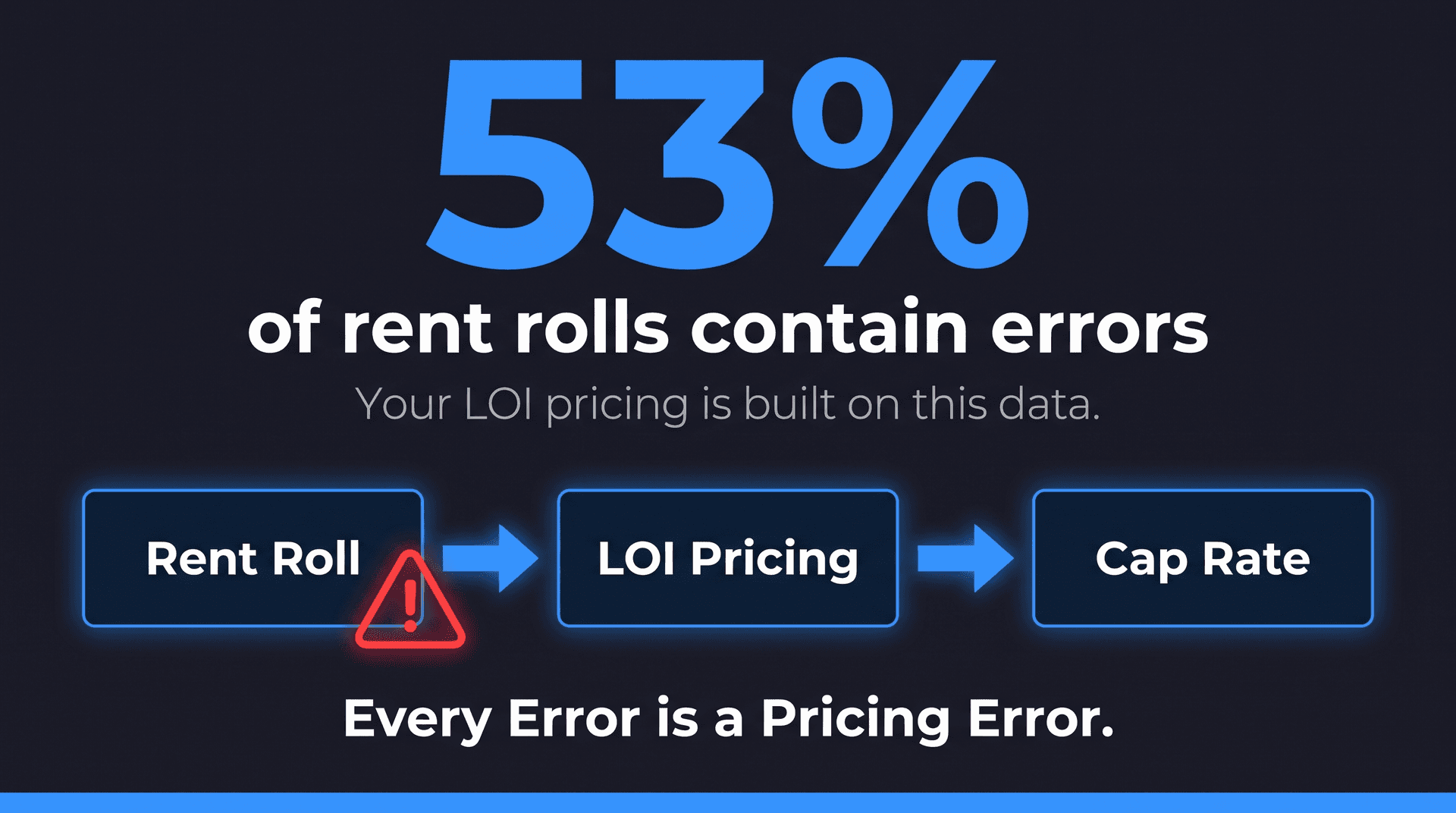
- •About 53% of rent rolls contain errors. That means the seller's financial summary your LOI pricing relies on likely doesn't match the actual lease documents.
- •Red flags fall into four groups: financial, operational, legal, and tenant risk. Each has a clear, modelable consequence.
- •Clauses missed during the audit phase come back as cap rate re-negotiations at closing. The co-tenancy clause nobody caught during diligence becomes the lender's problem — and then yours — weeks before closing.
What Is a Pre-Acquisition Lease Audit — and Why Most Buyers Get It Wrong
A pre-acquisition commercial property lease audit is a structured review of all lease documents before a property changes hands. It covers base leases, amendments, estoppel certificates, Subordination, Non-Disturbance, and Attornment (SNDA) agreements, and any side letters.
The goal is straightforward: confirm the seller's rent roll matches what the leases say. Then find any clauses that create risk or limit upside for the new owner.
Most acquisition guides treat this as a legal step. Read the leases. Flag issues. Call counsel. Move on. That's the wrong approach. Every lease clause is a financial input. Base rent sets your income. Escalation formulas drive income growth. CAM structures control expense recovery. Co-tenancy clauses determine whether that income is stable. Renewal options shape the exit cap rate a future buyer will use. These are not compliance questions. They are modeling inputs.
If your team treats the audit like a legal review, you are building a financial model without reading the source data. About 53% of commercial rent rolls contain material errors. Therefore, the seller's financial summary — the document your team underwrites against — likely misrepresents what the leases require. That is a pricing problem. Additionally, the lease audit is the only place in your diligence process where you can catch it in time.
Step 1: Build a Complete Lease Package Before You Read a Word
The most common lease audit failure happens before anyone reads a single clause. The document package is incomplete. Sellers send over what they have organized. That is rarely everything. Your first step is to request and confirm a full lease package for every tenant. A complete package includes:
- ✓Base lease — the original signed agreement between landlord and tenant
- ✓All amendments — every change in date order, numbered and linked to the base lease
- ✓Estoppel certificates — tenant-signed confirmations of current lease terms, dated within 90 days of closing
- ✓SNDA agreements — subordination, non-disturbance, and attornment agreements with any lenders
- ✓Side letters — any off-lease deals that change obligations or grant rights not in the main document
- ✓Assignment and assumption agreements — any prior transfers that changed who holds the tenant's obligations
- ✓Guaranty agreements — personal or corporate guarantees, including burn-off schedules and conditions that end them
Why Completeness Is the First Risk Checkpoint
A missing amendment can change your entire picture of a tenant's rent. A side letter granting a rent cut that's not in the base lease will destroy your NOI number. SNDA gaps can stall your financing or force a loan renegotiation. However, sellers often send base leases quickly and drag their feet on amendments. Side letters are frequently lost or forgotten.
When the package arrives, check for gaps before you start reading the substance:
- 1.Confirm every amendment is numbered and references the one before it
- 2.Confirm the amendment chain has no gaps in numbering or dates
- 3.Confirm estoppels are dated within 90 days of your target closing
- 4.Flag any tenant without an SNDA if the property carries lender debt
- 5.Ask the seller in writing whether any side letters or off-lease deals exist for each tenant
If the seller won't confirm completeness in writing, assume the package has gaps. Adjust your timeline accordingly.
Step 2: Abstract Each Document Field by Field
Once you have the full package, pull the data field by field. Don't write a narrative summary. Build structured records you can plug directly into your model. For each tenant, capture at minimum:
Financial Terms
- • Base rent at start date and current base rent
- • Rent escalation structure (fixed rate, CPI-linked, or periodic market reset)
- • CAM method (gross, NNN, modified gross, or base stop)
- • CAM caps, exclusions, and controllable/uncontrollable splits
- • Security deposit amount and any conditions that reduce it
- • Rent abatements, free rent periods, or outstanding TI allowances not yet funded
Critical Dates
- • Lease start and end dates
- • Renewal option windows and notice deadlines
- • Expansion option windows and notice deadlines
- • Termination option dates and notice requirements
- • Outstanding landlord obligation deadlines (TI delivery, HVAC replacement, etc.)
Tenant Rights
- • Renewal options — how many, how rent is set, what notice is required
- • Expansion rights — which spaces, whether it's a pre-emption or right of first refusal, rent formula
- • Contraction rights — what triggers them, when they are effective, how rent adjusts
- • Termination rights — qualifying conditions, notice period, penalties
- • Sublease and assignment consent thresholds
Special Provisions
- • Co-tenancy clauses — trigger events, remedy (rent cut or lease exit), cure periods
- • Exclusivity clauses — what competing uses the landlord cannot allow
- • Dark store rules — what happens if the tenant vacates while the lease runs
- • Personal guarantee burn-off schedules
- • SNDA obligations and specific lender consent requirements
The Amendment-Linking Requirement
The most common abstraction error is not a missed clause in the base lease. It is a missed amendment that changed a base lease clause — stored as a separate file that nobody linked back to the original.
Treat every amendment as a change record against the base lease. If Amendment 2 raises the base rent, your abstract must show the new rent. It should also note the original clause and the amendment that replaced it. Storing amendments as stand-alone documents gives you the lease as originally signed — not the lease as it exists today.
This is where AI-assisted abstraction built for CRE makes a real difference. Abstria links every amendment back to the base lease fields it changed. So your team sees the current rent, escalation formula, and CAM structure as one clean, verified record — not spread across four documents you reconcile by hand. Abstria extracts 200+ fields per lease and links every field to its exact source clause in the original PDF. The abstraction step moves faster without losing the precision your financial model needs.
Step 3: What Red Flags Should You Look for During a CRE Lease Audit?
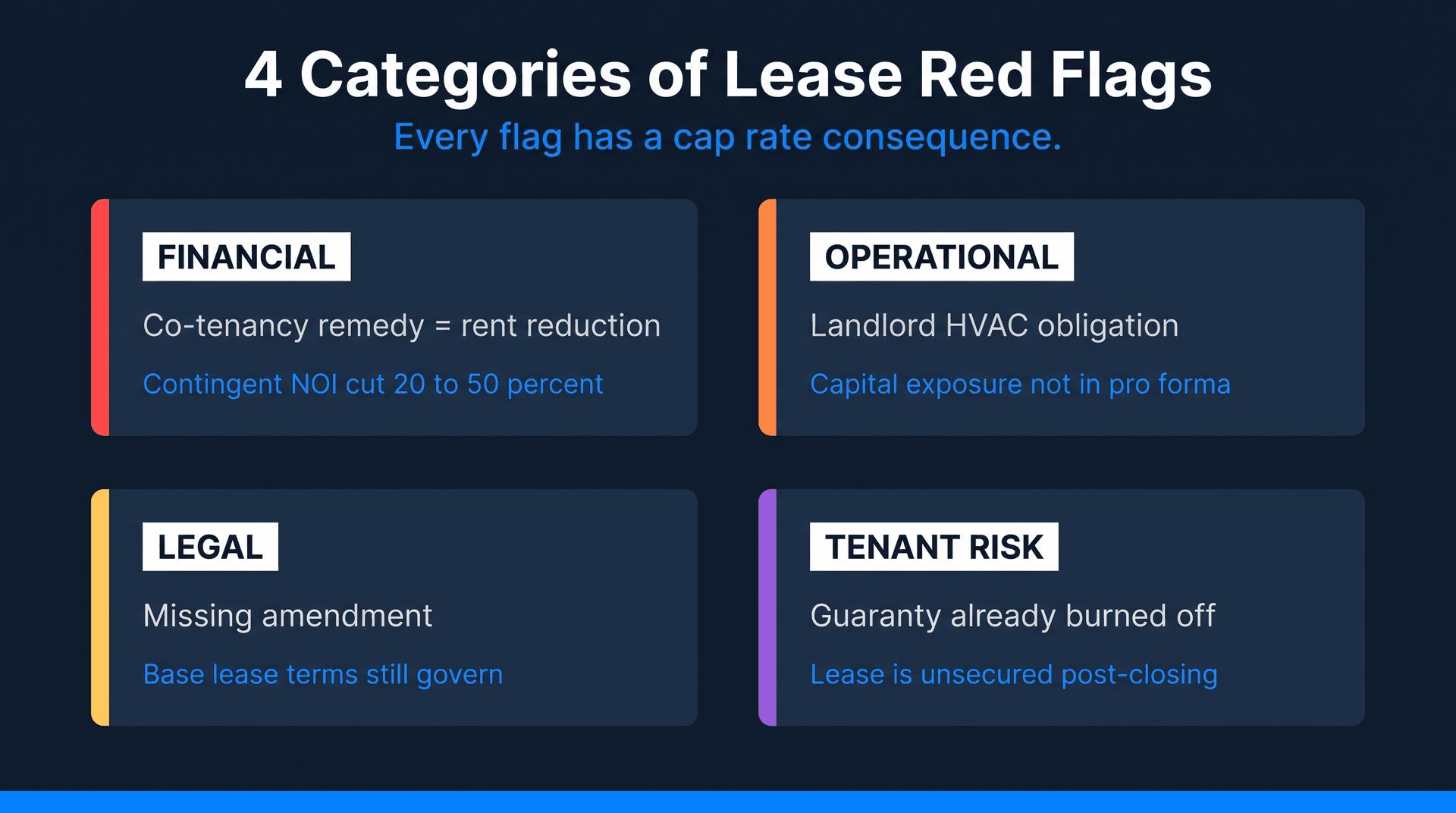
Red flags in a commercial property lease audit fall into four groups. Each group carries a different cap rate impact. Your job is not just to find them — it's to model them.
| Financial Red Flag | Cap Rate Implication |
|---|---|
| Below-market rent with no escalation | Suppressed NOI inflates your yield; you inherit the rent gap at expiration |
| CAM gross-up provision absent or unclear | Expense recovery runs below pro-rata during vacancy periods |
| Rent abatement still in effect | Reported base rent overstates current in-place NOI |
| TI allowance outstanding and unfunded | The obligation transfers to you at closing as a direct liability |
| Security deposit below market standard | Limited recourse if the tenant defaults early in the term |
| Co-tenancy remedy equals rent reduction | Possible NOI cut of 20–50% if the trigger fires |
Operational Red Flags
- Landlord repair duties on tenant-only systems — if the landlord owns responsibility for HVAC, rooftop gear, or interior mechanical systems, that is capital exposure your pro forma will miss
- Unclear repair and replacement lines — especially on roofs and structural elements in NNN deals where "NNN" can mean different things in different leases
- No continuous operation clause — the tenant can go dark with no default triggered, hurting other tenants' foot traffic with no remedy for the landlord
Legal Red Flags
- Missing or unsigned amendment — any amendment without both signatures is a negotiation record, not a binding change; the base lease still controls
- Guaranty already expired — if the personal or corporate guarantee burned off on its own schedule, the lease is unsecured; without burn-off dates in the abstract, you won't know
- Estoppel that conflicts with the abstract — the tenant's estoppel controls at closing; a conflict means the buyer inherits a dispute that should have been resolved before signing
- SNDA requiring lender consent to assignment — this can slow your financing if your lender needs existing lease transfers or prior lender sign-off
Tenant Risk Red Flags
- Credit tenant downgrade since original signing — a BBB-rated anchor from five years ago may now be weaker, recently acquired, or closing stores in similar markets
- Percentage rent with no minimum base — if sales drop, the floor is gone; your income sits fully at risk below the lease's breakpoint
- Sublease or assignment already in place without landlord consent — the current occupant may not hold the lease obligations, and the original guaranty may not cover them
Step 4: Model Every Red Flag as a Cap Rate Variable
This is the step most acquisition guides skip. They flag issues, hand them to legal counsel, and keep using the seller's NOI number. However, that number is now wrong. Every material clause has a financial result. That result belongs in your underwriting — not in a footnote. Here are three common examples, modeled clearly:
Example 1: Co-Tenancy Rent Reduction Clause
You're buying a retail center with a grocery anchor. One inline tenant — 4,200 square feet, $28 per square foot, lease ending in 2029 — has a co-tenancy clause. If the anchor goes dark, that tenant's rent converts to percentage rent only (3% of gross sales) until a replacement opens. The tenant can also exit after 24 months if no replacement comes.
If the anchor leaves, that tenant's rent drops from $117,600 per year to roughly $18,000 to $38,000. That's an NOI loss of $80,000 to $100,000 from one clause in one lease. At a 6.0% cap rate, that single clause represents $1.3 million to $1.6 million of value exposure. If the lease audit missed it, you'll find out when your lender's counsel flags it during underwriting — three weeks before closing. At that point, your negotiating position is gone.
Example 2: Below-Market Rent with No Escalation
A 3,500 square foot office tenant has paid $22 per square foot NNN since 2017 — $77,000 per year. Today's market rate for similar space is $34 per square foot. The lease ends in 2027 with one five-year renewal at fair market rent.
The seller's rent roll shows $77,000. However, if the tenant renews at market, that's $119,000 per year — a $42,000 annual upside. That belongs in your model. Additionally, it won't appear anywhere in the seller's financials. You have to find it in the lease.
Example 3: Outstanding TI Allowance
A tenant signed 18 months ago with a $175,000 TI allowance. The buildout stalled. The seller's financials don't list it as a liability. But the lease says the landlord must pay within 30 days of the tenant finishing the work.
That $175,000 transfers to you at closing. On a $22 million deal, it's under 1% of the price. However, it wasn't in your LOI model or your financing plan. When the tenant finishes the buildout and sends the invoice, it comes straight out of your equity. The only place this shows up in diligence is the lease itself. If your abstract missed the TI status, you missed a six-figure liability.
Step 5: Verify Estoppel Certificates Against Your Abstracts
Estoppel certificates do one specific job in acquisition diligence. They give buyers and lenders a tenant-signed statement of current lease terms they can rely on at closing — even if the underlying lease has gaps or unclear language.
A proper estoppel confirms:
- • Current base rent and escalation schedule
- • Lease start and end dates as the tenant understands them
- • Whether any defaults exist or are claimed by either side
- • That no amendments, side letters, or changes exist beyond those the tenant lists
- • Status of any outstanding landlord duties — TI funding, rent abatements, repair work
What to Do When the Estoppel Doesn't Match the Abstract
Mismatches between your abstract and the estoppel are some of the most important findings in pre-acquisition review. If a tenant certifies the base rent at $44,000 per month but your abstract shows $46,500 per month, the estoppel controls. The tenant has certified a lower number than you modeled.
Don't assume one document is right and the other is wrong. Instead, go back to the source and find out why. Did the abstract miss an amendment? Did the seller's rent roll carry an error? Did the tenant make a mistake in the estoppel? Each answer has a different fix — and a different financial result.
Also watch the dates. Estoppels dated more than 90 days before closing often go stale for lender purposes. Therefore, plan estoppel timing from day one. In a multi-tenant property, getting all tenants to sign and return estoppels can take two to four weeks. Teams that start late often close without them or have to extend the diligence period. Neither is a good outcome.
How Long Does a Pre-Acquisition Lease Audit Take?
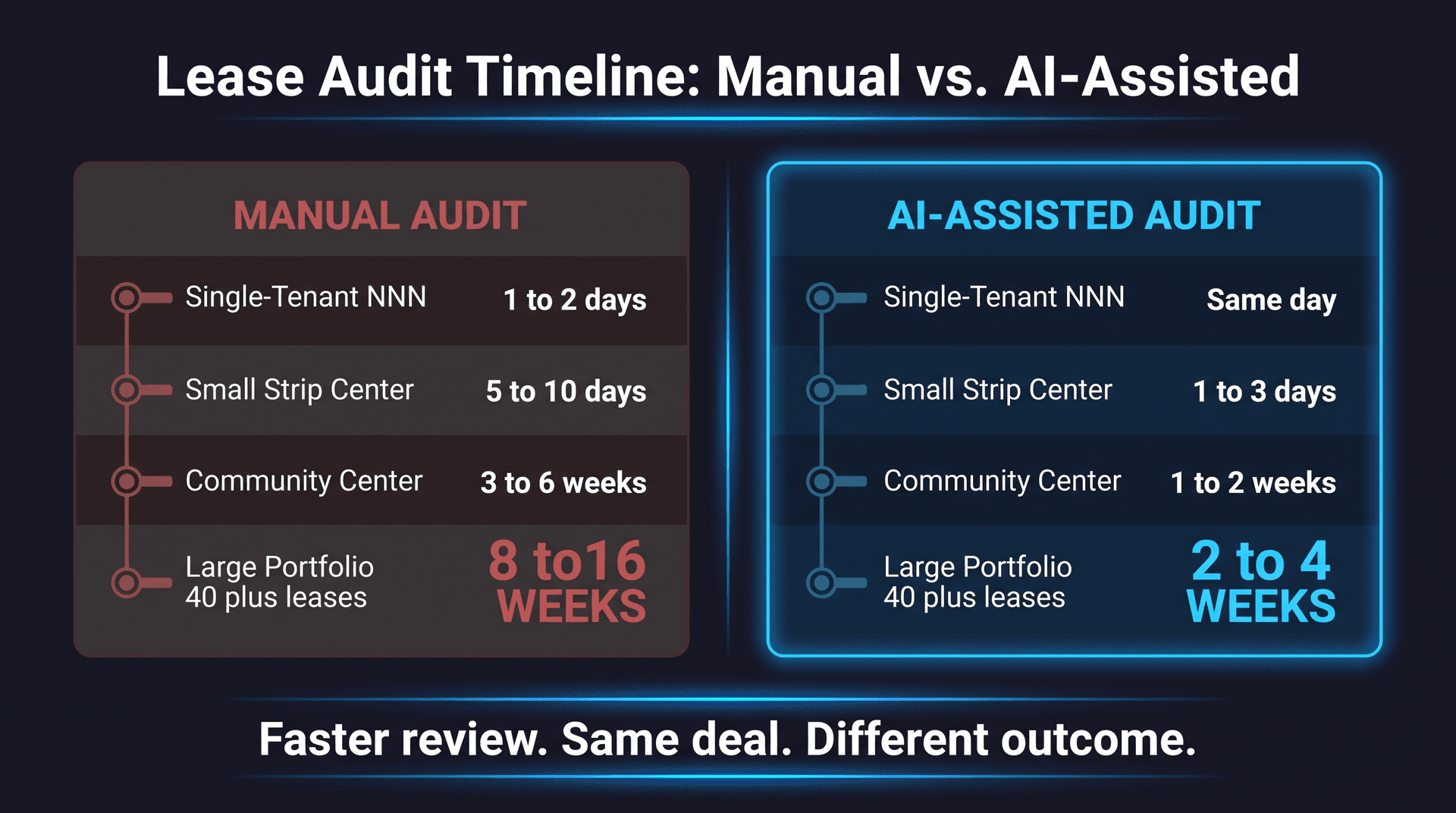
The timeline for a commercial property lease audit depends on three things: tenant count, lease complexity, and how well the seller organized their records.
| Property Type | Tenant Count | Manual Audit | AI-Assisted Audit |
|---|---|---|---|
| Single-tenant NNN | 1 | 1–2 business days | Same day |
| Small retail strip (5–15 tenants) | 5–15 | 5–10 business days | 1–3 business days |
| Community retail center (15–40 tenants) | 15–40 | 3–6 weeks | 1–2 weeks |
| Multi-tenant portfolio (40–100+ leases) | 40–100+ | 8–16 weeks | 2–4 weeks |
These numbers assume a complete lease package. Missing amendments, unsigned estoppels, or hidden side letters add time regardless of the tools you use.
Timeline also shapes deal strategy. As of 2025, Altus Group reported a broad recovery in CRE deal activity, with multiple buyers chasing the same assets. A buyer who finishes the lease audit in ten days operates from a stronger position than one who needs six weeks to reach the same point. Therefore, faster diligence is a competitive edge — in how deals are priced and in how they are won.
Frequently Asked Questions
What is a commercial property lease audit?+
What documents are needed for a pre-acquisition lease review checklist?+
What is the difference between a lease audit and lease abstraction in CRE due diligence?+
How do co-tenancy clauses affect acquisition pricing?+
What is an estoppel certificate, and why does it matter for a lease audit before closing?+
How early in the acquisition process should a lease audit begin?+
The Lease Audit Is Where the Deal Is Actually Priced
Most buyers think the LOI is where the deal gets priced. It isn't. The LOI is where you make an offer based on assumptions. The commercial property lease audit is where those assumptions get tested against the actual documents.
Every clause you find either confirms a modeling input or reveals that your model was wrong. The co-tenancy clause you catch in week one is a negotiating point. The same clause found by the lender's counsel in week eight is a crisis. The difference isn't the clause — it's when you found it.
Teams that treat the commercial property lease audit as a financial modeling exercise catch problems while they still have the upper hand. Teams that treat it as a compliance step find the same problems later — after the negotiating position has shifted to the other side.
A well-run lease audit is one of the highest-ROI steps in any acquisition. Every hour you put into careful abstraction, red flag modeling, and estoppel review protects a capital stack measured in millions. If your team still runs lease audits by hand — abstracting amendments manually, checking rent rolls against PDFs one field at a time — you know how long it takes and how easy it is to miss the clause in Amendment 4 that changes everything.
Speed Up Your Lease Audit. Without Losing Precision.
Abstria's CRE-native AI platform extracts 200+ fields per lease, links every amendment to its base lease record, and produces source-traced data your investment committee and lender can use directly. Acquisition teams using Abstria arrive at lender underwriting with clean, verified data — not analyst notes.
Related Reading
Lease Abstraction Due Diligence: What CRE Acquisition Teams Need to Know
30-vs-10-day due diligence timeline, tenant rights transfer, estoppel verification, CAM liability analysis.
Commercial Lease Administration: The CRE Professional's Operational Guide
Critical dates, CAM reconciliation, amendments, compliance, and revenue control frameworks.
Lease Critical Dates: What Asset Managers Must Track
Six critical date categories, amendment-driven date drift, and portfolio tracking best practices.
Lease Abstraction Guide
Complete guide to lease abstraction process, data categories, and accuracy standards for CRE teams.