
Commercial Lease Administration: The CRE Professional's Operational Guide
Most lease administration failures are not legal technicalities. They are preventable revenue losses caused by incomplete data, stale abstracts, and missed operational triggers.
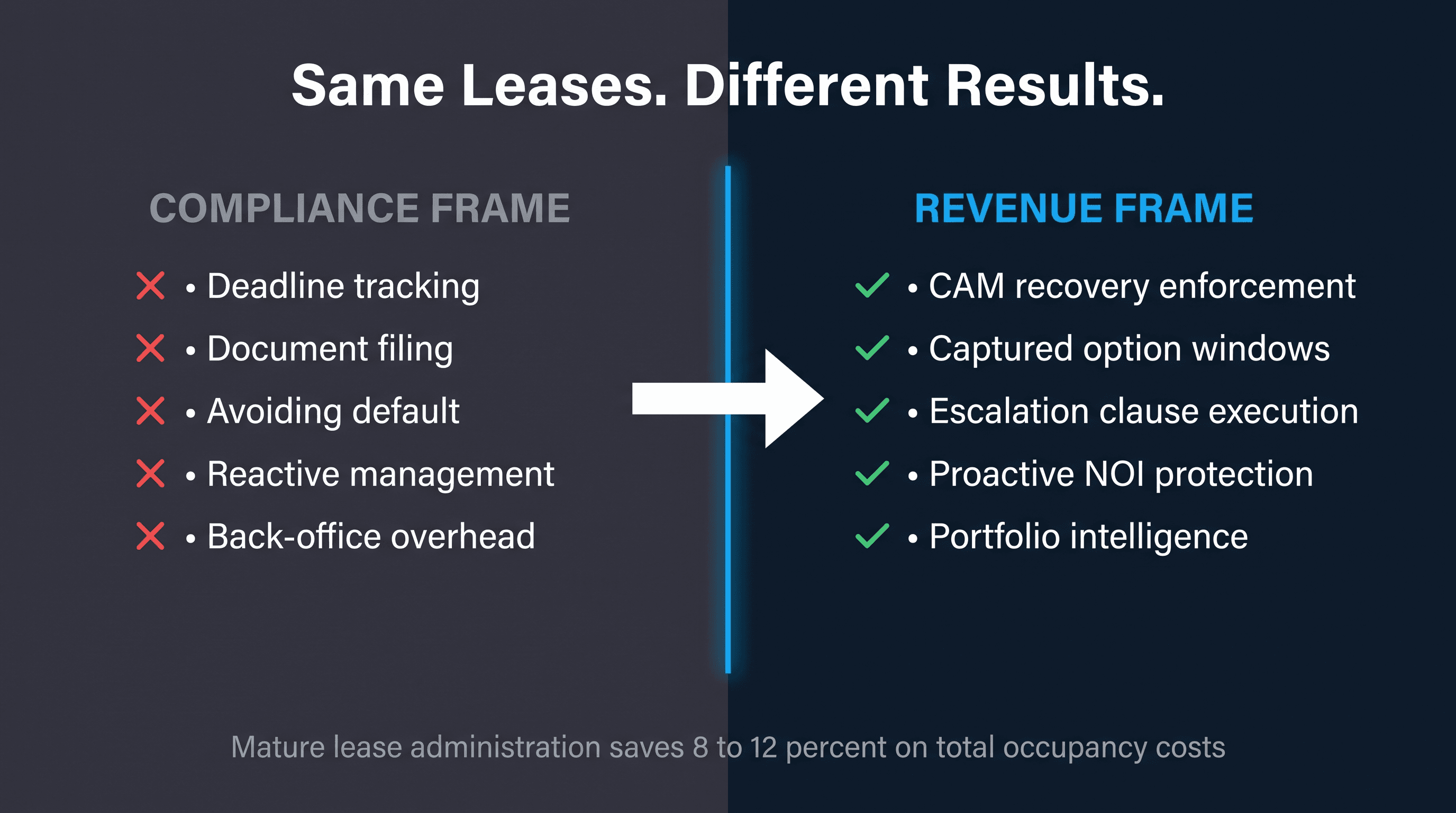
Most guides on commercial lease administration frame the function as compliance. That is only half the operating reality. High-performing CRE teams treat lease administration as revenue infrastructure.
Every correctly processed CAM reconciliation, every captured option window, and every enforced escalation contributes directly to NOI over the life of a lease.
Key Takeaways
- Commercial lease administration is a revenue function, not just a compliance checklist.
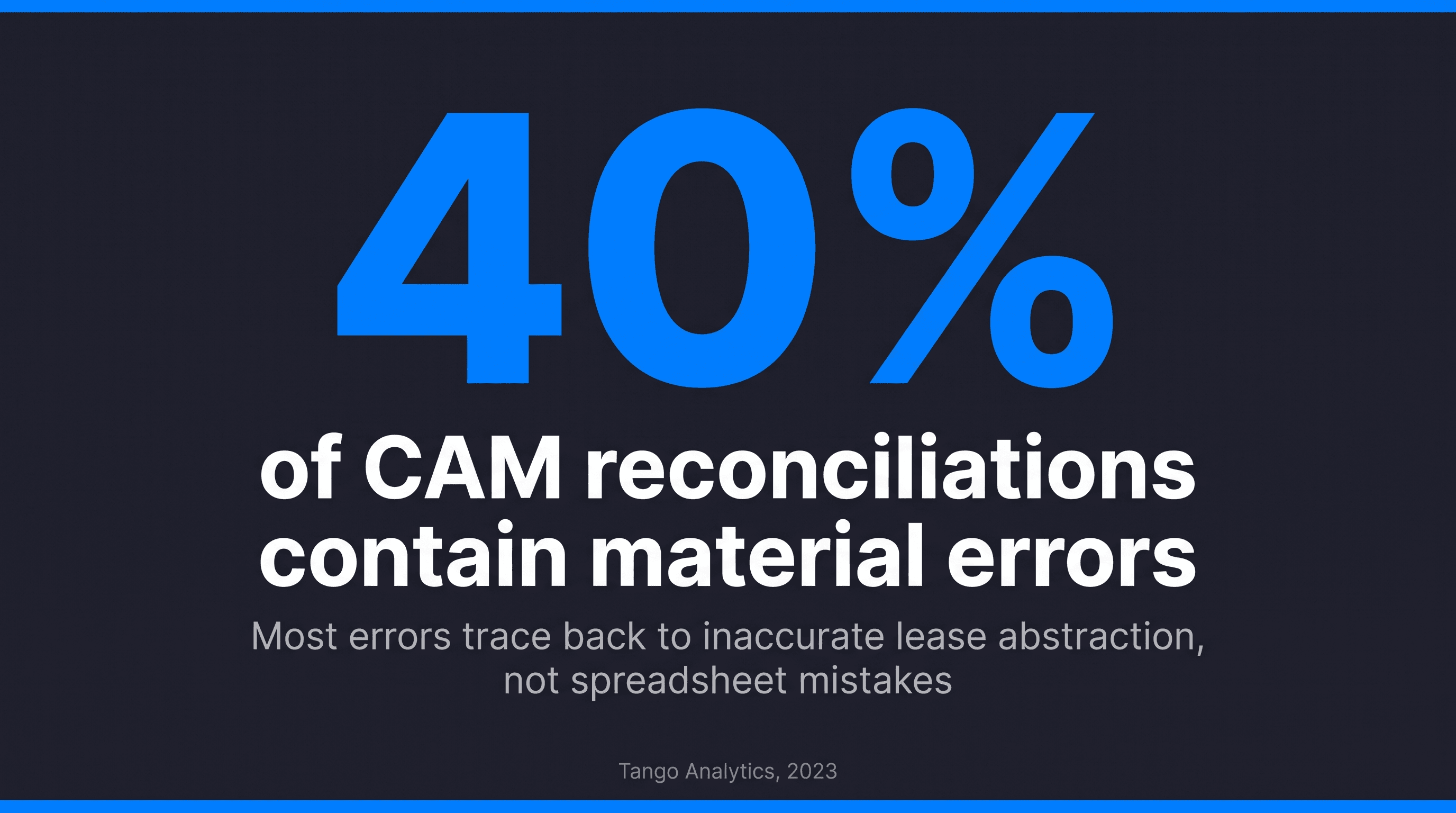
- In a 2023 Tango Analytics analysis, 40% of CAM reconciliations in U.S. retail centers contained material errors.
- KPMG has reported that many companies still struggle with core lease administration controls, including dates and reconciliations.
- The five core responsibilities are critical dates, CAM reconciliation, compliance monitoring, amendment administration, and financial reporting.
- In larger portfolios, preventable administration failures can create multi-million-dollar annual leakage.
What Commercial Lease Administration Actually Is
Commercial lease administration is the ongoing management of every active obligation in a commercial lease: financial terms, notice windows, amendment history, compliance duties, and reporting fields.
The mechanics are the same for landlord and tenant teams: extract data from source documents, structure it in a trackable system, monitor obligations continuously, and act before deadlines pass.
What changes is where risk sits. Landlords lose recoverable income from missed escalations and under-billed CAM. Tenants overpay when exclusions and caps are not captured accurately.
Why Most Lease Administration Teams Get the Frame Wrong
Compliance framing creates reactive behavior. Teams focus on avoiding breach instead of actively preserving and recovering value.
A compliance-oriented team tracks option deadlines to avoid default. A revenue-oriented team uses the same window to evaluate market rent and renegotiate before the option locks in outdated economics.
The Five Core Responsibilities of Commercial Lease Administration
1. Critical Date Management
Track commencement, expiration, notice windows, escalation effective dates, estoppel and SNDA timing, and amendment-driven recalculations. Missing unsurfaced dates is the larger risk than missing dates already on a calendar.
2. CAM Reconciliation
CAM accuracy depends on lease-level data quality: exclusions, caps, pro-rata share, gross-up rules, and controllable-expense limits. Reconciliation errors are often abstraction errors upstream.
3. Compliance Monitoring
Monitor obligations for both parties: insurance renewals, reporting deadlines, co-tenancy provisions, maintenance allocations, and delivery conditions. Failure on either side creates contractual exposure.
4. Amendment Administration
Leases evolve. Each amendment must be delta-linked to the live abstract so rent schedules, dates, CAM structures, and rights remain current. Storing amendments as passive attachments is a systemic failure mode.
5. Financial Reporting
Rent roll accuracy, CAM forecasts, expiration schedules, and NOI projections all depend on administration data quality. Operational errors here directly distort investment decisions and valuation models.
Six Systemic Failures That Cost CRE Portfolios Real Money
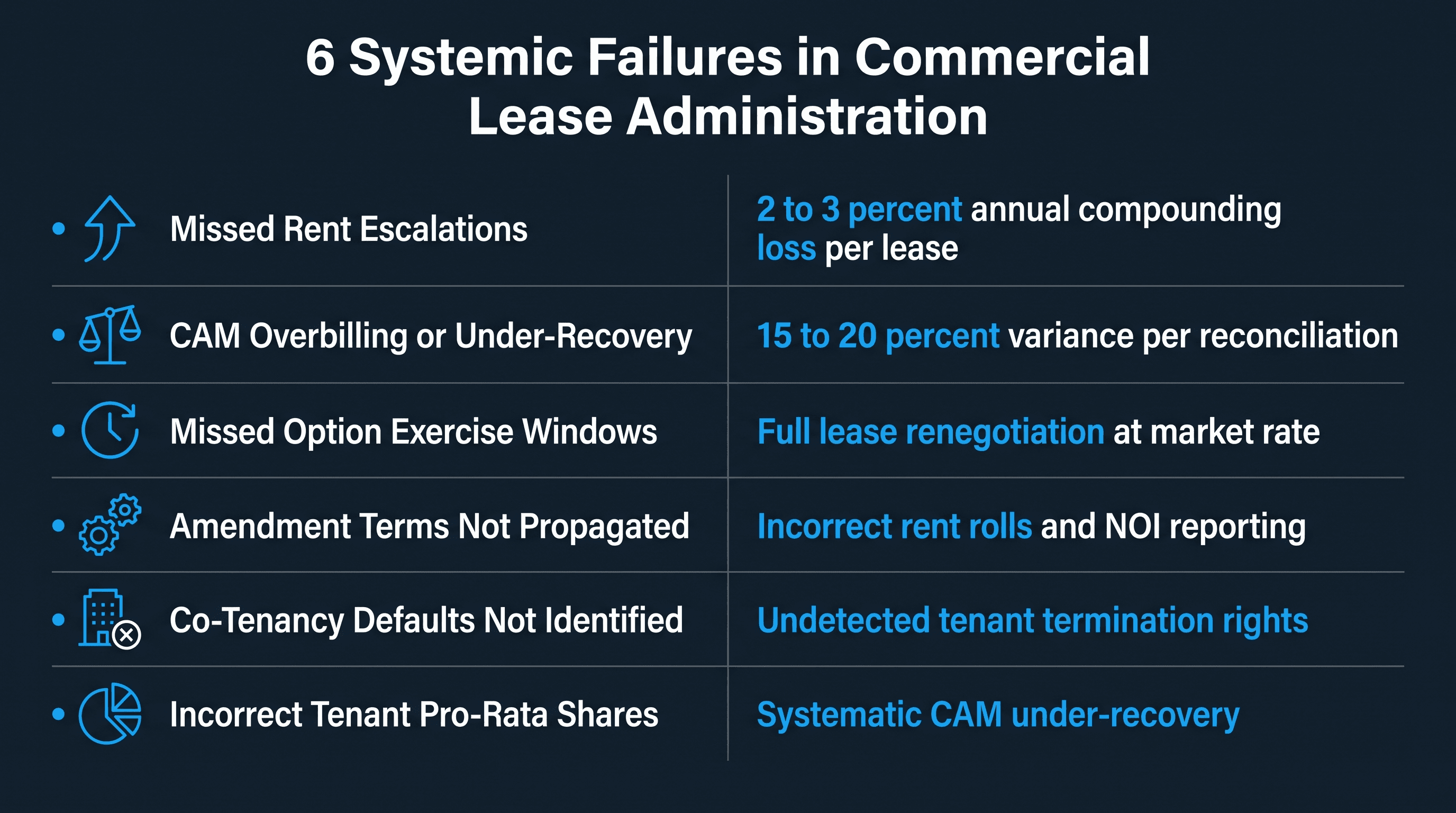
The recurring failure pattern is consistent across portfolios: missed escalations, option windows triggered too late, stale amendment terms, undetected co-tenancy exposure, and incorrect pro-rata allocations.
These are usually data-currency problems, not effort problems. Teams are working hard inside systems that do not keep the lease abstract synchronized with document reality.
How the Lease Administration Technology Stack Has Evolved
Spreadsheet era
Spreadsheets remain common because they are flexible and familiar, but they separate the system from the source document and hide drift until an issue becomes financial.
Platform era
Centralized platforms improved structure and alerting, but still depended on manual data entry and manual amendment propagation.
AI-assisted era
AI-assisted abstraction closes the document-to-system gap by extracting fields from source, linking each field to the clause, and identifying amendment deltas. Human review remains essential for non-standard and high-consequence provisions.
Commercial Lease Administration Practitioner Checklist
- Complete critical date inventory exists for every active lease, with long-horizon advance alerts.
- Tenant-specific CAM exclusions, caps, base years, and pro-rata logic are abstracted and current.
- All amendments are mapped as data deltas and propagated into live abstract fields.
- Tenant and landlord compliance obligations are tracked with proactive alerting and ownership.
- Rent roll and forecast outputs reflect fully amended terms, not original lease-only values.
What Sets High-Performing Teams Apart
They treat the abstract as a living record, not a one-time output. Amendments are processed immediately and reflected in active fields before filing completes.
They run a rolling 24-month forward view on options, escalations, and obligations to turn deadlines into strategic decisions, not fire drills.
They maintain source-traceability for every critical field, so disputes and audits can be answered at clause level within minutes.
Related Reading
Frequently Asked Questions
What does a lease administrator do in commercial real estate?
Lease administrators track and enforce the contract mechanics of active leases: terms, obligations, notice windows, CAM structures, amendment updates, and reporting outputs.
How is lease administration different from property management?
Lease administration focuses on contract data and obligations. Property management focuses on day-to-day operations. Strong operations depend on accurate lease administration inputs.
What are the most common default triggers?
Common triggers include missed payments, insurance lapses, non-compliant use, and reporting failures. On the landlord side, co-tenancy or delivery obligation failures are frequent drivers of disputes.
How does AI improve lease administration workflows?
AI improves throughput and consistency by extracting structured data from documents, surfacing deltas across amendments, and keeping teams anchored to source text for fast validation.
Conclusion: Administer Leases Like Revenue Infrastructure
Commercial lease administration should not be managed as a back-office filing function. The same fields that drive compliance also drive cash recovery, negotiation leverage, and valuation outcomes.
Teams that run administration as an active, source-traceable operating discipline capture more contractual value and carry less hidden risk.