
How to Manage Lease Amendments Across a CRE Portfolio Without Losing Track
The core amendment risk in CRE is not missing files. It is failing to connect amendment changes to the base lease fields that drive operations, reporting, and lender underwriting.
Key Takeaways
- Amendments often sit as separate files instead of updating base lease fields, creating silent data drift.
- Expansion, rent reduction, and co-tenancy amendments are frequent sources of downstream financial and compliance errors.
- Guarantee integrity is commonly missed when financial terms are modified without guarantor reaffirmation review.
- Lender underwriting can be repriced or delayed when amendment obligations surface late in diligence.
- Delta-linked intake workflows catch these issues when documents are uploaded, not years later during transactions.
The Refinance That Exposed Three Years of Missed Connections
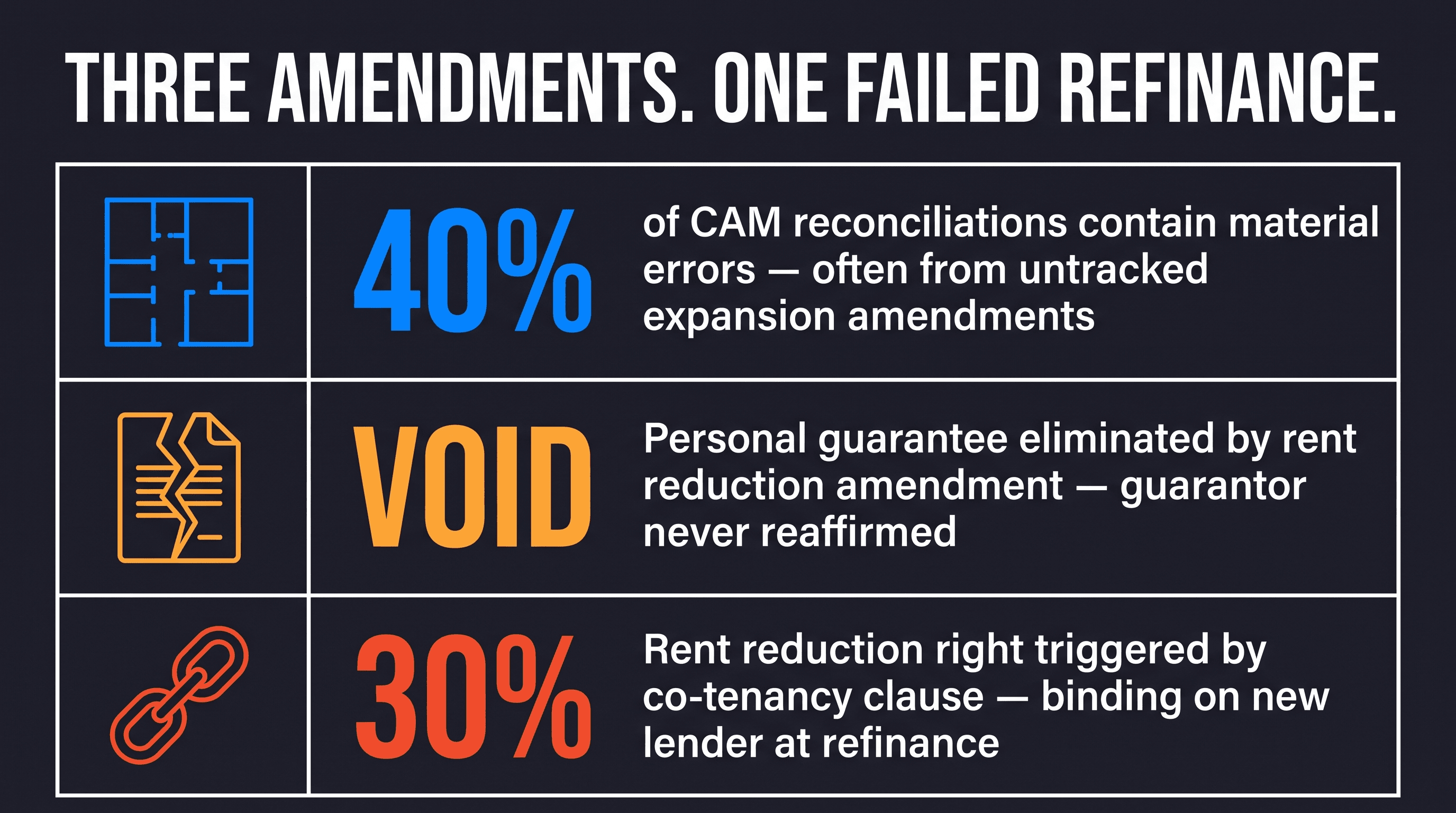
The recurring amendment failure pattern is quiet: executed documents are filed, but their field-level effects are never propagated. Transaction diligence then surfaces stale records under time pressure.
In practice, three issues recur most often: CAM allocation drift after premises changes, guarantee enforceability gaps after rent modifications, and unmodeled co-tenancy obligations.
The Structural Problem in Most Lease Databases
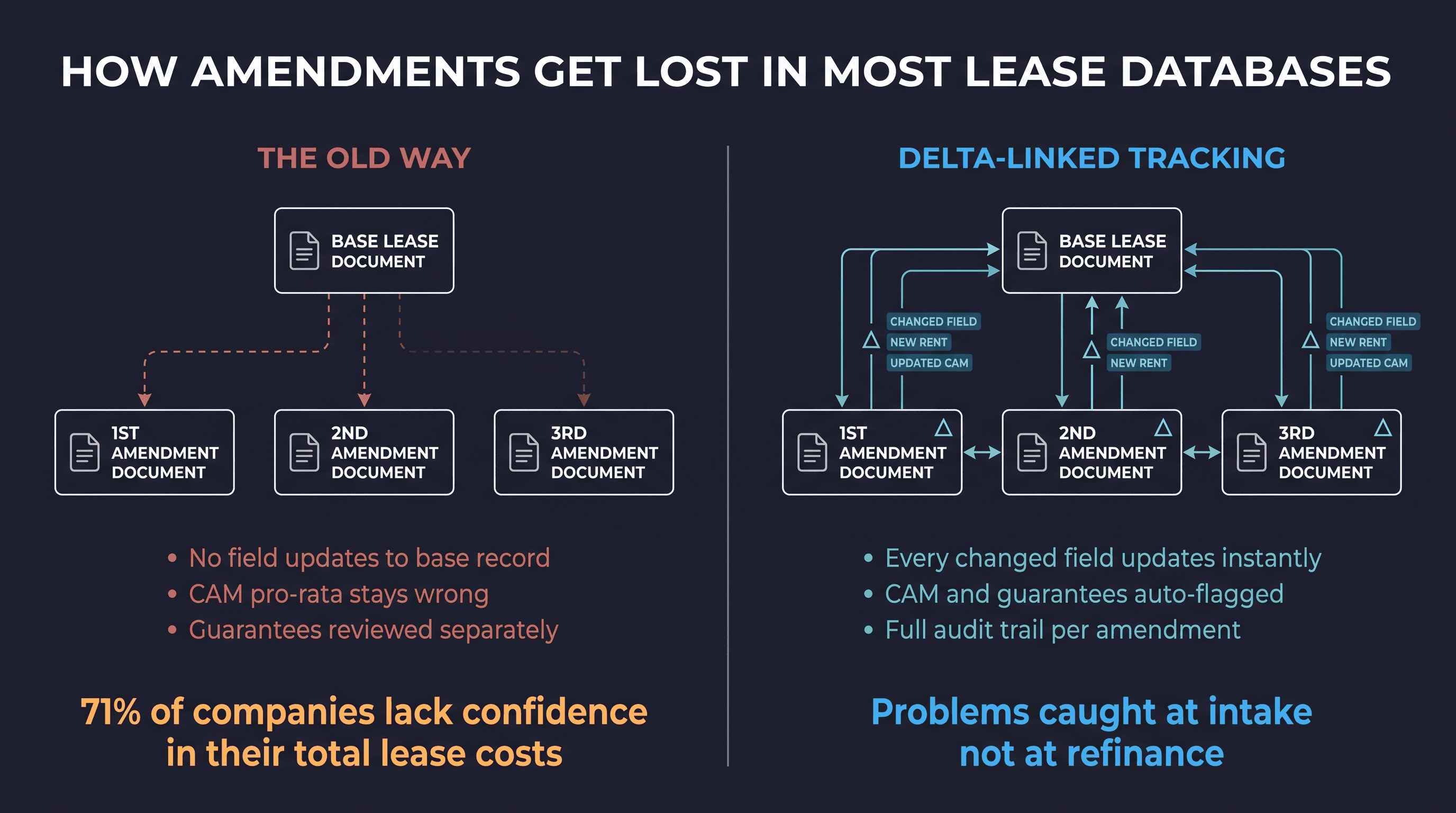
Most systems archive amendments as companion documents. The base abstract, which drives rent roll, CAM, reporting, and diligence outputs, often remains unchanged.
This creates a split reality: legal terms changed in documents, operational data did not. Downstream teams then make accurate calculations on outdated inputs.
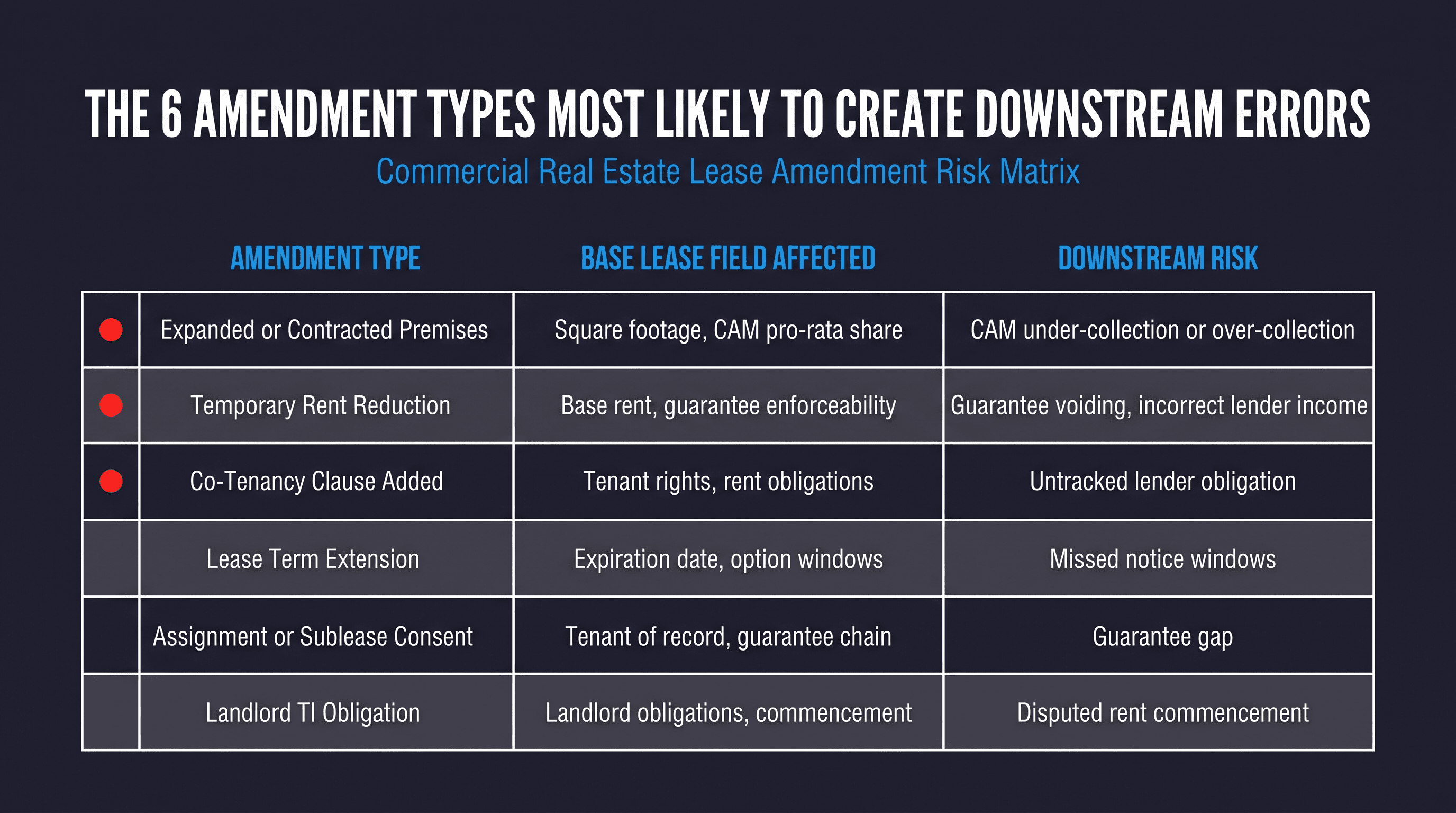
Six Amendment Types Most Likely to Create Downstream Errors
- Expanded or contracted premises
- Temporary rent reduction or abatement
- Co-tenancy clause additions or modifications
- Lease term extensions
- Assignment or sublease consent changes
- Landlord work and TI obligation updates
Three High-Risk Patterns to Control
Premises Expansion and CAM Drift
When square footage changes are not reconciled into base records, pro-rata allocation errors repeat each reconciliation cycle.
Rent Reduction and Guarantee Integrity
Financial modifications can affect guaranty enforceability unless consent and reaffirmation requirements are reviewed and satisfied.
Co-Tenancy Clauses as Lender Exposure
Co-tenancy rights added through amendments can change underwriting assumptions and may bind successors in interest if triggered.
How Delta-Linked Amendment Intake Solves It
Effective intake treats amendments as change events. Each upload produces a field-level delta: old value, new value, source clause, and affected workflows.
Approved deltas propagate into the live abstract so downstream teams query current terms, not legacy snapshots.
What Good Amendment Management Looks Like at Scale
- Every amendment triggers a documented field-level delta review.
- The base abstract is maintained as a living record, not a one-time snapshot.
- Guarantee, co-tenancy, and lender-consent obligations are tracked as explicit risk categories.
Frequently Asked Questions
How many amendments does a typical long-term CRE lease accumulate?
Multi-year leases commonly accumulate multiple amendments over time, especially in active tenant relationships and mixed-use portfolios.
What is the biggest operational risk of storing amendments separately?
The base lease record stays stale, so rent roll, CAM, and diligence outputs are produced from outdated terms despite complete document archives.
When should amendment risk be reviewed?
At intake, immediately when the amendment is uploaded, before downstream reports, reconciliations, and lender packages are generated.
The Cost of Separate-Document Thinking
Amendment risk compounds when executed terms are archived without updating operational fields. The correction cost then appears later during refinance, sale, or dispute.
See how Abstria manages amendment delta-linking across live CRE portfolios.