
Lease Critical Dates: What Asset Managers Must Track (and Why Portfolios Still Miss Them)
The biggest date-risk in CRE is not forgetting deadlines you know. It is missing binding windows that were never surfaced from source documents.
Key Takeaways
- Critical lease dates fall into six risk categories, each with different financial consequences if missed.
- High-impact deadlines are commonly buried in amendments, exhibits, and rider clauses.
- Option notice windows and amendment-triggered date changes are the most dangerous failure classes.
- At 100-plus lease scale, spreadsheet-only tracking is structurally unreliable.
- Reliable teams tie alerts to verified, source-linked abstracted lease fields.
The Real Risk Is Not Knowing a Deadline Exists
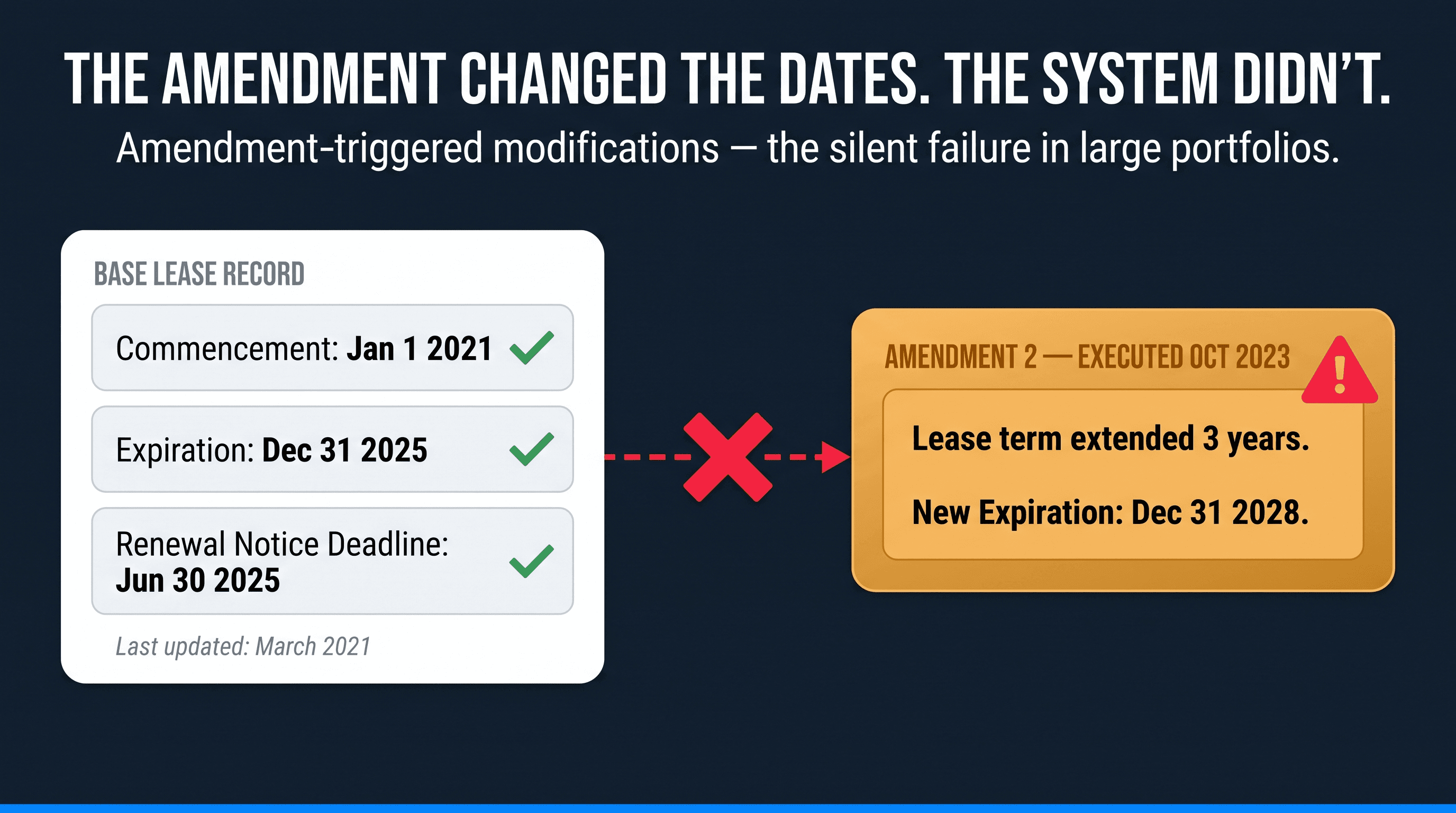
Most teams track obvious dates such as expiration and renewal milestones. The deeper risk appears when amendments create or shift windows that never propagate into the active date record.
A date tracker can be perfectly organized and still wrong if amendment deltas were never reconciled against base lease fields.
Six Critical Date Categories Every CRE Portfolio Must Track
1. Lease Commencement and Expiration
These anchor dates drive escalations, options, and free-rent boundaries. If commencement or term changes are missed in amendments, downstream schedules drift silently.
2. Option Notice Windows
Renewal, expansion, and termination rights are governed by notice deadlines, not by option exercise dates. Missing the notice cutoff can forfeit rights entirely.
3. Rent Escalation Effective Dates
Missed fixed-step or CPI adjustments generally become unrecoverable forward-revenue leakage.
4. SNDA and Estoppel Response Windows
Event-triggered deadlines around refinancing and transaction events can create binding outcomes if response windows are missed.
5. Tenant Reporting Deadlines
Sales reports, insurance renewals, and financial submissions often sit outside obvious date sections and are routinely under-tracked.
6. Amendment-Triggered Date Modifications
This is the hidden failure class: amendments update legal reality but not base system fields unless date deltas are explicitly reconciled.
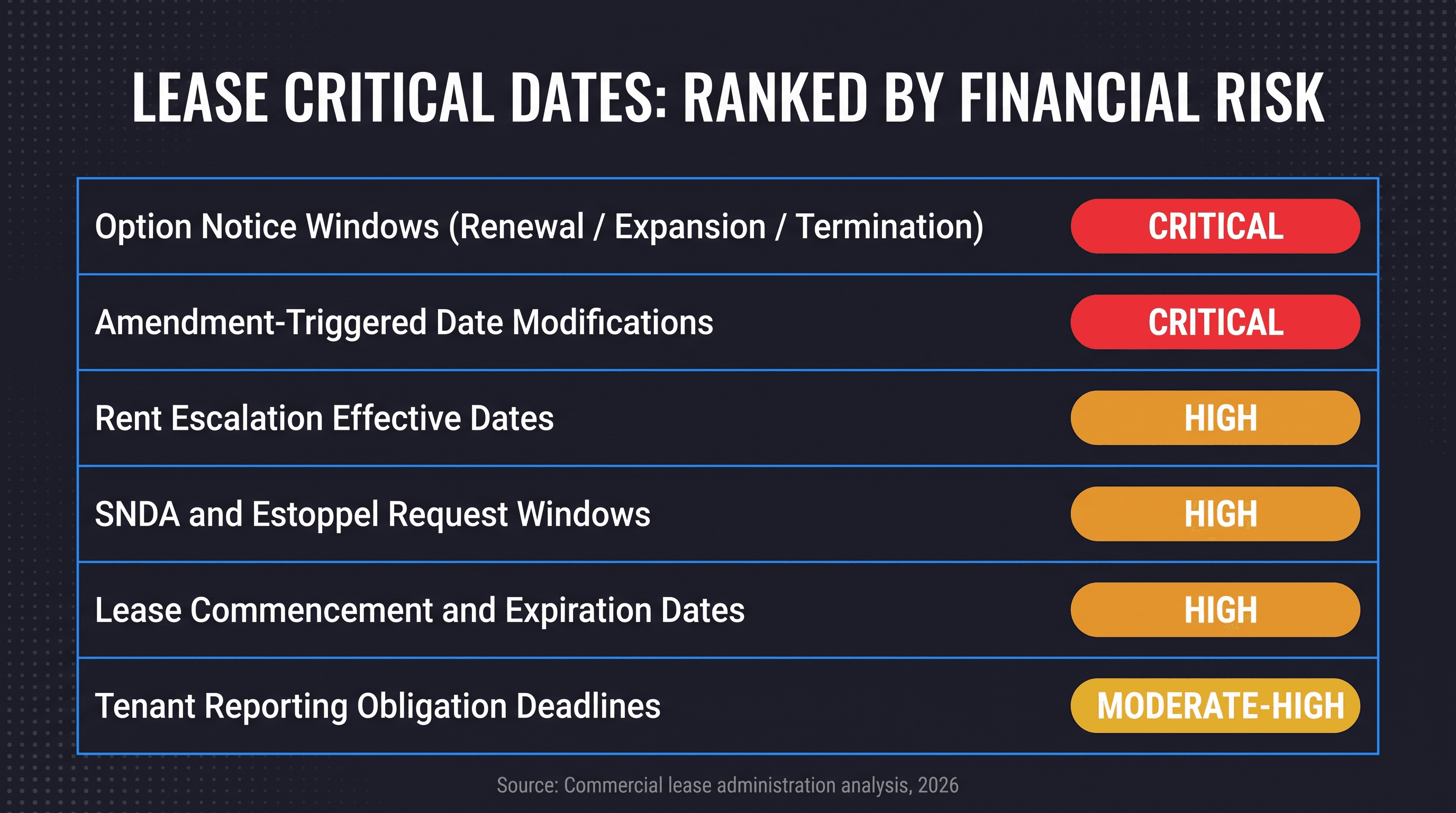
Risk-Ranked Date Categories by Financial Exposure
Option windows and amendment modifications are typically the highest-risk categories because they are both high consequence and easy to miss in manual workflows.
Why 100+ Lease Portfolios Still Miss Critical Dates
Spreadsheet-driven tracking can work for small books, but portfolio scale introduces change volume that static systems cannot absorb reliably.
The breakdown is architectural: version drift, manual update dependency, and amendment reconciliation workload outgrow team capacity.
What High-Performing Teams Do Differently
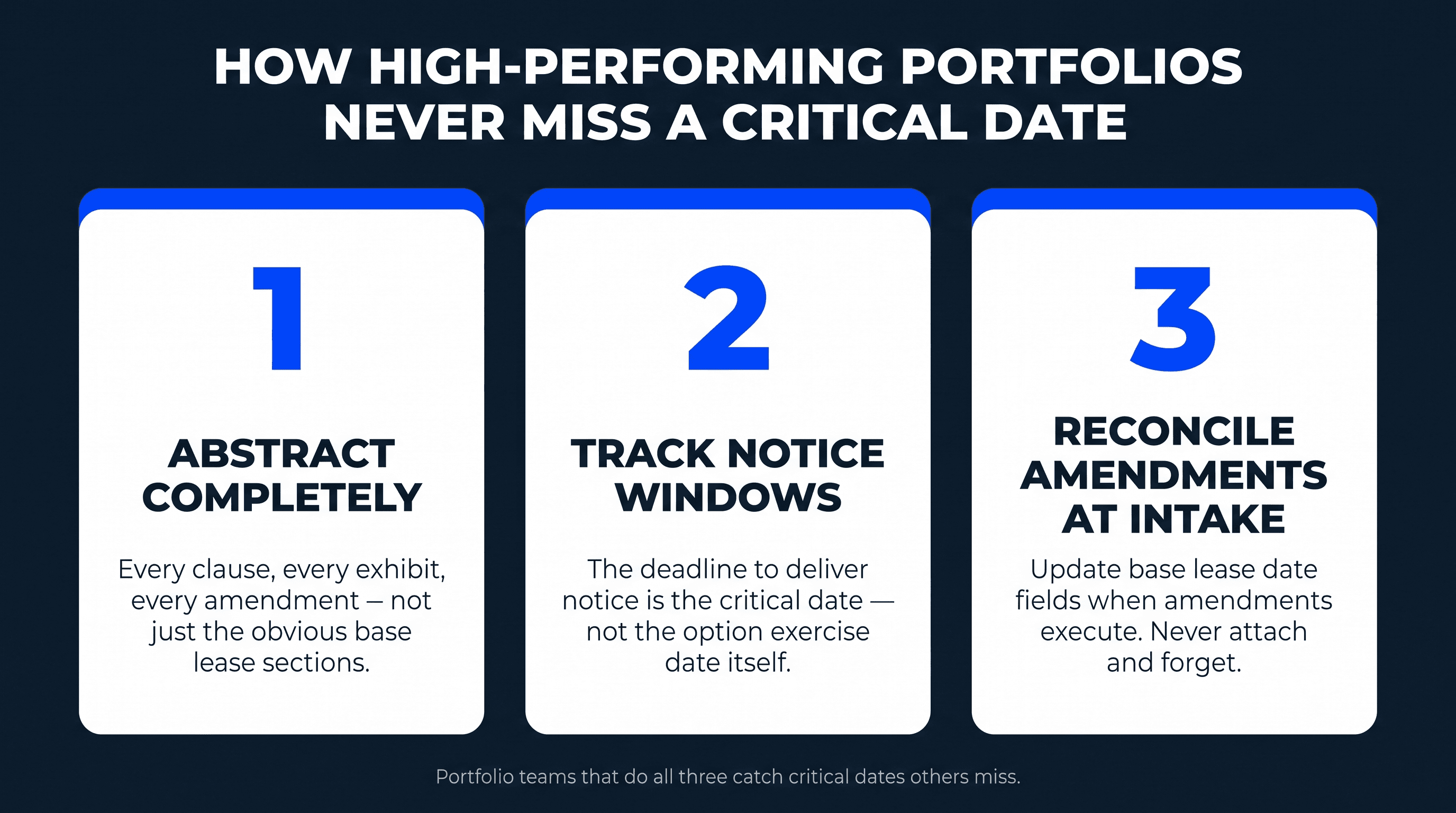
- Abstract all date-relevant clauses, not only headline financial terms.
- Treat notice windows as primary tracked deadlines.
- Apply amendments as structured deltas against base records at intake.
Frequently Asked Questions
How far in advance should alerting start for option deadlines?
Use tiered alerting: early strategic planning at 180 to 365 days, action-required at 90 days, and escalation at 30 days based on contractual notice mechanics.
What happens if a tenant misses a renewal notice deadline?
In many jurisdictions, late notice forfeits the option right. Holdover and forced relocation exposure can follow depending on lease terms and market conditions.
Can a system be accurate once and wrong later?
Yes. Any amendment can change date logic. Without formal delta reconciliation, previously correct dates become stale while still appearing trustworthy in reports.
Getting Date Tracking Right at Scale
Reliable date management at portfolio scale requires verified lease data, amendment-aware record updates, and automated alerting tied to source clauses.
See how Abstria handles source-linked critical date tracking across large CRE portfolios.