
CAM Reconciliation Errors: The Multi-Billion Dollar Problem Hiding in Commercial Leases
Quick answer: CAM reconciliation errors are widespread, expensive, and usually caused by upstream lease-data failures rather than spreadsheet math.
Quick Answer
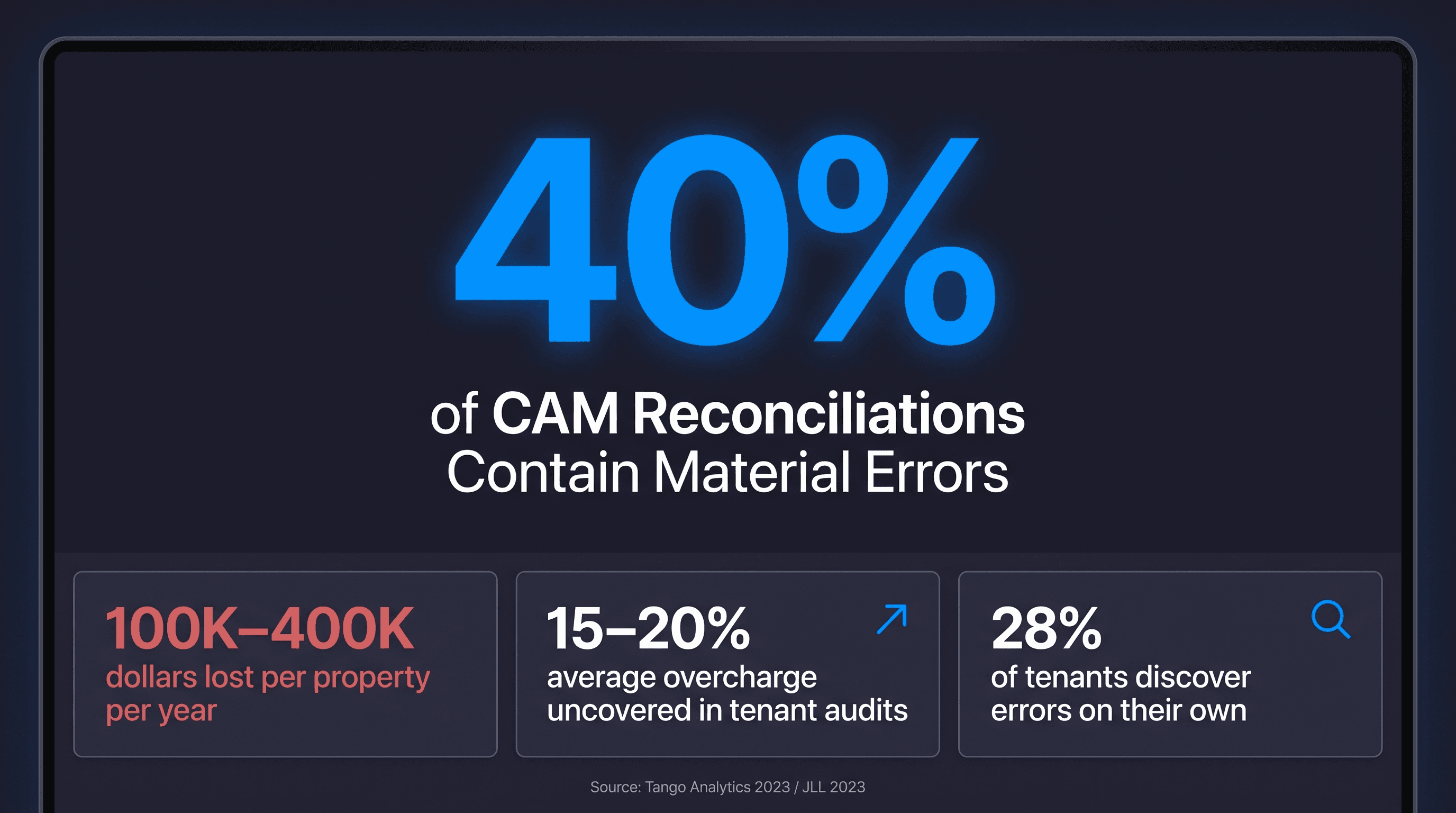
Approximately 40% of CAM reconciliations contain material errors, according to a 2023 Tango Analytics analysis of U.S. retail centers. The exposure runs both directions: landlords lose recoverable revenue through under-billing, and tenants overpay when exclusions and cap logic are not applied correctly.
The recurring pattern is structural. Most errors start when lease abstraction misses exclusion lists, cap definitions, and pro-rata formulas, then reconciliation workflows run calculations on incomplete or stale inputs.
Key Takeaways
- Material CAM errors appear in a large share of reconciliations and create recurring dispute exposure.
- CAM often represents a meaningful share of occupancy cost, so even small percentage errors become material over multi-year terms.
- The most common failures look like accounting mistakes but usually trace back to abstraction quality.
- Reliable CAM outcomes require source-verified lease data, not only stronger year-end workflows.
- Fixing upstream abstraction quality reduces both overcharge disputes and under-recovery leakage.
The True Scale of the CAM Error Problem
CAM reconciliation compares estimated payments collected through the year against actual recoverable operating expense. The calculation is routine. The inputs are not.
In many portfolios, lease terms sit in PDFs, accounting activity sits in a property system, and exception logic lives in analyst notes. When those layers drift, annual true-ups inherit that drift.
Why Most CAM Errors Start Before Reconciliation
Every CAM reconciliation depends on three lease-data blocks: exclusion lists, cap definitions, and allocation formulas. If any of these are incomplete, precise arithmetic still yields incorrect results.
This is why recurring CAM errors often survive process changes. Teams improve reconciliation steps while the underlying abstract remains partially wrong.
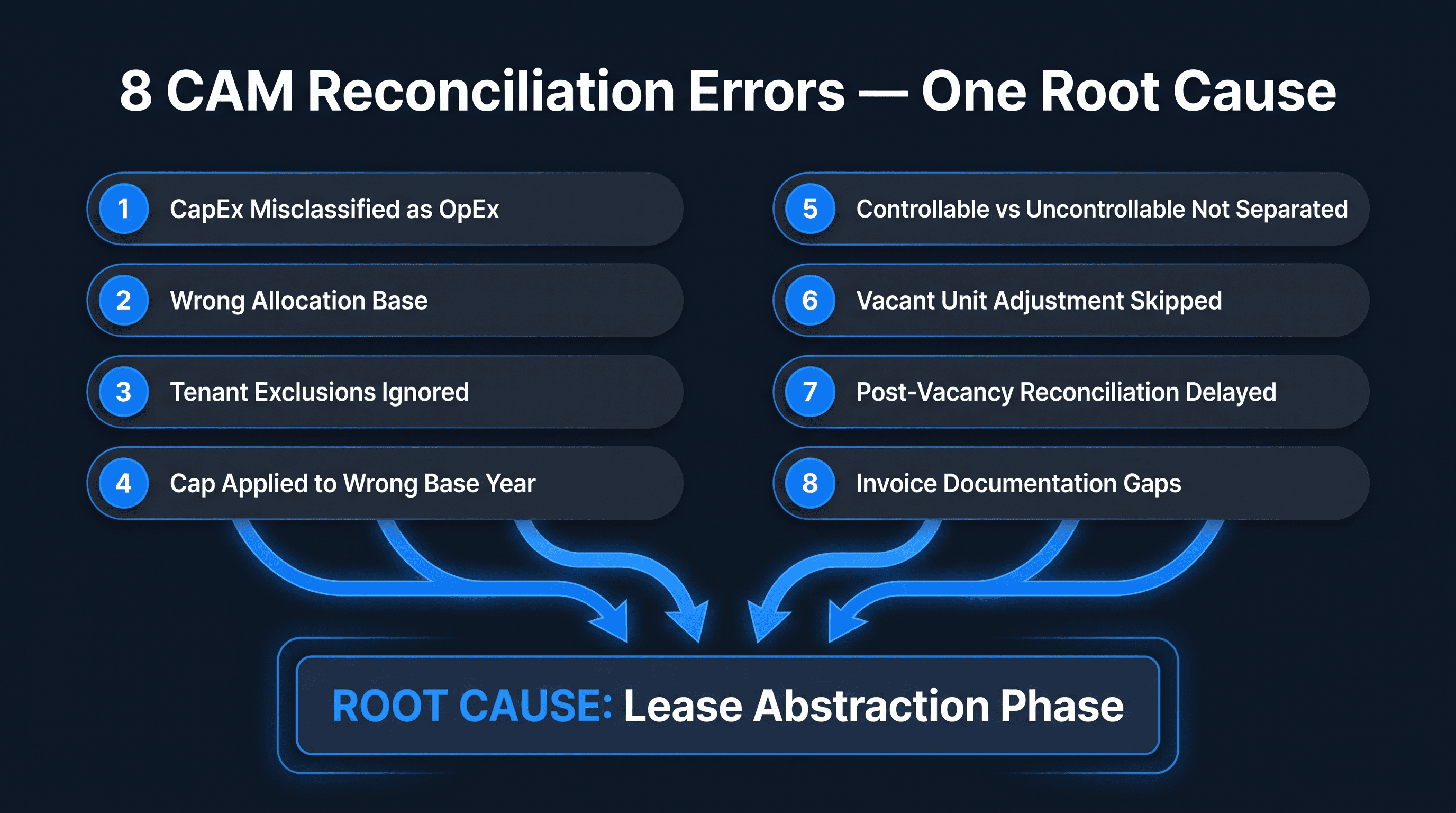
The Eight Most Common CAM Reconciliation Errors
1. CapEx Misclassified as Operating Expense
Capital work is billed into CAM without lease-required exclusions or amortization treatment.
2. Wrong Allocation Base
The pro-rata denominator is applied generically instead of per-lease definitions and modifiers.
3. Tenant-Specific Exclusions Ignored
Portfolio-wide templates override negotiated exclusions for individual tenants.
4. CAM Caps Applied to the Wrong Base Year
Cap structure is right on paper but anchored to an incorrect base year, often after amendments.
5. Controllable vs. Uncontrollable Not Separated
Expense pools are blended before cap logic, producing systematic over- or under-application.
6. Vacant Unit Adjustment Skipped
Gross-up provisions are not triggered when occupancy drops below lease-defined thresholds.
7. Post-Vacancy Reconciliation Delay
Statement delivery deadlines are missed because they were never abstracted as tracked critical dates.
8. Invoice Documentation Gaps
Charges cannot be validated quickly during audit windows because support records are fragmented.
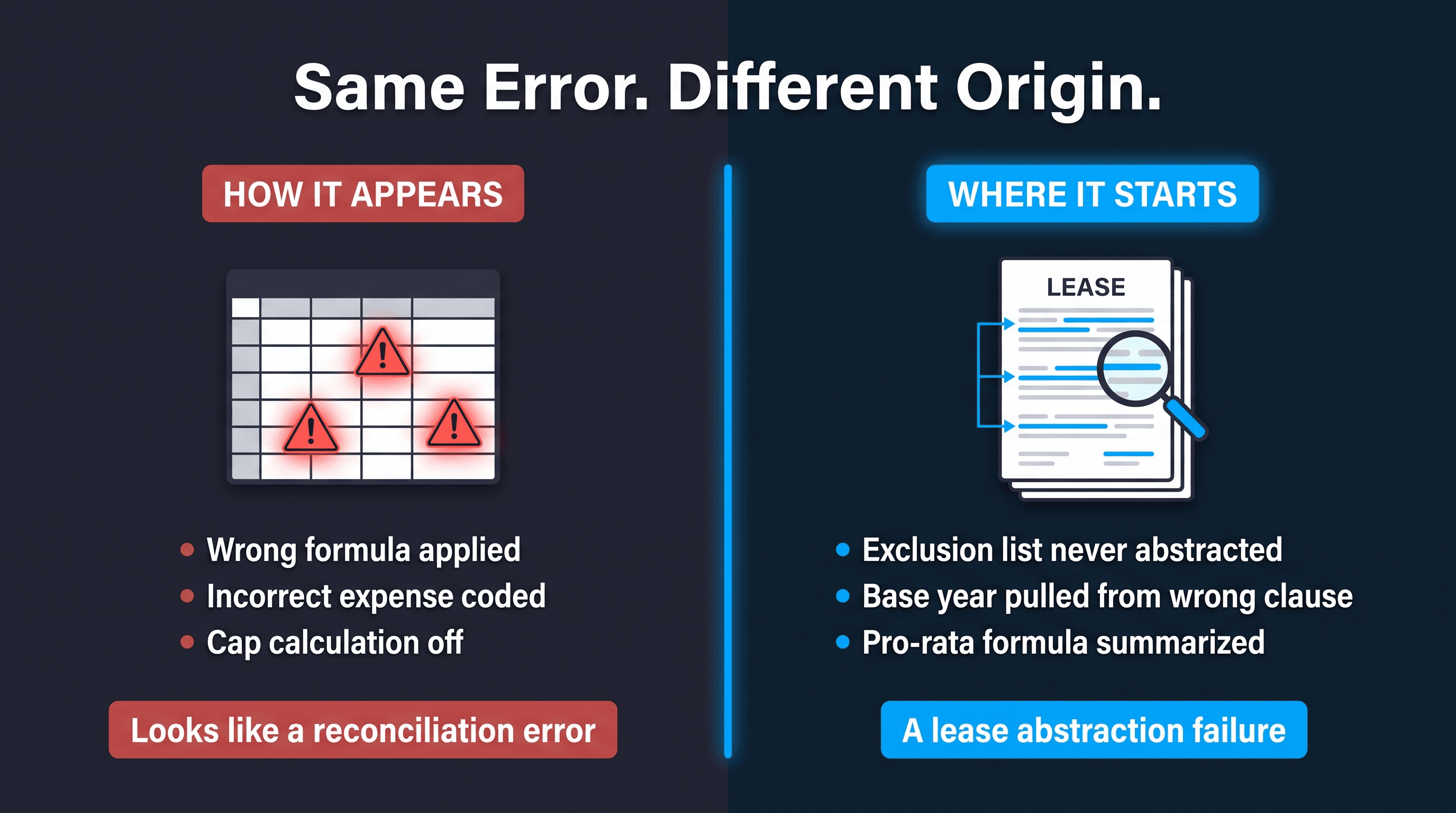
CAM Error Comparison: Root Cause vs. Symptom
The visible failure usually appears in reconciliation output, but the underlying defect is almost always missing or stale lease data.
What Accurate Lease Abstraction Actually Prevents
- CapEx misbilling risk when exclusion and amortization terms are extracted verbatim.
- Allocation drift when pro-rata formulas include all lease-specific modifiers.
- Exclusion misses when each tenant clause is captured as structured data.
- Cap-base-year errors when amendment deltas update live abstract fields.
- Gross-up and deadline misses when provisions are captured as triggerable dates and conditions.
CAM Reconciliation Best Practices
Verify lease data before reconciliation build
Confirm exclusion lists, cap structure, pro-rata rules, and gross-up logic against source text before running annual true-up calculations.
Separate expense pools before cap logic
Split controllable, uncontrollable, and excluded categories first, then apply cap rules only to the appropriate bucket.
Track post-vacancy deadlines at onboarding
Capture reconciliation delivery windows as critical dates when leases are abstracted, not at move-out.
Keep documentation linked to line items
Organize invoices and support records as expenses are posted so audit-right requests can be answered quickly and defensibly.
Frequently Asked Questions
What are CAM reconciliation errors?
They are inaccuracies in annual CAM true-up statements caused by incorrect expense inclusion, allocation, cap handling, or support documentation.
Do tenants have the right to audit CAM charges?
Most commercial leases include audit-right provisions with defined windows and procedures. The exact scope depends on lease language.
Why do recurring CAM errors survive process upgrades?
Because improved process cannot compensate for incorrect inputs. Persistent errors typically indicate abstraction-layer gaps.
How can teams reduce CAM dispute exposure?
Improve lease abstraction quality, source-link critical CAM clauses, and treat reconciliation as a data-governance workflow rather than a year-end spreadsheet exercise.
The Problem Is Usually Upstream
CAM reconciliation errors are persistent because the industry often diagnoses them at the output layer. Durable improvement starts earlier, at the lease abstraction layer where exclusion, cap, and allocation logic are captured.
See how Abstria captures CAM-critical lease data with source-linked traceability.