
CRE Legal + Operations
Lease Abstraction QA Playbook for CRE Teams
A renewal deadline slips. A CAM cap is applied incorrectly. The abstract looked complete, but one amended clause never made it into the live record. This playbook focuses on the part teams usually miss: quality control discipline that keeps lease abstraction reliable after the first extraction.
Published: 2026-08-14
Author: Abstria Team
Key Takeaways
- Lease abstraction is not a one-time summary task; it is a data control process for dates, options, escalations, CAM terms, and amendments.
- A complete commercial abstract usually includes 200+ fields that must remain synchronized when amendments are executed.
- The highest-cost abstraction failures usually come from amendment reconciliation and notice period calculations, not obvious fields like base rent.
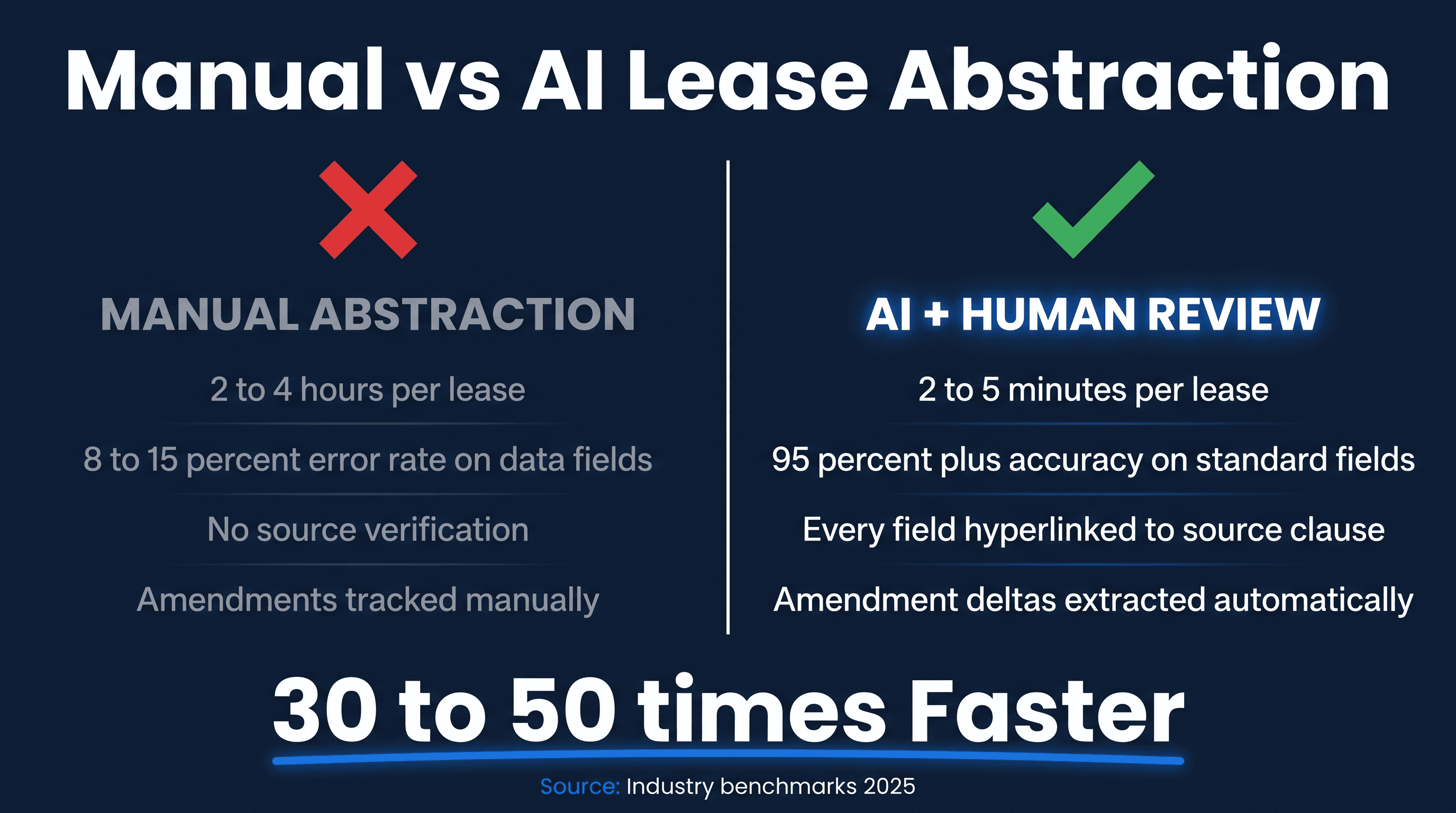
- AI can accelerate first-pass extraction, but accuracy at portfolio scale still depends on source traceability and a legal/ops verification workflow.
- The right abstraction model depends on lease volume, amendment velocity, and risk tolerance.
What Lease Abstraction Means in Production
In production CRE workflows, lease abstraction is the conversion of contract language into auditable operational fields. The abstract is not a replacement for the lease. It is the working dataset teams rely on for deadline management, escalation controls, audit prep, and landlord-tenant issue response.
If your abstract cannot be traced back to source clauses, or if amendments do not update the effective-state record, your team is operating on stale data. That is where avoidable cost, timeline pressure, and legal friction begin.
The 200+ Field Reality and Why It Matters
Most teams remember the obvious fields: base rent, commencement date, expiration date. Production abstraction requires much deeper capture and governance. A robust record spans financial terms, exercise windows, rights, obligations, and non-standard clause conditions.
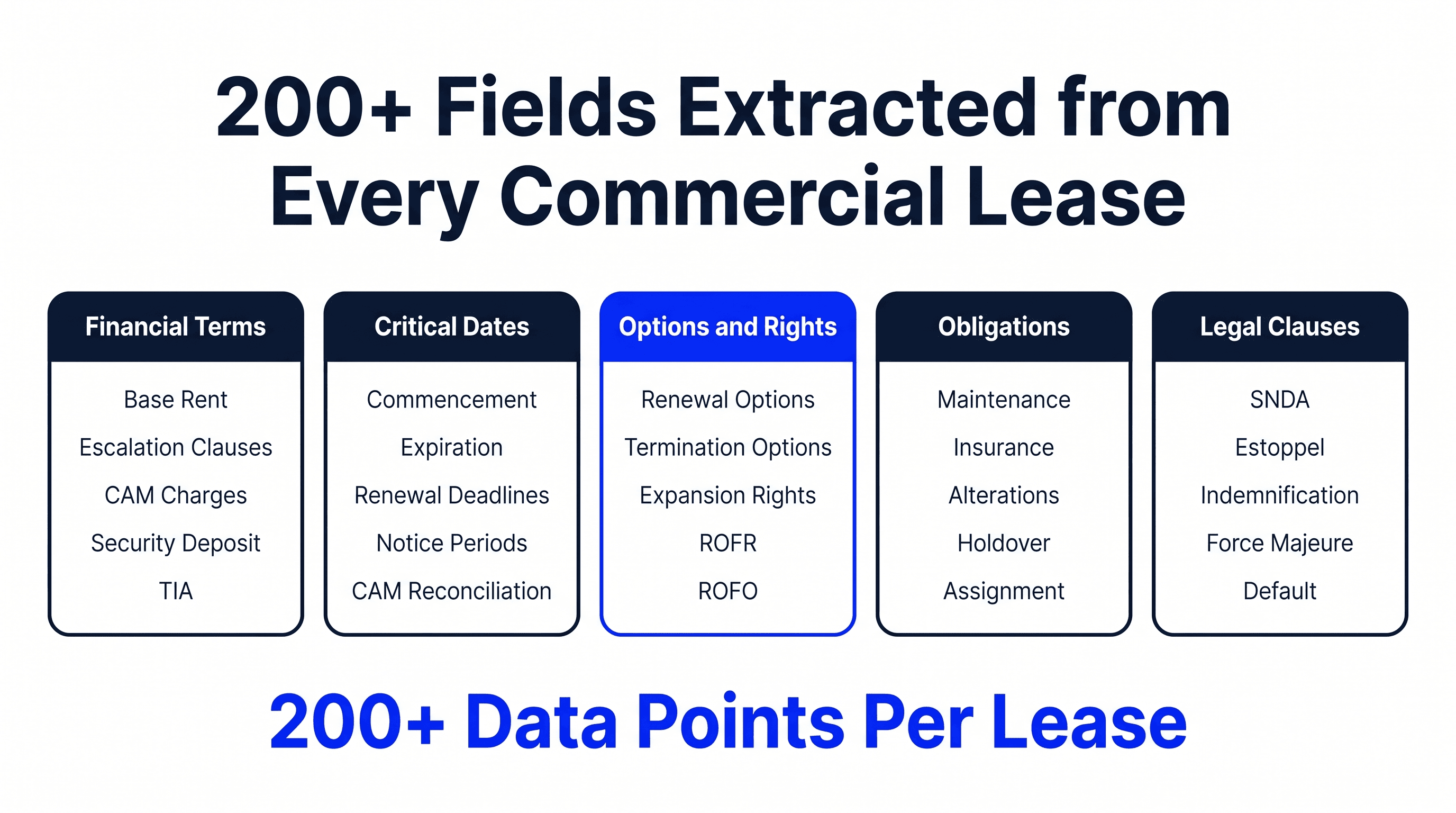
Teams that under-spec field coverage often discover the gap only when they need to answer a time-sensitive diligence, compliance, or negotiation question.
Where Abstraction Errors Create Financial Exposure
- Renewal and termination option windows missed because amended notice language was not carried forward.
- CAM overpayment exposure when cap type, exclusions, or cumulative logic is abstracted incompletely.
- Escalation schedule drift when revised formulas in amendment chains are not reconciled to the effective term state.
- Dispute cycle delays because teams cannot quickly verify a field value against the source clause.
Choosing the Right Workflow Model
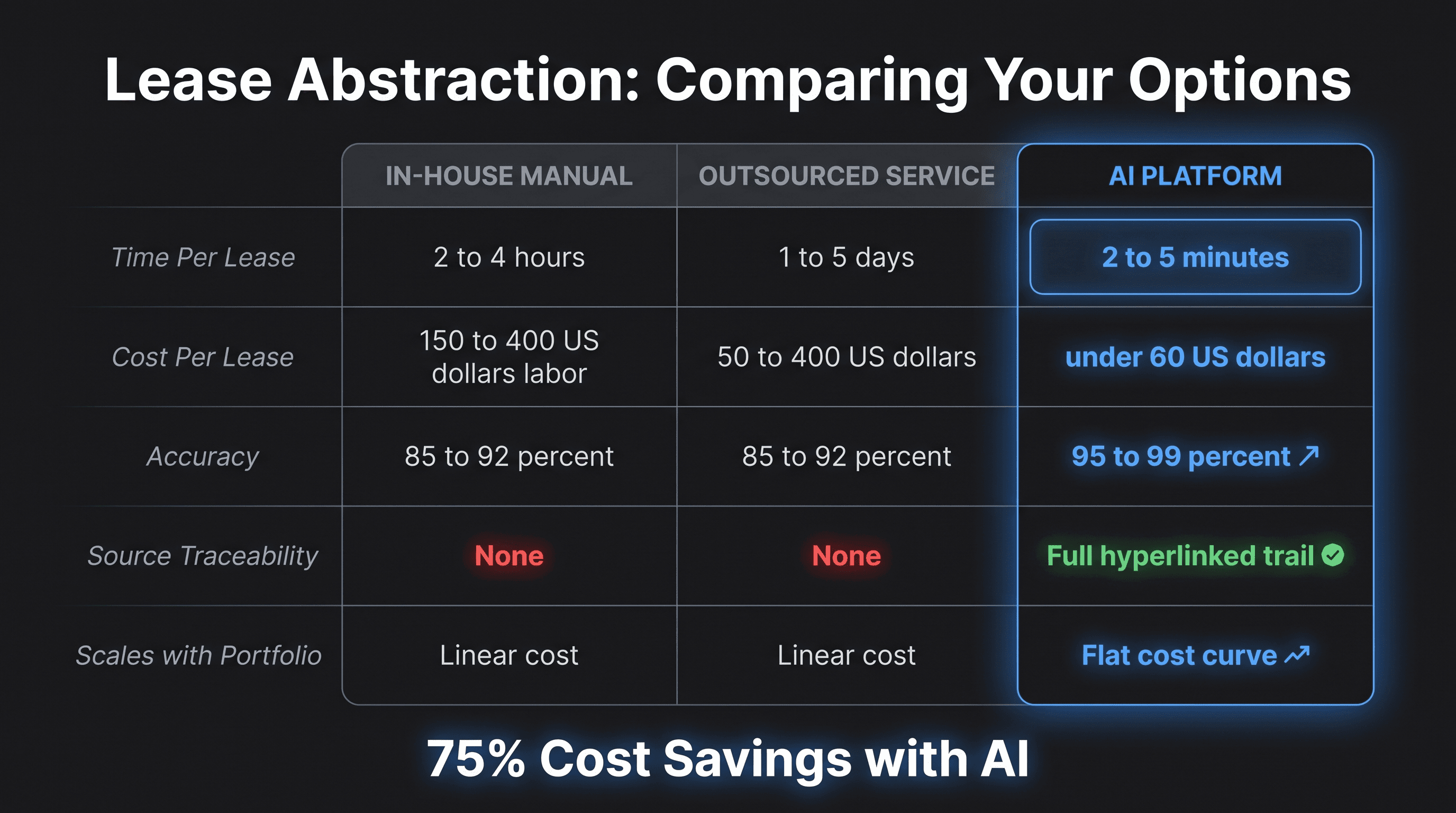
Manual, outsourced, and AI-assisted workflows each have a role. The decision should be based on portfolio context rather than headline claims.
| Model | Best Fit | Primary Risk |
|---|---|---|
| In-house manual | Small portfolios, low amendment churn | Throughput limits and silent field errors |
| Outsourced service | Predictable volume with strict QA oversight | Opaque quality and weak source traceability |
| AI-assisted with human review | Scale, amendment-heavy portfolios, fast diligence cycles | Overconfidence if confidence scoring and review gates are ignored |
A Practical QA Framework for CRE Teams
- Define one standardized 200+ field schema used by legal, operations, and acquisitions.
- Require source-clause linkage on every high-impact field (dates, options, CAM, escalations, assignment, default).
- Run amendment delta checks before publishing any abstract as operationally active.
- Enforce confidence-based review queues so low-certainty fields are validated first.
- Audit a sample of finalized abstracts monthly and feed errors back into playbooks and model prompts.
Related Reading
- Lease Abstraction: The Complete Guide for CRE Teams
- Lease Abstraction Accuracy: Why Speed Is the Wrong Metric to Optimize
- How to Manage Lease Amendments Across a CRE Portfolio Without Losing Track
Frequently Asked Questions
What is lease abstraction in a CRE legal and operations workflow?
Lease abstraction is the process of converting lease language into structured fields that legal and operations teams can verify, track, and use for renewal deadlines, CAM review, escalation controls, and amendment management.
How many fields should a commercial lease abstract include?
For enterprise-grade CRE workflows, a complete abstract usually includes 200+ fields across financial terms, dates, options, obligations, and clause-level risk controls.
What is the biggest cause of costly abstraction mistakes?
Amendment reconciliation is typically the highest-risk failure point. Teams often abstract base lease terms correctly, then fail to propagate later amendment changes into the active record.
Is AI lease abstraction accurate enough for production use?
AI is strong on standard structured fields and can accelerate first-pass extraction significantly. Production reliability still depends on human verification of complex or negotiated clauses and field-level source traceability.
How should teams choose between manual, outsourced, and AI-assisted abstraction?
Use your volume and risk profile as decision inputs. Lower-volume portfolios may tolerate manual workflows. Larger or amendment-heavy portfolios usually need source-linked, confidence-scored AI workflows with legal/ops QA gates.
What should happen after a lease is abstracted?
The abstract should feed a living workflow: critical date tracking, escalation controls, CAM reconciliation, amendment delta updates, and periodic QA audits tied to source clauses.
The Bottom Line
Lease abstraction quality determines whether your downstream CRE decisions are defensible or fragile. If your current workflow lacks source traceability, amendment discipline, and review gates, fix that foundation before scaling volume.
Request a Demo