
Lease Abstraction Accuracy: Why Speed Is the Wrong Metric to Optimize
Speed is easy to demo. Accuracy is what determines whether your rent roll, CAM reconciliation, and renewal workflow can be trusted. This article shows why verifiable lease abstraction accuracy matters more than a fast first pass.
Every major proptech vendor in the lease abstraction space leads with the same claim: 2-5 minutes per lease. Some push it further - under 90 seconds. A few tout completion times that would make a seasoned lease analyst deeply skeptical.
Speed is easy to demonstrate. It is visceral. It makes for a compelling product demo. And for CRE teams buried under manual abstraction backlogs, the promise of a 30-50x time reduction is genuinely compelling.
The problem is not that AI-powered abstraction is not fast. It is. The problem is that the industry has positioned speed as the primary metric of value, while leaving the harder question - the question that actually determines whether your lease data is trustworthy - largely unaddressed.
A fast, inaccurate abstract is not just unhelpful. It is actively dangerous. Your team will use it. They will build rent rolls from it, reconcile CAM charges against it, and track critical dates from it. The abstract is the operational record.
Key Takeaways
- [NEEDS VERIFICATION: Prophia source] Approximately 53% of rent rolls contain at least one material error, and those errors often start upstream in abstraction.
- Speed is demonstrable. Accuracy claims are usually not.
- A fast, inaccurate abstract is more dangerous than a slow one because the output gets treated as the source of truth.
- Source traceability - every extracted field linked to its exact clause and page - is the only lease abstract verification standard that holds up in practice.
- The question to ask vendors is not just what their accuracy rate is, but whether you can trace every extracted field back to the governing language.
The Proptech Industry Has Optimized for the Wrong Variable
The lease abstraction software market has converged on a narrative: AI is dramatically faster than manual review, and speed is the headline story.
This is true in the narrow sense. AI extraction genuinely compresses abstraction time from hours to minutes. A modern platform can complete an initial pass of a standard commercial lease in 2-5 minutes. For CRE teams managing portfolios of 50, 200, or 1,000 leases, that time reduction is operationally significant.
But the speed conversation has crowded out a more important one.
When vendors lead with 2-5 minutes per lease, the implicit promise is that those minutes produce the same quality of output as 2-4 hours of careful manual review - just faster. That claim deserves scrutiny. Speed tells you how long the process takes. It tells you nothing about what the process gets right.
Manual lease abstraction, done carefully by an experienced analyst, achieves roughly 90% accuracy on standard lease terms. The remaining 10% is the result of document complexity, multi-amendment reconciliation, and the difficulty of tracking how a fifth amendment modifies a term established in the original document.
AI-powered platforms report accuracy rates of 90-99%, depending on the vendor and the methodology used to measure. That range should itself prompt questions. What counts as an accurate extraction? Measured on a curated dataset or on your real-world portfolio with poor OCR quality and handwritten rider pages?
What the Data Actually Shows About Lease Data Quality
According to research published by Prophia, approximately 53% of rent rolls contain at least one material error [NEEDS VERIFICATION: Prophia source]. A 2023 analysis by Tango Analytics found that 40% of CAM reconciliations in U.S. retail centers contain material mistakes [NEEDS VERIFICATION: Tango Analytics analysis]. Industry estimates place the annual revenue leakage from CAM errors alone at between $5 billion and $15 billion across the U.S. commercial real estate market [NEEDS VERIFICATION: source].
These are not fringe findings. They describe the baseline state of CRE data accuracy across a broad cross-section of the industry.
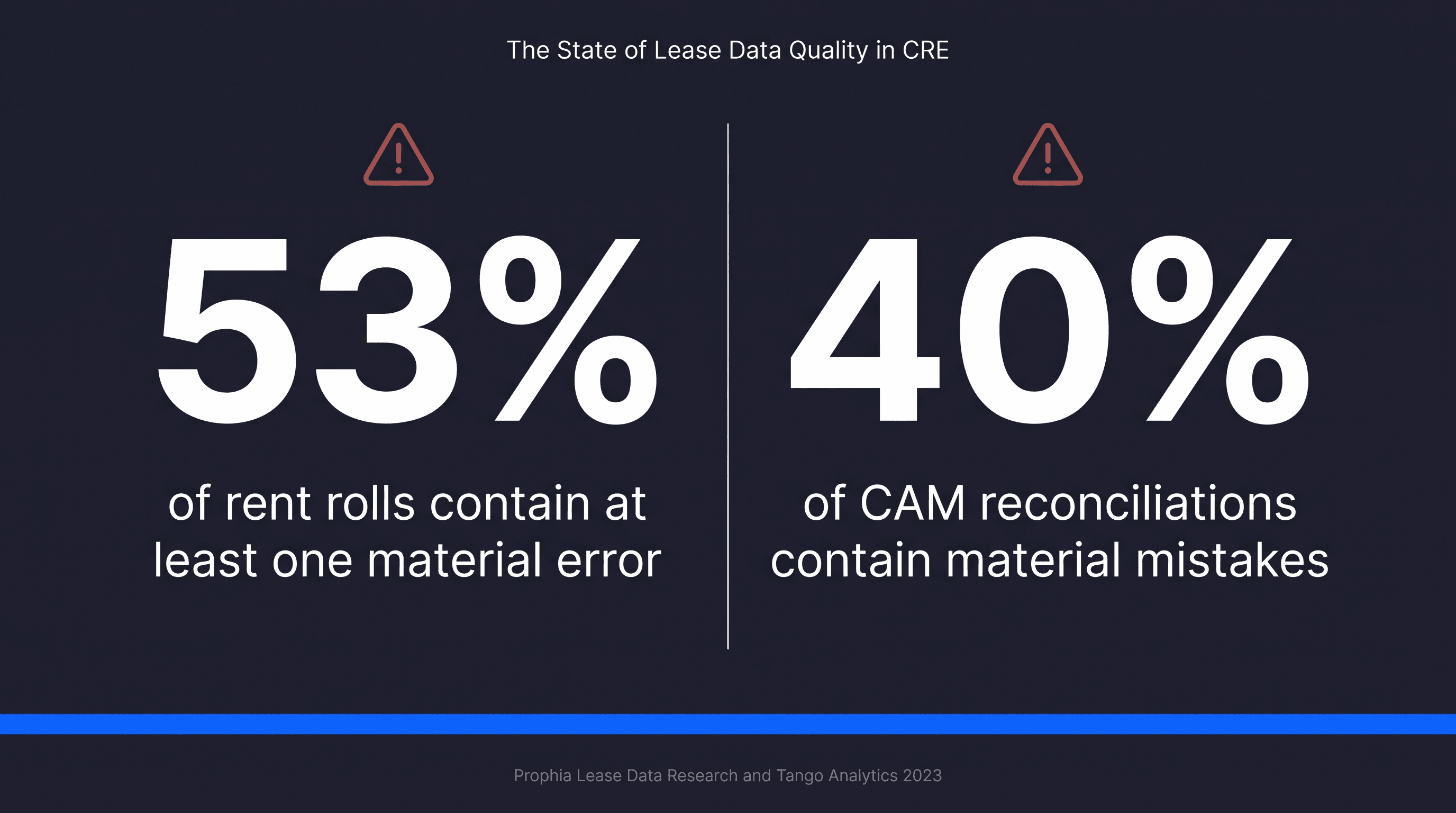
The question worth asking: if AI abstraction tools have been available and widely adopted for several years, why are lease data quality problems still this pervasive?
Why a Fast Abstract Is More Dangerous Than a Slow One
Here is the argument the proptech industry's speed narrative obscures: the operational risk profile of a fast, inaccurate abstract is structurally worse than a slow, accurate one.
When manual abstraction takes 3 hours per lease, the analyst's work is visible. Someone reviews it. The slowness creates pressure for a quality control layer because the cost of the process makes accuracy worth protecting.
When AI extraction takes 3 minutes, that same quality control pressure evaporates. A completed abstract with 200+ filled fields reads as done. Teams see comprehensive output and implicitly trust it.
A slow abstract is a bottleneck. A fast, wrong abstract that your team implicitly trusts is a liability embedded in every downstream decision.
What Does "95% Accuracy" Actually Mean?
Most lease abstraction vendors publish an accuracy rate. The numbers cluster in a narrow band: 90%, 95%, 97%, 99%. The variation is real, but it tells you considerably less than it appears to.
Accuracy claims in this space are almost universally measured on internal benchmark datasets using methodologies the vendor controls and does not publish.
- Which fields are being measured?
- Which documents are being measured?
- What counts as correct?
- What percentage of fields are tested?
The point is not that accuracy claims are fabricated. It is that they are measured under conditions more favorable than the conditions in which your actual portfolio exists.
Speed vs. Accuracy: A Framework for CRE Teams
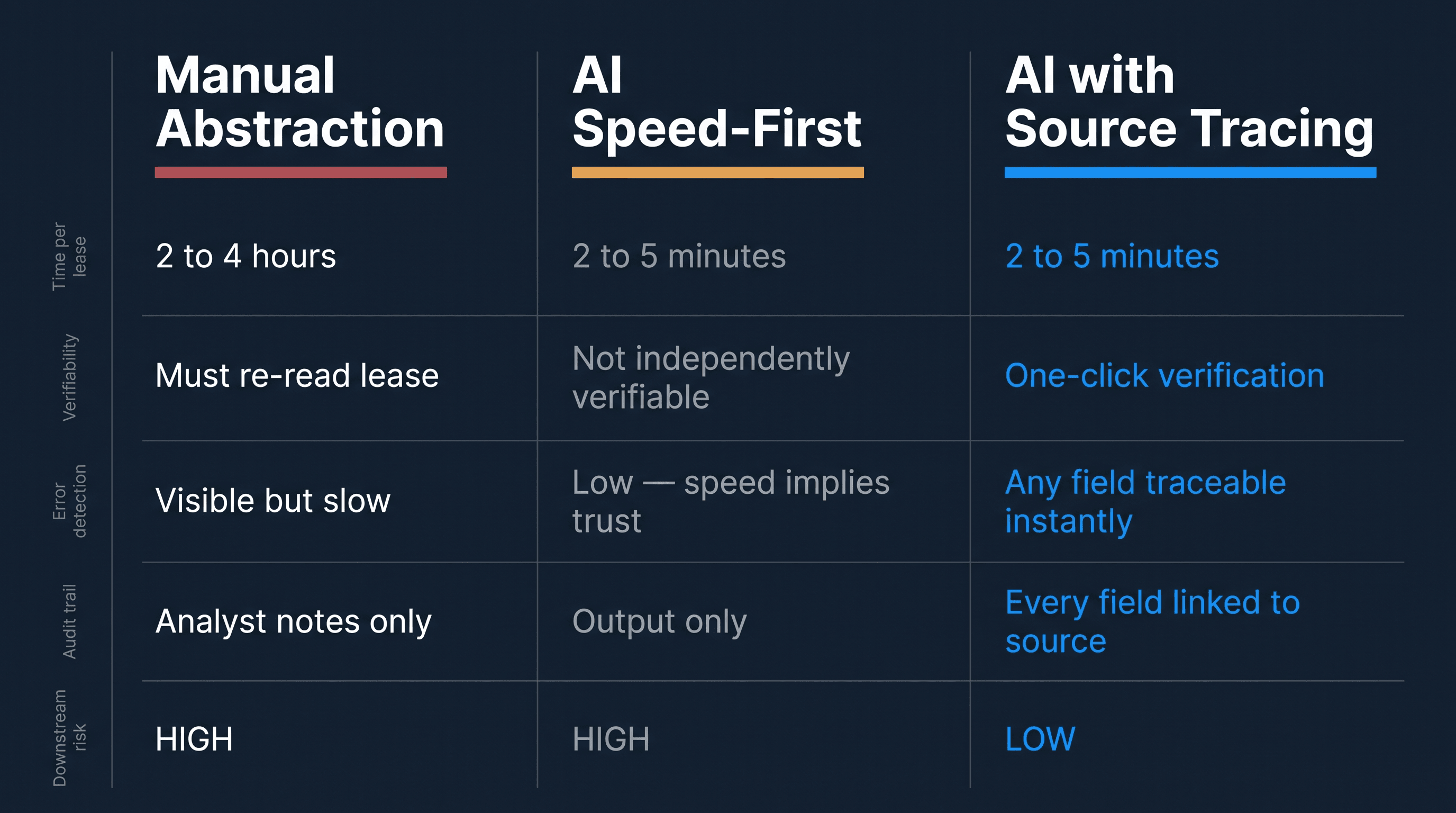
| Dimension | Manual Abstraction | AI (Speed-First) | AI with Source Traceability |
|---|---|---|---|
| Time per lease | 2-4 hours | 2-5 minutes | 2-5 minutes |
| Field coverage | Analyst-dependent | 200+ fields | 200+ fields |
| Accuracy benchmark | Expert review | Vendor-internal | Field-level source link |
| Verifiability | Requires re-reading lease | Not independently verifiable | Verifiable without rereading |
| Error detectability | High | Low | High |
| Amendment handling | Manual delta-tracking | Varies | Automated delta-linking |
| Audit trail | Informal notes | Output only | Every field linked |
Source Traceability: The Only Verification Standard That Holds Up
Source traceability means that every extracted field in a lease abstract is hyperlinked directly to the specific page and clause in the source PDF from which it was drawn.
This is not the same as a confidence score. A confidence score is a self-assessment, not a verification.
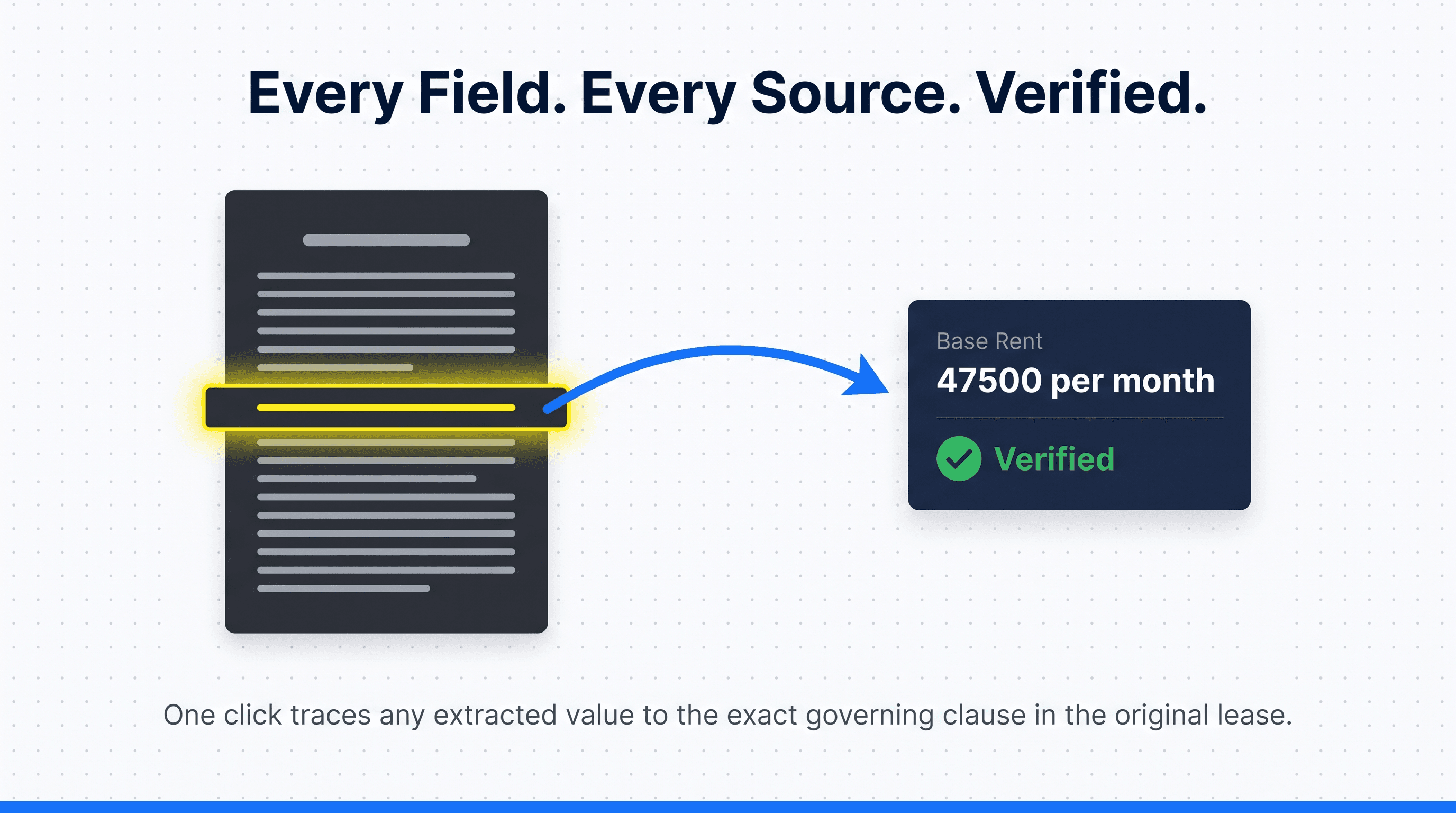
Abstria's dual-panel editor keeps each extracted field linked to the exact page and clause it came from. Every field is traceable, so any team member can verify the output in seconds.
How to Evaluate CRE Data Accuracy Before You Trust It
1. Can every field be traced to a source clause?
Not just some fields. Every field. Partial traceability creates a false sense of security.
2. How do you handle multi-amendment chains?
A base lease with four amendments is not four separate documents. Ask how the platform resolves conflicts and surfaces the current effective state.
3. What does the accuracy benchmark measure?
If a vendor cannot describe the benchmark methodology, or will not run a sample on your own lease, that is its own data point.
These questions do not require technical expertise to ask or evaluate. The answers will tell you more about a platform's real-world reliability than any published accuracy percentage.
Frequently Asked Questions
What is a good accuracy rate for lease abstraction?
Published rates between 90% and 97% are common, but the percentage alone is not enough. Source traceability is the practical standard because it lets you verify any field yourself.
Can AI lease abstraction be trusted without human review?
AI makes a strong first pass, but human review is still important for complex provisions, multi-amendment chains, and edge cases that change the effective meaning of a clause.
Why do rent rolls contain so many errors?
Because errors often enter upstream during abstraction. If the underlying clause was extracted incorrectly, the rent roll inherits the mistake.
How do you verify the accuracy of a lease abstract?
Use source traceability, then spot-check high-consequence fields such as base rent, CAM structure, option windows, and termination provisions against the governing language.
The Metric You Should Actually Optimize For
Speed is a genuine operational benefit. AI-powered lease abstraction reduces processing time from hours to minutes.
But lease abstraction accuracy is not a byproduct of speed. The two are independent variables.
The metric CRE teams should optimize for is verifiable accuracy: the ability to confirm that any extracted field matches the governing lease language, without specialized expertise, in seconds.