
Definition + Workflow
What Is Lease Abstraction? Definition, Process, and Real-World Examples
Quick answer: lease abstraction is the process of extracting critical data points from a commercial lease agreement into a structured summary called a lease abstract. It transforms dense legal language into searchable operational data.
Published: 2026-08-15
By: Abstria Team
Key Takeaways
- Lease abstraction converts lease language into structured data that legal and operations teams can query and verify quickly.
- A complete abstract commonly includes 200+ fields across financial terms, dates, options, obligations, and legal provisions.
- Manual workflows are slower and more error-prone at scale, especially for amendment-heavy portfolios.
- AI improves extraction speed, but source-linked human verification is still critical for high-consequence terms.
- Abstraction and administration are connected but not the same function.
What Does Lease Abstraction Mean?
Lease abstraction is the process of extracting and organizing key terms from commercial lease documents into a structured record. The lease remains the governing contract. The abstract is the operational layer teams use to act.
In active CRE portfolios, this is not optional administration detail. It is a control function for rent obligations, renewal windows, CAM caps, escalation formulas, and amendment-driven changes.
For foundational context, see the canonical lease abstraction guide. This article focuses on production workflow and verification examples to avoid overlap.
What Data Does a Lease Abstract Capture?
A robust abstraction model captures 200+ fields. Teams should prioritize field coverage based on real downstream decisions.
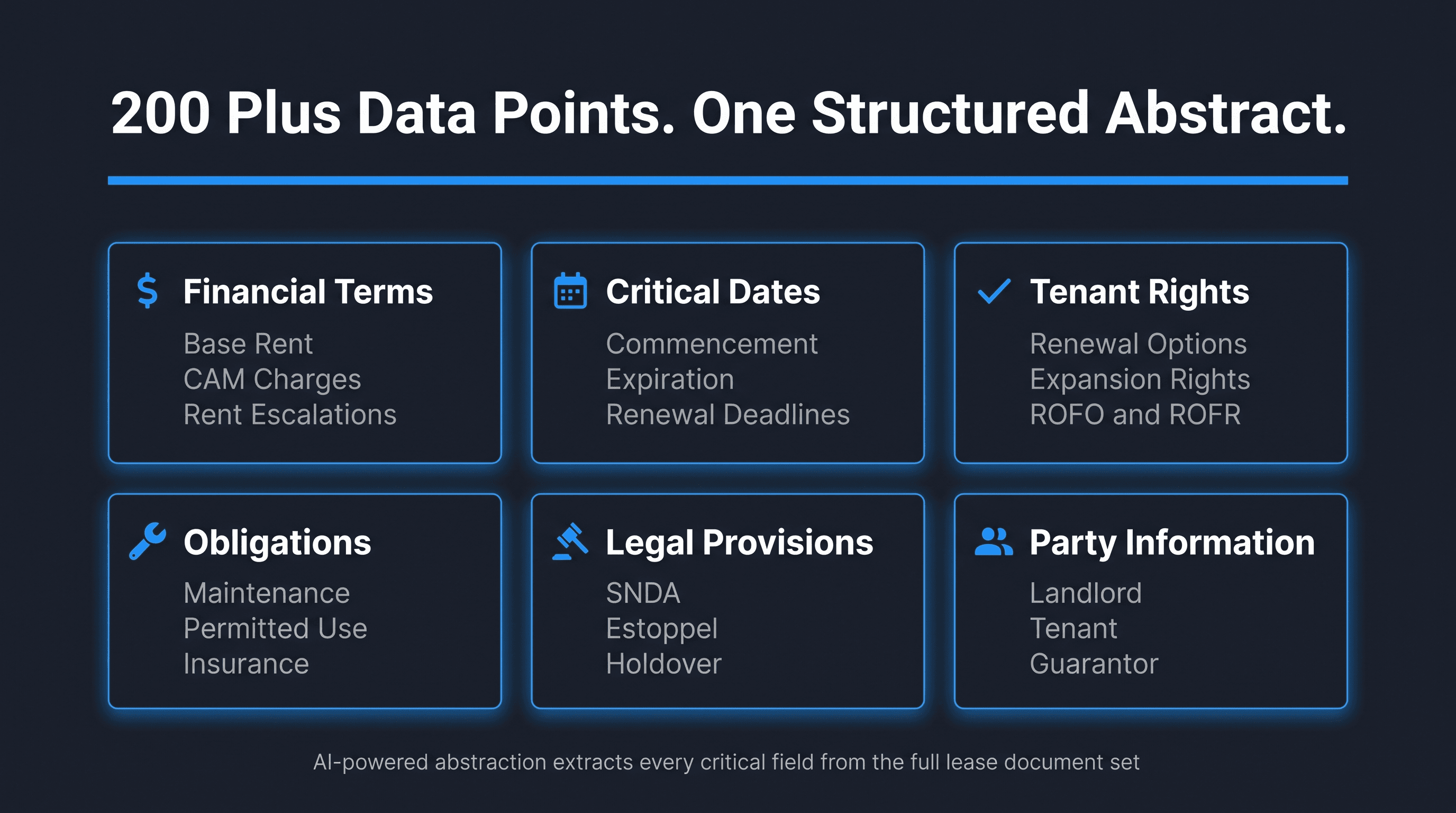
| Category | Representative fields |
|---|---|
| Financial terms | Base rent, escalations, CAM obligations, gross-ups, security deposit, TI allowance |
| Critical dates | Commencement, expiration, renewal notice deadlines, rent steps, CAM reconciliation windows |
| Party information | Landlord/tenant legal entities, guarantor, notice addresses, broker information |
| Rights and options | Renewal, expansion, termination, ROFO/ROFR, co-tenancy, exclusivity |
| Obligations | Maintenance splits, use restrictions, insurance requirements, assignment/subletting terms |
| Legal provisions | SNDA, estoppel, cure periods, subordination, force majeure, governing law |
How the Lease Abstraction Process Works
1. Document collection and ingestion
Collect the base lease, amendments, exhibits, acknowledgements, estoppels, and SNDAs before extraction starts. Missing one amendment can invalidate key fields.
2. AI extraction
Extraction identifies field values and maps each field to source clauses. Clause-level linkage is what makes review fast and defensible.
3. Human verification
Reviewers validate high-consequence fields first: notice windows, escalations, CAM caps, options, and assignment restrictions.
4. QA and structured delivery
Approved fields flow into lease operations, diligence, and analytics systems with full reviewer attribution and history.
Real-World Examples
Example 1: Office lease portfolio
A team managing 30 office leases needs upcoming renewal windows, CAM obligations, and rent schedule validation before budgeting. With source-linked abstraction, reviewers focus on exception fields instead of repeating full-document reads.
Example 2: Retail due diligence
A buyer reviewing 15 retail leases needs co-tenancy triggers, percentage rent mechanics, and exclusivity clauses verified before closing. Structured extraction reduces diligence risk by surfacing these clauses consistently across the set.
Manual vs. AI Lease Abstraction
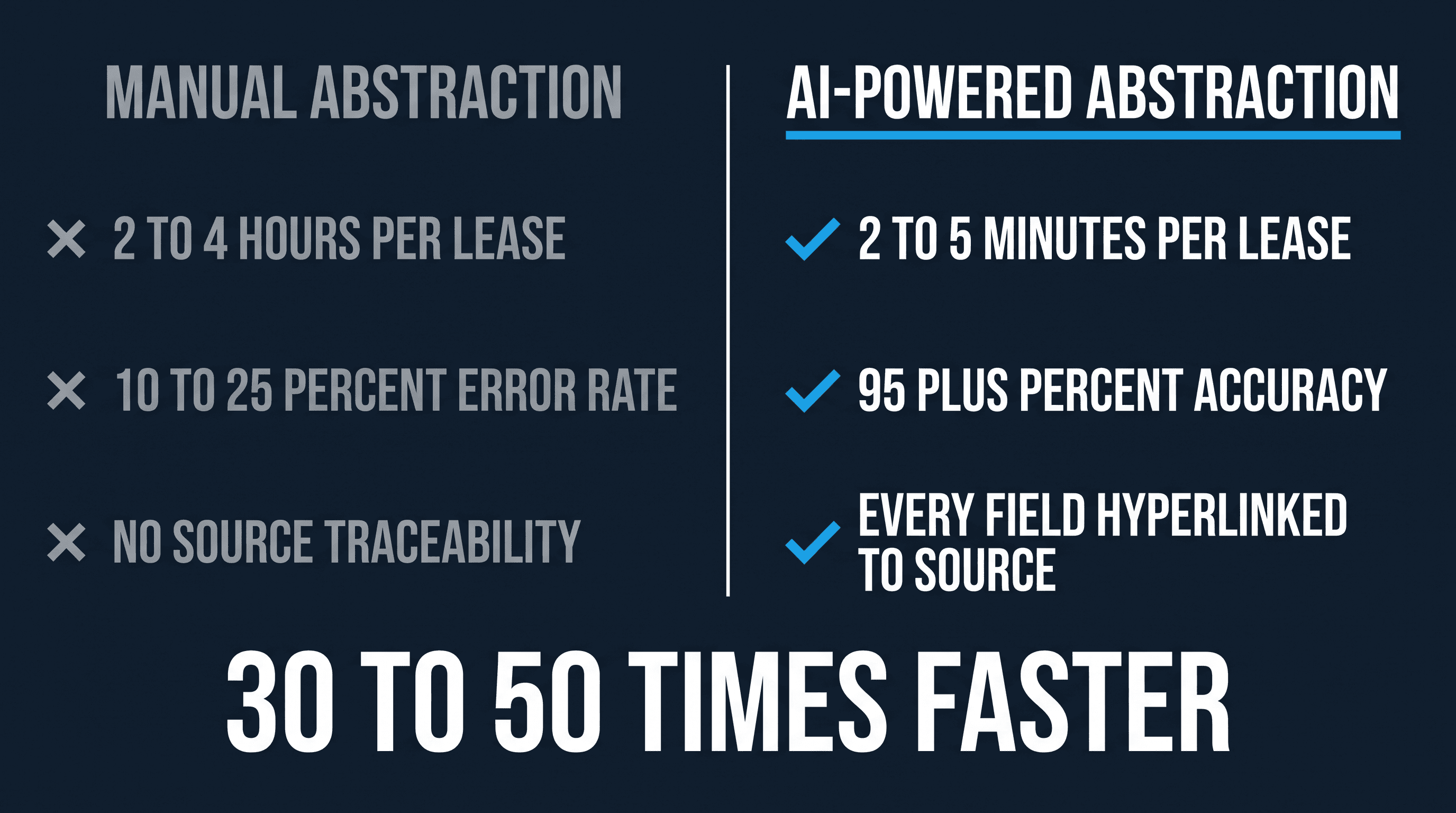
| Metric | Manual | AI-assisted |
|---|---|---|
| Time per lease | 2-4 hours | 2-5 min extraction + review |
| Source verification | Manual searching | Clause-level field links |
| Amendment handling | Manual reconciliation | Structured delta review |
| Scalability | Headcount-bound | Portfolio-scale throughput |
Frequently Asked Questions
What is the difference between lease abstraction and lease administration?
Lease abstraction is the extraction and structuring step. Lease administration is the ongoing management step that uses that data for renewals, notices, CAM review, and compliance workflows.
How many fields should a commercial lease abstract include?
Most CRE teams need far more than basic rent and date fields. Production workflows commonly use 200+ fields spanning financial terms, dates, options, obligations, and legal provisions.
Can AI replace human review for lease abstraction?
AI can accelerate first-pass extraction dramatically, but high-impact terms should still be verified by a qualified reviewer using source-linked clause traceability.
Why do amendment errors happen so often?
Teams often extract the base lease accurately but fail to reconcile later amendments into a single effective-state record. That leaves stale values in active portfolio reporting.
What should teams verify first in a new abstract?
Start with high-consequence fields: renewal notice windows, termination rights, rent escalations, CAM caps, and assignment or subletting restrictions.
Is source traceability optional?
For defensible legal and operations workflows, source traceability should be treated as mandatory. Review speed and audit reliability depend on it.
The Bottom Line
Lease abstraction is the step that turns legal text into usable CRE intelligence. Teams that combine extraction speed with source-traced verification make better decisions faster and with lower operational risk.