
What Is Lease Abstraction? A Complete Guide for CRE Professionals
Lease abstraction is not clerical summarization. It is the data foundation behind rent rolls, CAM reconciliation, option tracking, and portfolio decision-making.
Key Takeaways
- Lease abstraction is decision infrastructure, not a reading shortcut.
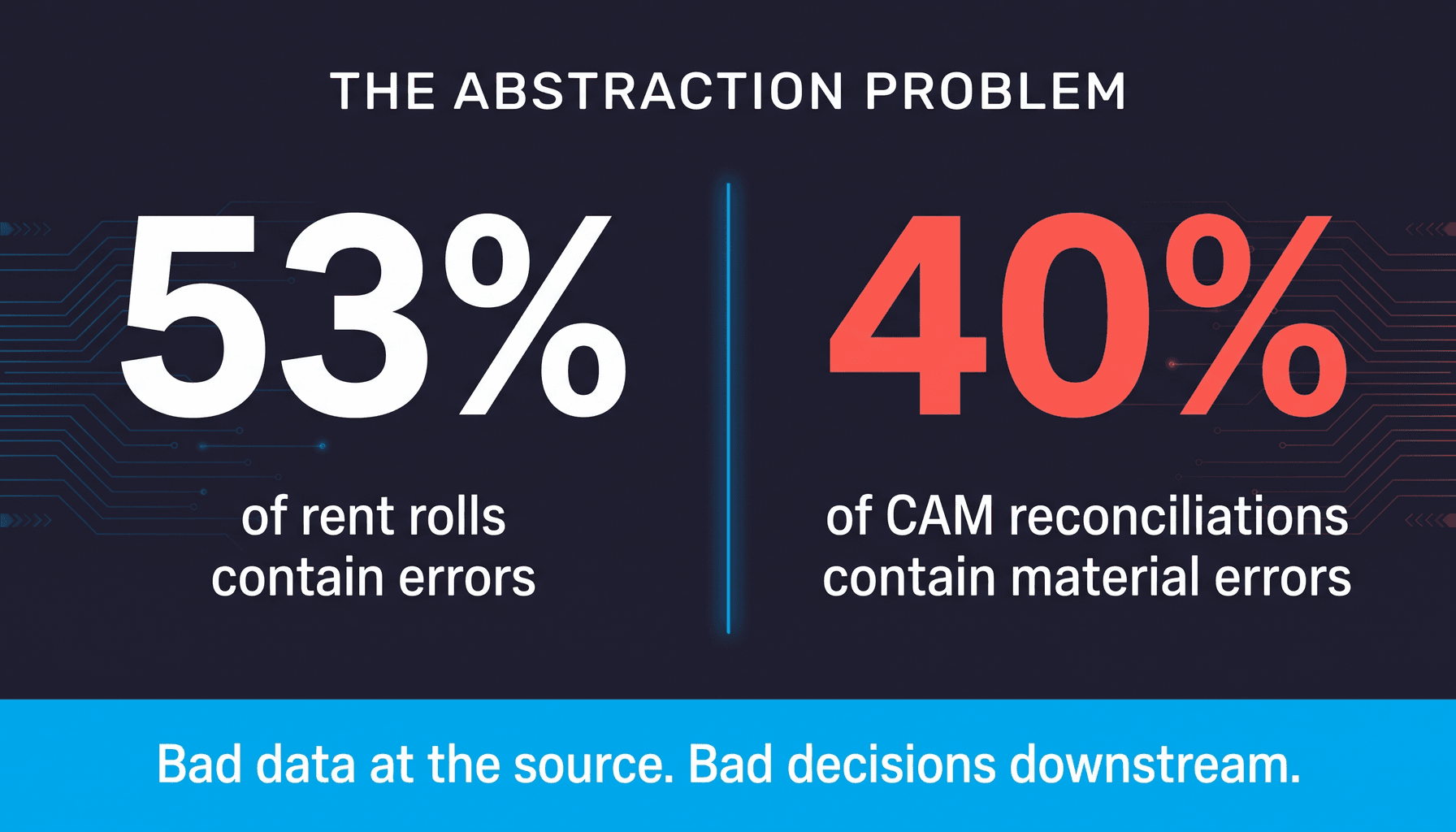
- Industry benchmarks report persistent abstraction-linked errors in downstream processes such as CAM and rent reporting [NEEDS VERIFICATION: add source citation URLs used by legal/ops team].
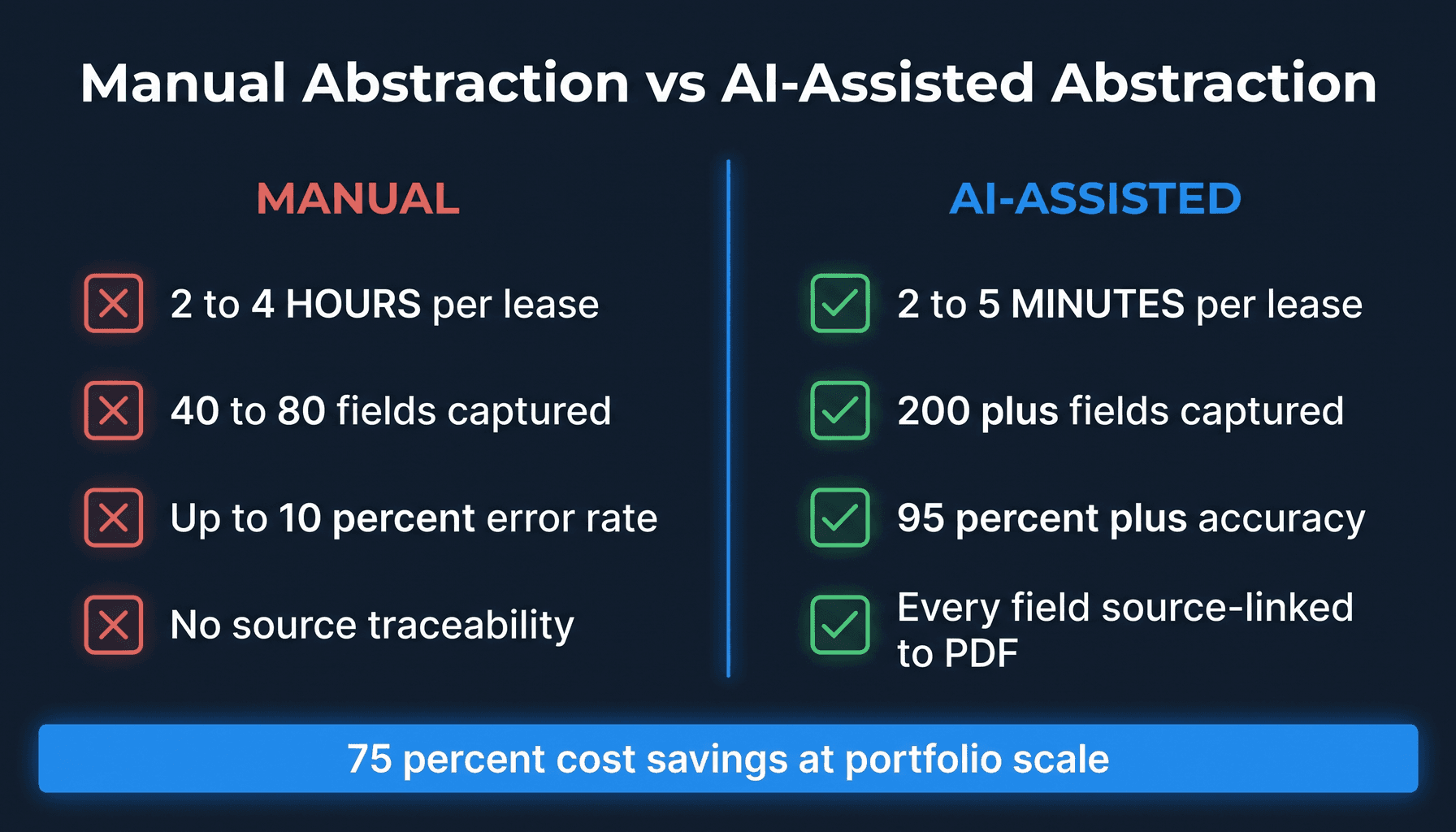
- Manual workflows often take hours per lease, while AI-assisted extraction can reduce first-pass processing to minutes with human validation.
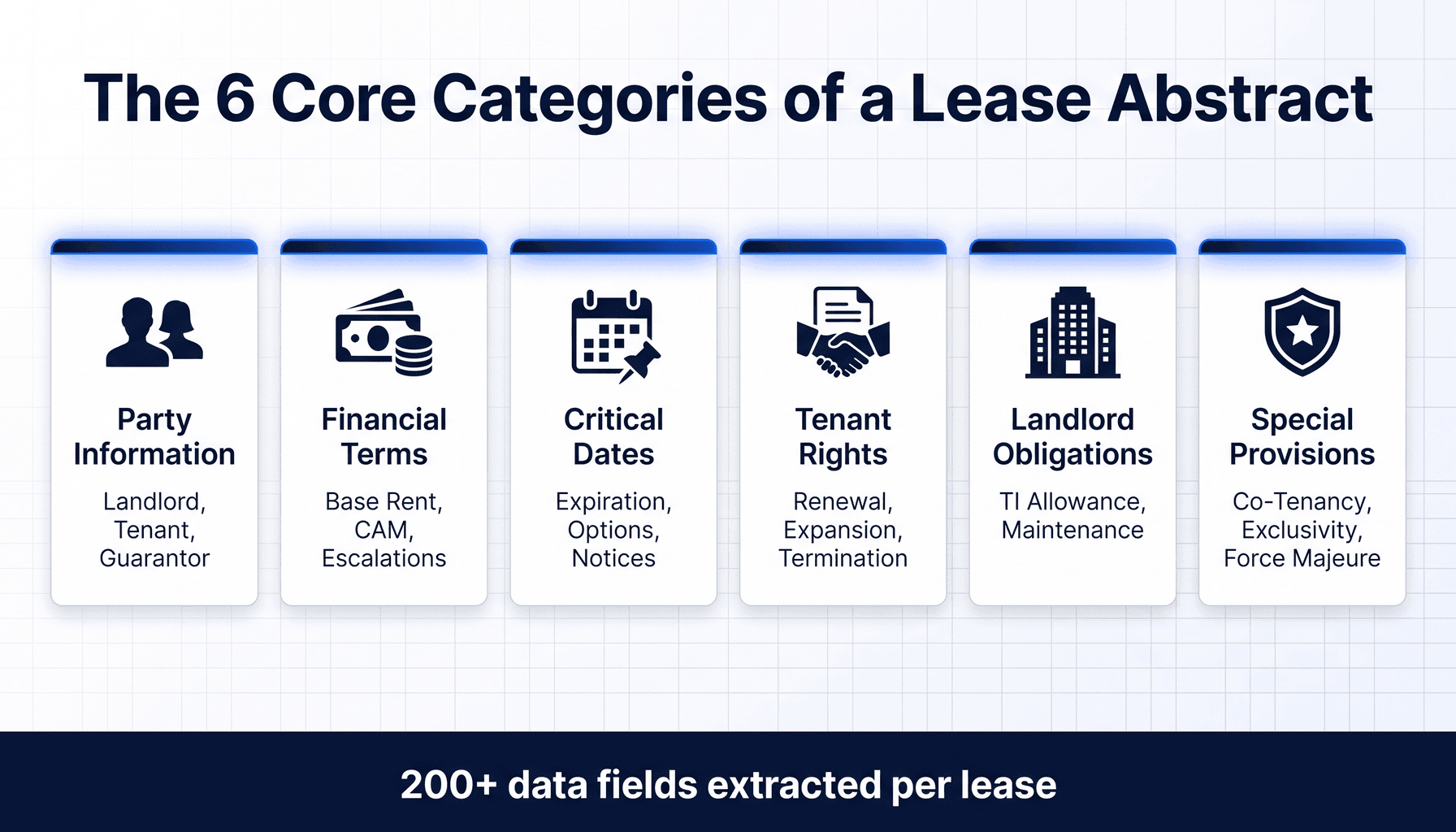
- A complete abstract should include six categories: party details, financial terms, critical dates, tenant rights, landlord obligations, and special provisions.
- The biggest portfolio risk is often invisible: bad lease data that looks complete until a deadline, dispute, or audit exposes it.
Table of Contents
The Industry Framing Problem
In CRE, lease abstraction is still often described as summarization. That definition is incomplete and operationally risky. A lease abstract drives budgets, rent escalations, CAM calculations, option tracking, and due diligence. If abstraction is inaccurate, every downstream decision inherits that error.
Teams that treat abstraction as back-office paperwork generally get back-office data quality: partial fields, inconsistent amendment handling, and weak traceability. Teams that treat abstraction as core infrastructure can make faster and more reliable decisions across the portfolio.
What Is Lease Abstraction? Functional Definition
Lease abstraction is the structured extraction of financial, legal, and operational data from commercial lease documents into a standardized format that can be queried, reviewed, and acted on.
The output is a lease abstract: a data record that captures specific field-level values, not a narrative summary. It includes terms such as commencement, rent schedules, CAM structure, notice windows, renewal rights, and obligation clauses.
A practical abstraction process follows six steps:
- Collect base lease plus amendments and related records.
- Map clauses to standardized data fields.
- Extract field values.
- Reconcile amendment deltas against base terms.
- Run quality control against source language.
- Publish data into operational systems.
From Manual Workflows to AI-Assisted Workflows
Historical abstraction workflows were manual: attorneys, paralegals, and administrators reading line-by-line, then entering values into templates. Spreadsheet tooling improved consistency but did not remove the extraction bottleneck.
AI-assisted systems changed this model by combining OCR, document intelligence, and field extraction into a fast first pass, then layering human validation on top. The value is not speed alone. It is speed plus consistency, traceability, and amendment-aware updates.
For related implementation and operations guidance, see manual-to-AI transition patterns and renewal deadline control frameworks.
The Six Core Data Categories
A complete commercial lease abstract should capture six categories without gaps:
Manual vs AI: Direct Comparison
Method selection directly affects turnaround time, consistency, and auditability. Manual abstraction can be highly accurate in narrow use cases, but it scales linearly with portfolio volume and is harder to keep synchronized across amendment chains.
AI-assisted workflows reduce first-pass extraction time, increase field coverage, and make field-level verification easier when each output is linked to source language.
For an ROI model using team-specific assumptions, see The Real ROI of AI Lease Abstraction.
What Makes an Abstract Reliable?
Reliability is mostly a traceability problem. If a field cannot be checked against the original clause quickly, the abstract depends on institutional memory and trust. That breaks down as documents, analysts, and years accumulate.
Reliable abstraction requires source-linked fields, amendment delta visibility, version history, and a repeatable human-review protocol. These controls matter most during diligence, dispute resolution, and audit events.
Foundational reading: Lease Abstraction Guide and What Is Lease Data.
Frequently Asked Questions
What does lease abstract meaning refer to in CRE?
It refers to the structured output of lease abstraction: field-level financial, legal, and operational terms captured from the original lease into a searchable record.
How long does lease abstraction take?
Manual abstraction often takes 2 to 4 hours for straightforward commercial leases and more for complex amendment-heavy documents. AI-assisted extraction can reduce first-pass work to minutes, with human review layered in.
What is the difference between a lease and a lease abstract?
The lease is the legal contract. The abstract is the operational record used for portfolio management and reporting. The abstract should always remain traceable back to the legal source.
What happens when a lease is amended?
The abstract must be reconciled so changed values replace stale base-lease fields. If this step is skipped, teams may continue operating on outdated data.
Lease Abstraction Is the Foundation - Build It Right
Every CRE financial and operational workflow eventually depends on lease data quality. If abstraction is partial, unverified, or stale, the resulting decisions carry hidden risk.
Treat lease abstraction as strategic infrastructure: structured extraction, source traceability, amendment governance, and human-in-the-loop quality control.
Request a Demo