
The Lease Abstraction Process: A Step-by-Step Walkthrough for CRE Teams
Most abstraction errors are not created in base lease review. They are created in amendment reconciliation, where unchanged templates quietly overwrite the current legal state of the lease.
Every lease abstraction guide covers the basics: collect documents, extract key terms, validate, and hand it off. That process works tolerably well for a clean, single-document base lease. It fails in a consistent, predictable, and expensive way when amendments appear. In CRE portfolios, amendments are common rather than exceptional.
Industry analyses frequently point to amendment prevalence and data-quality exposure. The key operational point is simple: if abstraction does not reconcile amendments against parent lease fields, the resulting abstract can be complete in format but stale in legal substance.
This guide walks through a complete five-phase workflow: document collection and completeness audit, initial review and field mapping, data extraction and validation, amendment delta-linking, and QC sign-off.
Key Takeaways
- The lease abstraction process has five distinct phases, and each phase has failure modes that can be controlled.
- Amendment delta-linking is the most commonly skipped step and the most common source of silent abstraction errors.
- Completeness audit at intake prevents costly downstream errors from missing amendments, exhibits, or side letters.
- AI can accelerate extraction and mapping, but reconciliation and QC still require structured workflow design.
- Without source traceability, defects can survive QC and remain invisible until dispute, audit, or diligence events.
Table of Contents
Why Most Lease Abstraction Process Guides Skip the Hardest Part
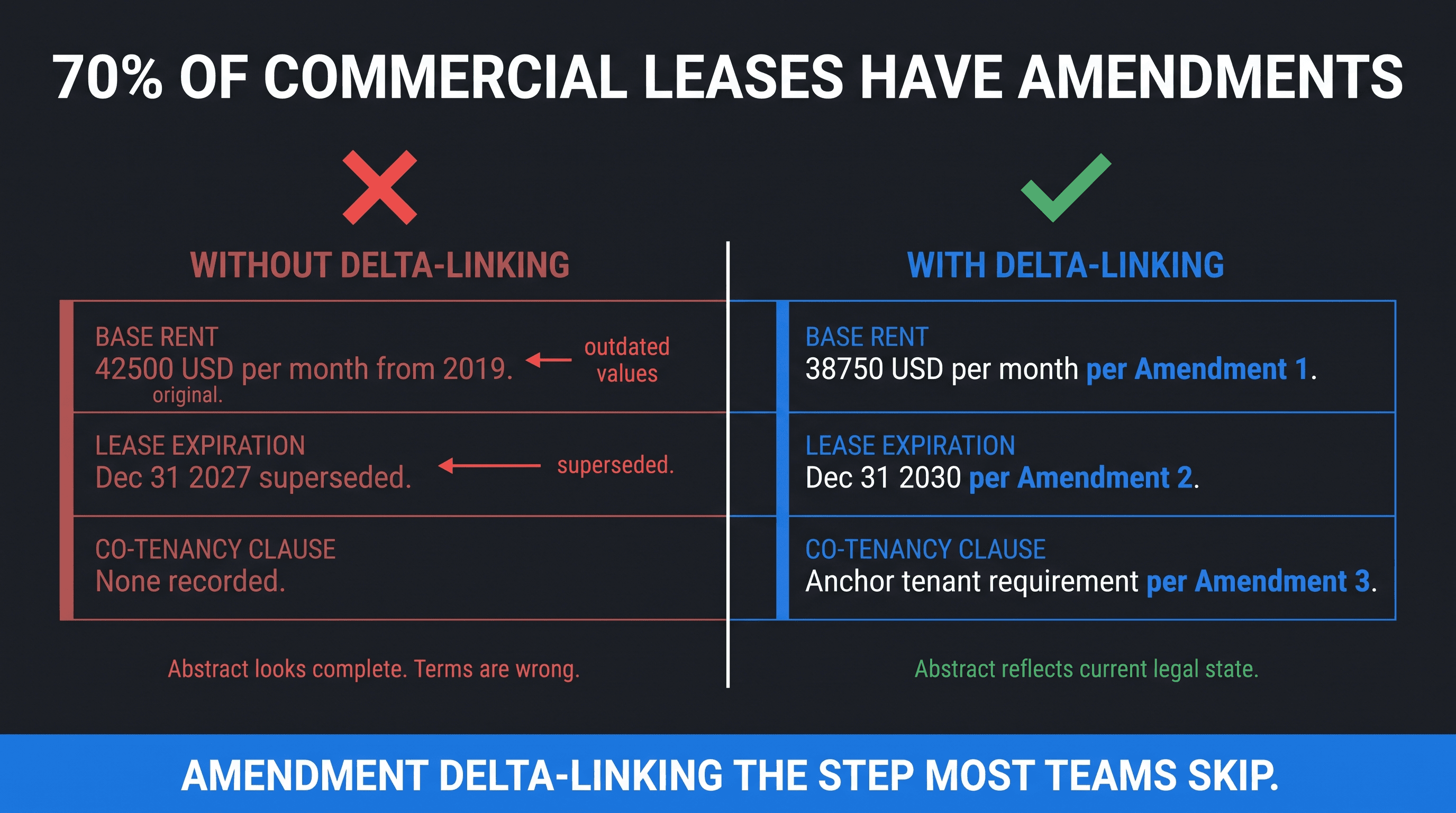
Many workflows treat base leases and amendments as separate abstraction artifacts. That is the core design flaw. Amendments are not side notes. They modify governing terms directly. If the abstract captures amendment text but does not overwrite superseded base values in active fields, the portfolio runs on stale data.
The problem is subtle because the abstract can still look complete. Required fields exist. Documents are attached. But key values are historically correct rather than currently effective. This is exactly how renewal deadlines, CAM calculations, and tenant-rights tracking drift out of legal alignment.
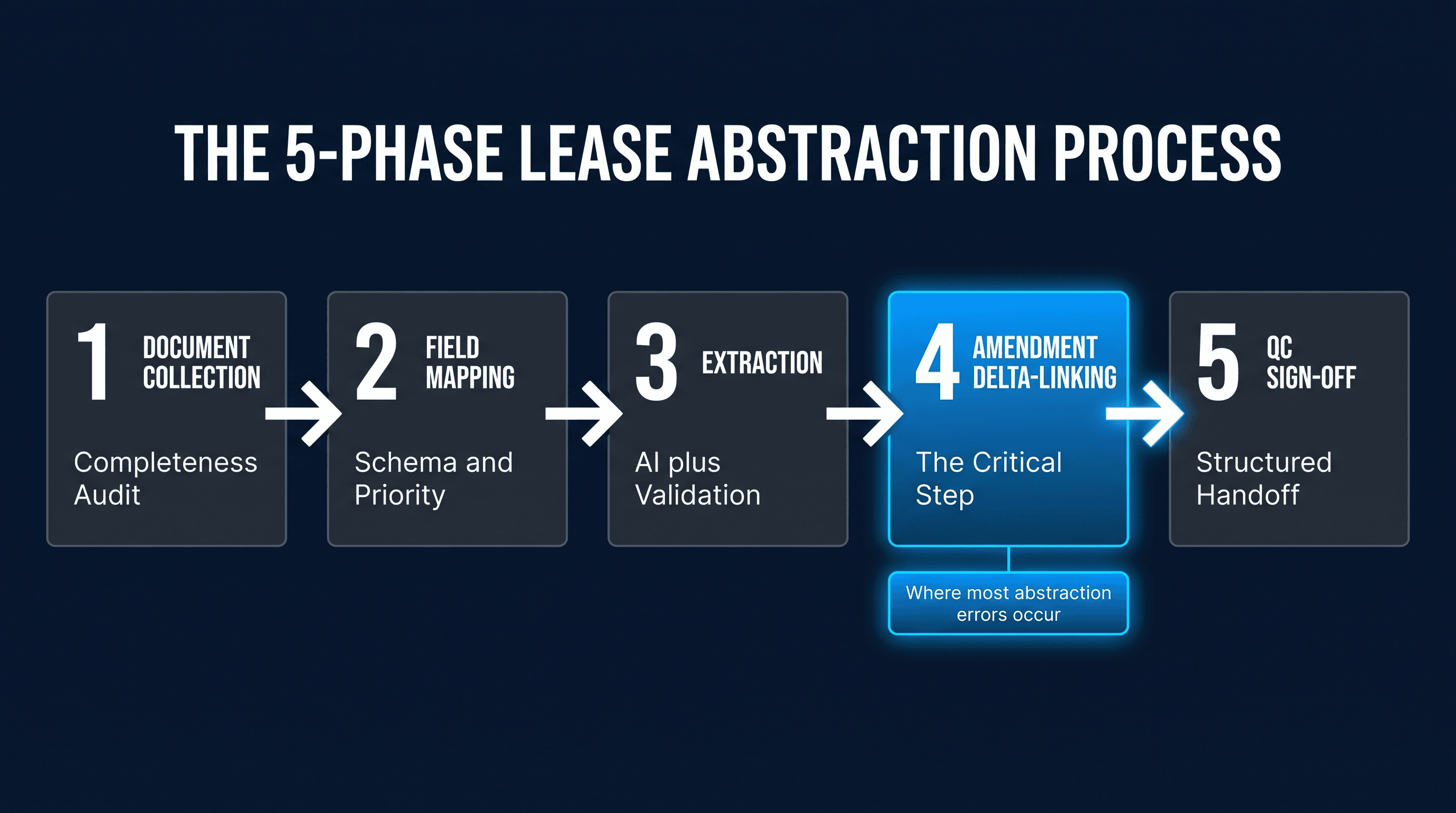
Phase 1 - Document Collection and Completeness Audit
No extraction should begin until document completeness is confirmed. The intake package should include the executed base lease, all executed amendments in sequence, commencement acknowledgements, relevant estoppels, SNDAs, side letters, and referenced exhibits.
Side letters are frequently missed and can carry binding rent adjustments, waived obligations, or revised notice windows. Missing one can invalidate the practical reliability of the entire abstract.
Completeness audit controls should include:
- Verify amendment sequence is unbroken.
- Verify execution status before treating terms as binding.
- Resolve all internal references to exhibits or letter agreements.
- Log missing documents and hold extraction until risk acceptance is explicit.
Phase 2 - Initial Review and Field Mapping
This phase establishes field authority before data entry. For each high-impact field, identify which document and clause currently governs the value. In amendment-heavy files, authority often moves across multiple documents over time.
Prioritize high-exposure domains for double QC:
- Critical dates and notice windows.
- Financial terms and escalation logic.
- Tenant rights and landlord obligations.
- Guarantee scope and burn-off mechanics.
A strong field map prevents template-default behavior where base lease values are copied even after amendments have modified those values.
Phase 3 - Data Extraction and Validation
AI-assisted extraction is highly effective for standard fields: dates, party names, financial terms, and clearly labeled options. It is especially valuable when each extracted value links back to source language in the document.
Human review remains necessary for non-standard clause logic, cross-referenced exhibits, and contextual dependencies. Extraction confidence alone is not a substitute for field authority and legal context review.
For related reading, see understanding the lease abstraction process and manual-to-AI workflow transition.
Phase 4 - Amendment Delta-Linking: The Step That Breaks Everything Else
Delta-linking is a mandatory reconciliation process. Every amendment must be evaluated against base terms and prior amendments to identify explicit changes, implicit effects, and new provisions introduced for the first time.
For each amendment, update the active abstract by:
- Replacing superseded field values with current governing values.
- Recalculating dependent fields and date windows.
- Adding new rights and obligations that did not exist in base documents.
- Recording governing version and effective date per updated field.
Phase 5 - QC Sign-Off and Structured Handoff
QC is not a visual polish pass. It is a source-level verification process designed to catch the exact failure modes introduced earlier in the workflow. The reviewer should validate financial fields, critical dates, amendment completeness, internal consistency, and source traceability.
Structured handoff should include:
- Final abstract with source references.
- Document inventory and completeness status.
- Flagged-items log for unresolved ambiguities.
- Version history for amended fields.
Common Failure Points in the Lease Abstraction Process
| Failure Point | Phase | What Goes Wrong | Consequence |
|---|---|---|---|
| Incomplete intake package | 1 | Missing amendment never abstracted | Incorrect rent, rights, or guarantee status |
| No field authority map | 2 | Base terms copied despite amendments | Stale values appear current |
| No source traceability | 3 | QC cannot quickly verify extraction origin | Errors survive into production systems |
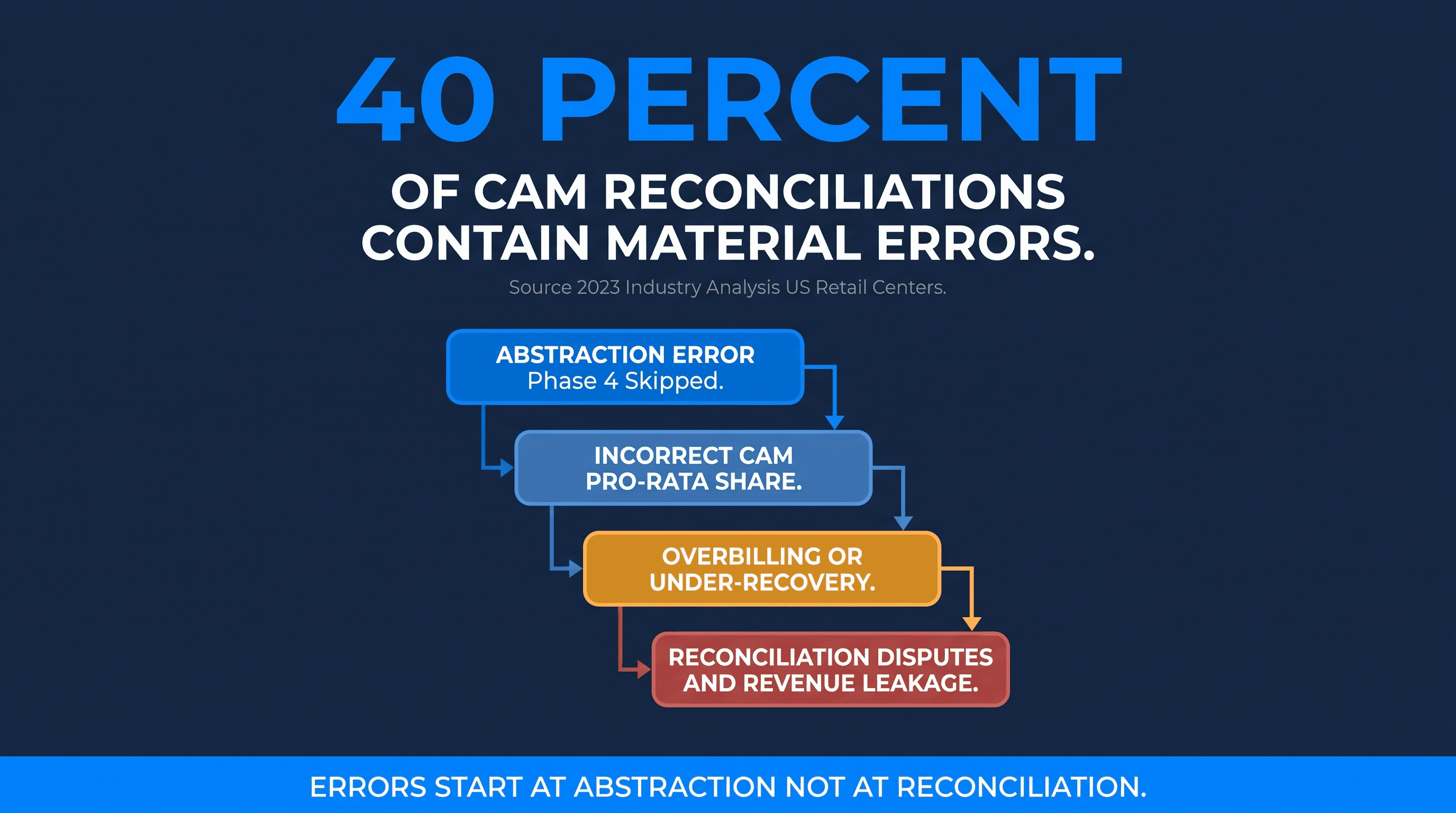
| Amendments not delta-linked | 4 | New terms sit outside active field set | Missed deadlines, wrong CAM billing, rights exposure |
| Handoff lacks flagged items log | 5 | Receiving team assumes completeness | Unknown gaps remain unmanaged |
Frequently Asked Questions
How long does the lease abstraction process take?
Manual abstraction often takes 2 to 4 hours per document for experienced analysts. AI-assisted workflows can reduce first-pass extraction to minutes, with review time shaped by complexity and amendment count.
What is included in a lease abstract?
A complete abstract includes parties, dates, financial terms, tenant rights, landlord obligations, and special provisions, with source references for each governing value.
How do amendments affect abstraction quality?
Amendments change governing terms. If they are not reconciled into active fields through delta-linking, the abstract can be formally complete but operationally outdated.
Can AI automate the full lease abstraction process?
AI can automate significant portions of extraction and mapping. The highest-quality outcomes come from AI speed combined with structured human QC and amendment-aware reconciliation controls.
The Lease Abstraction Process Done Right
Effective abstraction is not just extraction speed. It is process integrity from intake through handoff. The workflow only succeeds when amendment reconciliation is explicit, mandatory, and traceable.
If your team needs reliable lease data for CAM billing, renewal control, diligence, and portfolio reporting, treat Phase 4 as a core operating control rather than a cleanup step.
Request a Demo