
AI vs. Manual Lease Abstraction: The Real Cost Comparison for CRE Portfolios
A complete cost model of manual versus AI-assisted lease abstraction, including labor, error impact, rework, and acquisition opportunity cost.
Most cost comparisons stop at analyst hours. That captures part of the picture, but not the downstream cost of abstraction errors, rework loops, and delays during active acquisitions.
This guide models full cost, not time-only cost, and shows how economics change across portfolio sizes.
Key Takeaways
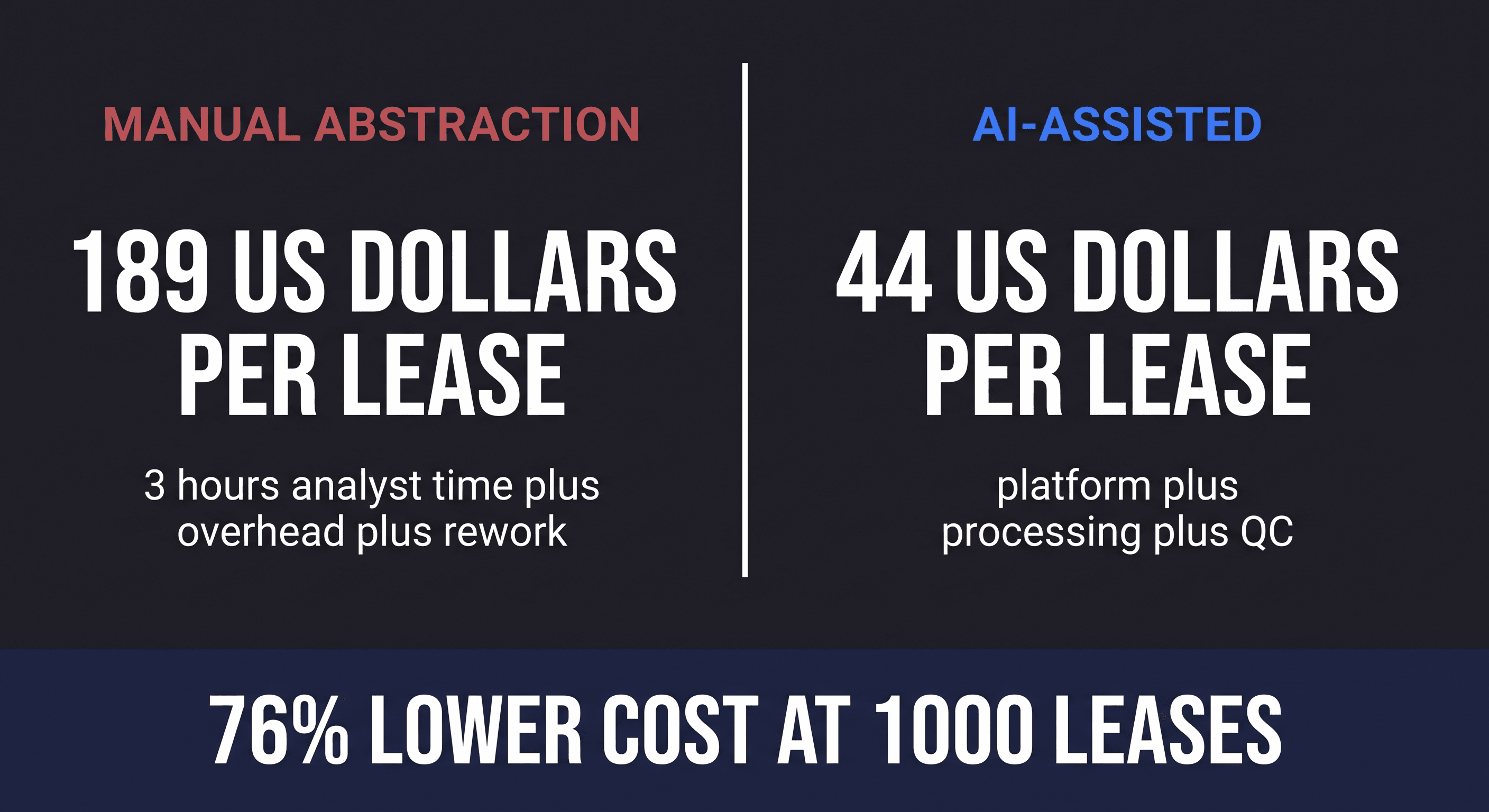
- Fully loaded manual abstraction commonly lands around 100 to 200 dollars per lease.
- AI-assisted workflows typically reduce direct cost substantially at scale.
- Error consequences can exceed labor savings by wide margins.
- Manual cost scales linearly; AI cost curves flatten with higher volume.
- Acquisition opportunity cost is often the largest missing budget line item.
What Manual Lease Abstraction Actually Costs
A complete manual model includes base abstraction time, loaded compensation, QC pass time, rework, and coordination overhead. Time-only estimates systematically understate total cost.
- Base abstraction: usually 2 to 4 hours for standard leases
- QC review: frequently 30 to 60 minutes per lease
- Rework: correction cycles after downstream error discovery
- Management overhead: assignment, tracking, exception handling
The Error Costs Nobody Puts in the Budget
Two recurring failure modes produce outsized loss: missed renewal notice windows and CAM structure errors. Both originate in abstraction quality and both compound over time.
[NEEDS VERIFICATION: Prophia benchmark] and CAM-audit datasets are frequently cited to show systemic upstream data quality issues.
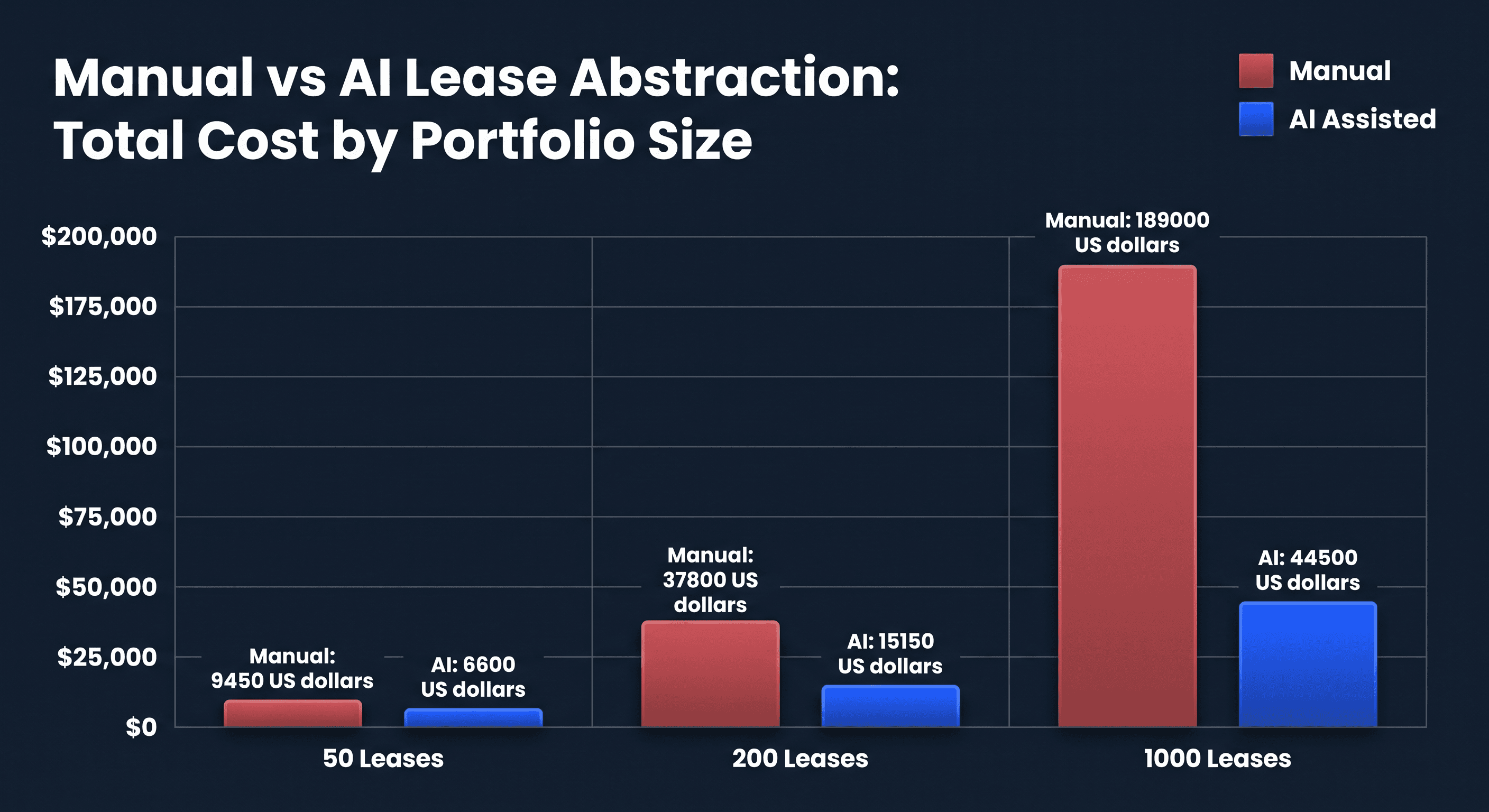
The Full Cost Comparison: Three Portfolio Sizes
At smaller portfolios, savings exist but may look moderate. At 200+ leases, differences become material. At 1,000 leases, manual and AI-assisted economics diverge structurally.
How AI Lease Abstraction Changes the Economics
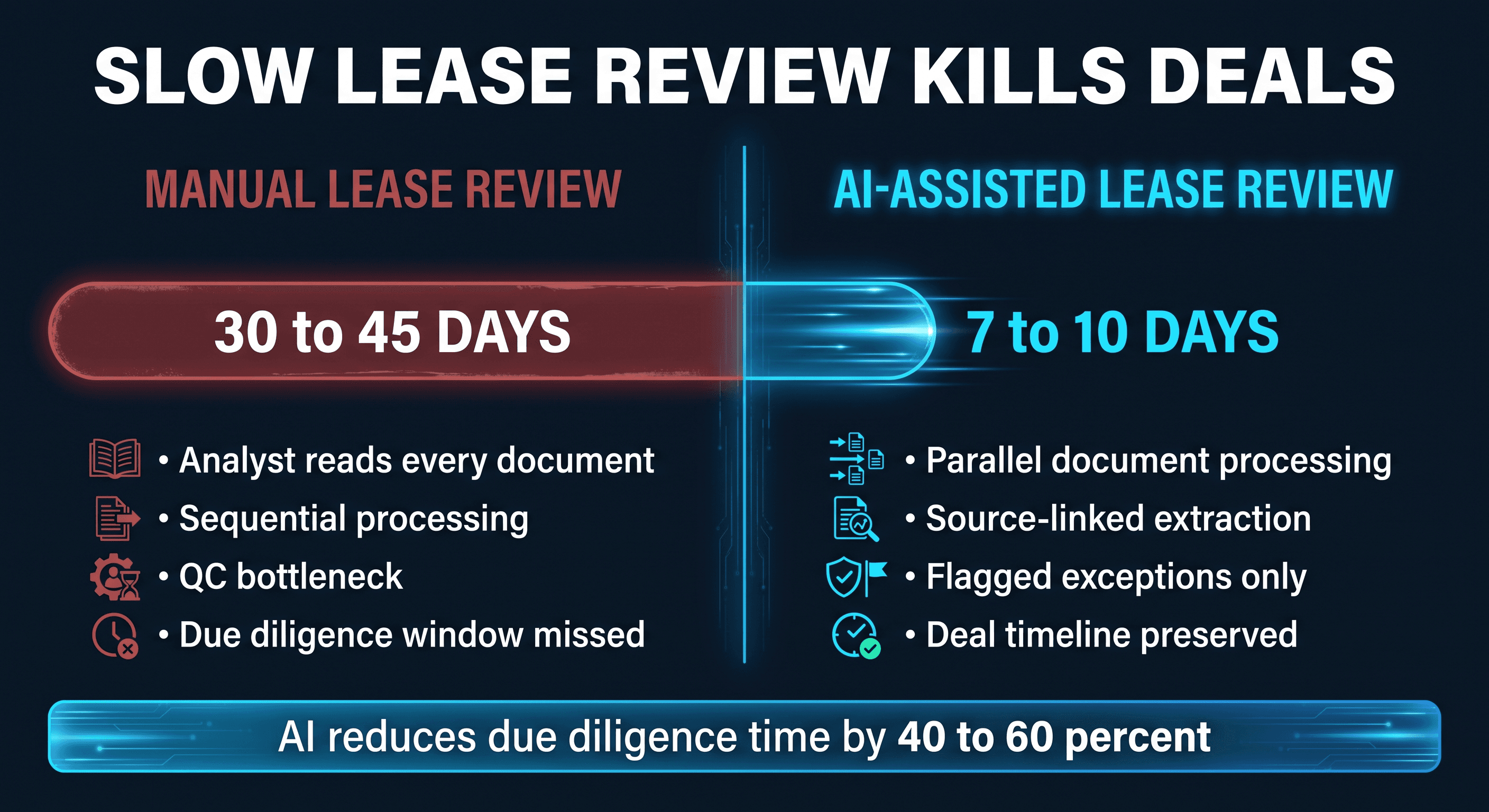
- Processing time drops from hours to minutes for first-pass extraction
- Source traceability enables rapid high-risk field verification
- Rework cycles shorten due to structured correction workflows
- Consistency improves across large document sets
At Scale, the Math Isn't Even Close
Manual workflows maintain near-linear cost growth. AI-assisted platforms amortize fixed cost and typically decrease effective per-lease cost as volume rises.
Is There Still a Case for Manual-Only Abstraction?
Yes, in narrow scenarios: highly bespoke legal structures and very small one-time portfolios. Outside those cases, manual-only models typically underperform on cost and speed.
Frequently Asked Questions
How long does manual lease abstraction take?
Standard leases often take 2 to 4 hours plus QC, while complex amendment chains can require materially more time.
What happens when a lease renewal notice is missed?
Notice failures can forfeit option rights and force market-rate renegotiation, creating significant cost exposure.
Does AI eliminate attorney review?
No. AI improves speed and consistency; legal judgment remains essential for non-standard and high-consequence provisions.
The Bottom Line
The standard manual cost estimate is directionally true but incomplete. Once full cost and timing consequences are modeled, AI-assisted abstraction is usually the economically stronger operating model for active CRE portfolios.
See what AI-assisted lease abstraction looks like on your portfolio