
Best Lease Abstraction Software in 2026: A CRE Buyer's Evaluation Guide
A practical framework for CRE legal and operations teams to evaluate lease abstraction software based on reliability, not feature-count marketing.
Every "best lease abstraction software" roundup tends to rank tools by speed claims and feature count, then present checkmarks as if all platforms are equivalent. For CRE teams that use abstracted data for rent rolls, CAM reconciliation, and option tracking, that framing is misleading.
Feature breadth is not the same as data trustworthiness. A platform with hundreds of features but no field-level source traceability can create silent operational risk at scale.
This guide replaces feature-count ranking with a five-point buyer framework focused on whether a platform is safe to rely on across a portfolio.
Key Takeaways
- Feature count is a weak proxy for reliability in lease abstraction software.
- Source traceability is the most important evaluation criterion.
- Amendment handling is a frequent hidden failure zone.
- Portfolio querying separates extraction tools from intelligence platforms.
- CRE-native design materially improves coverage of complex clause structures.
Table of Contents
- Why Most Software Rankings Get This Wrong
- The Five-Point Evaluation Framework for CRE Buyers
- Criterion 1: Source Traceability
- Criterion 2: Field Coverage Depth
- Criterion 3: Amendment Handling
- Criterion 4: Portfolio Querying Capability
- Criterion 5: CRE-Native Design vs. Generic Contract AI
- Lease Abstraction Software Comparison: 2026 Platform Overview
- How to Run a Structured Vendor Evaluation
- Red Flags to Watch for in Vendor Demos
- Frequently Asked Questions
- The Right Framework Changes the Decision
Why Most Software Rankings Get This Wrong
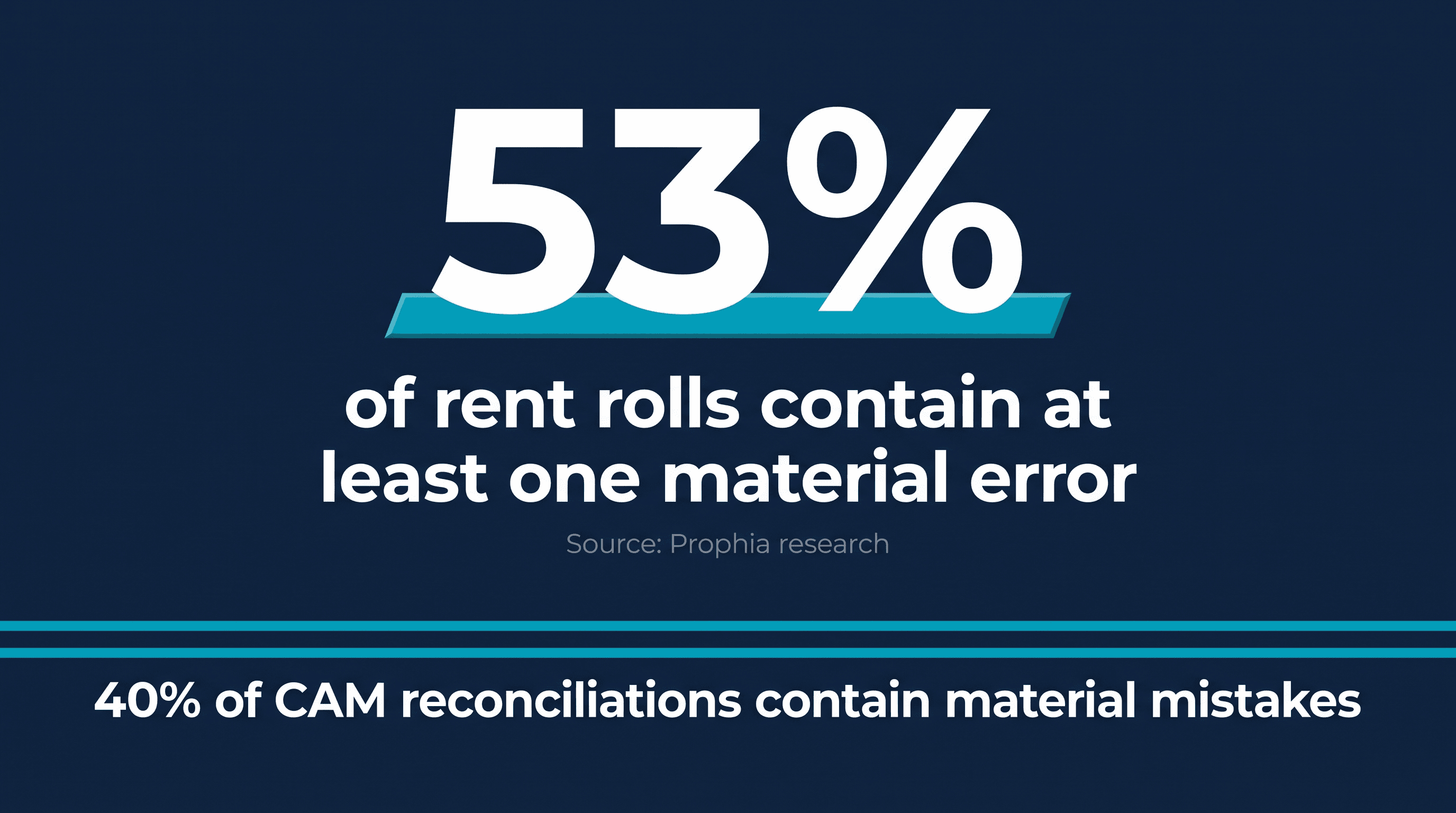
Most rankings optimize for breadth: features, integrations, and surface-level claims. CRE buyers need to optimize for verifiability. [NEEDS VERIFICATION: Prophia source] widely cited figures suggest many rent rolls still contain material errors, and [NEEDS VERIFICATION: CAM source] CAM reconciliation error rates remain high.
If abstraction output is wrong and untraceable, downstream reports, billing, and dates are wrong with no fast way to audit field origin.
The Five-Point Evaluation Framework for CRE Buyers
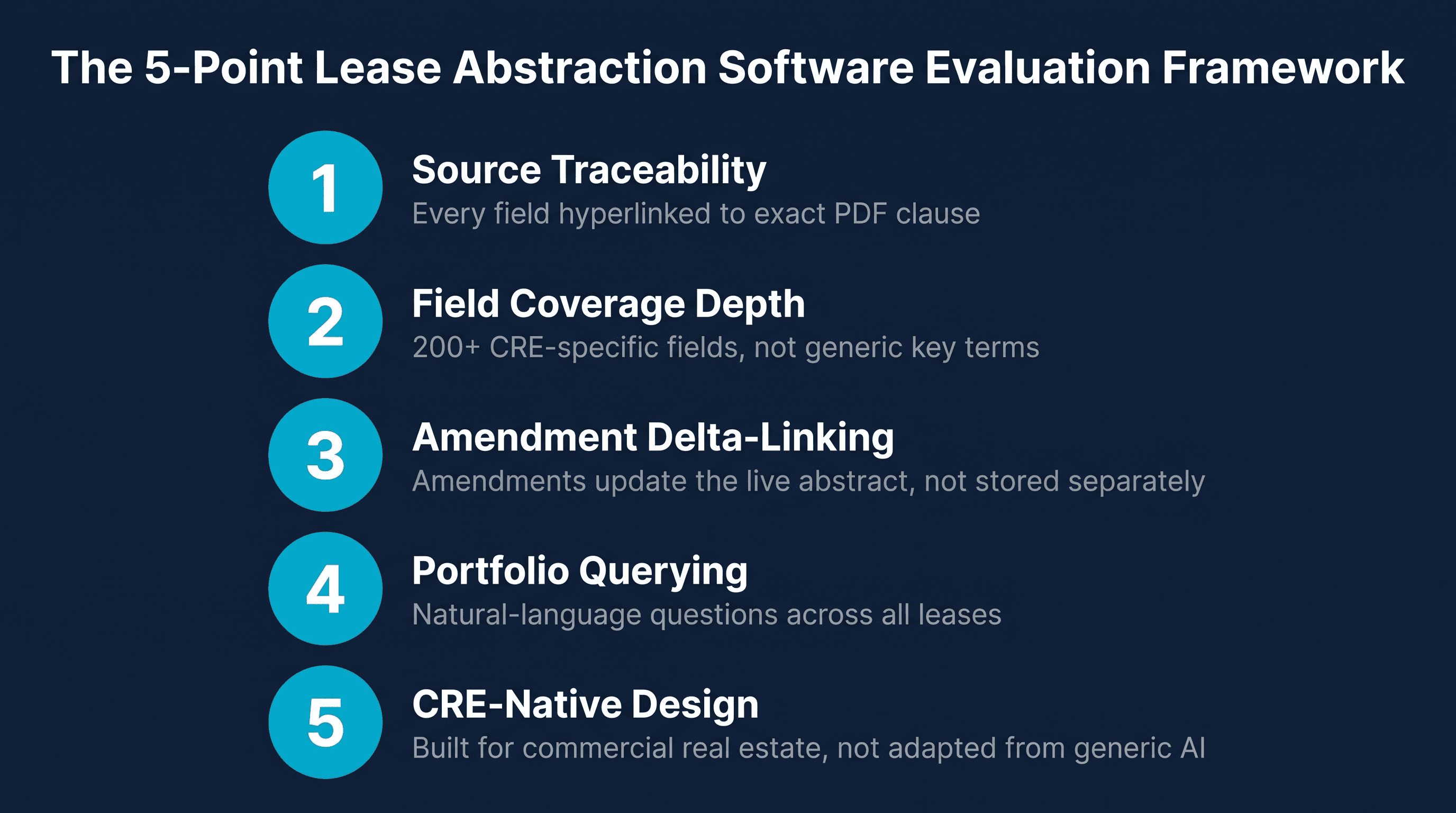
Evaluate platforms in this order: source traceability, field coverage depth, amendment handling, portfolio querying capability, and CRE-native architecture.
Criterion 1: Source Traceability
Ask first: does every extracted field deep-link to exact clause-level source in the PDF. Page-level references and confidence scores are not equivalent to traceable evidence.
This criterion determines whether review takes seconds or requires manual document re-search.
Criterion 2: Field Coverage Depth
Differentiate between generic extraction and CRE-specific field taxonomy. "Rent extracted" is not enough for CAM, escalation, or option governance.
- CAM exclusions, caps, and gross-up details
- Notice windows and exercise mechanics for options
- Special rights such as co-tenancy, dark-store, and guarantee burn-off logic
Criterion 3: Amendment Handling
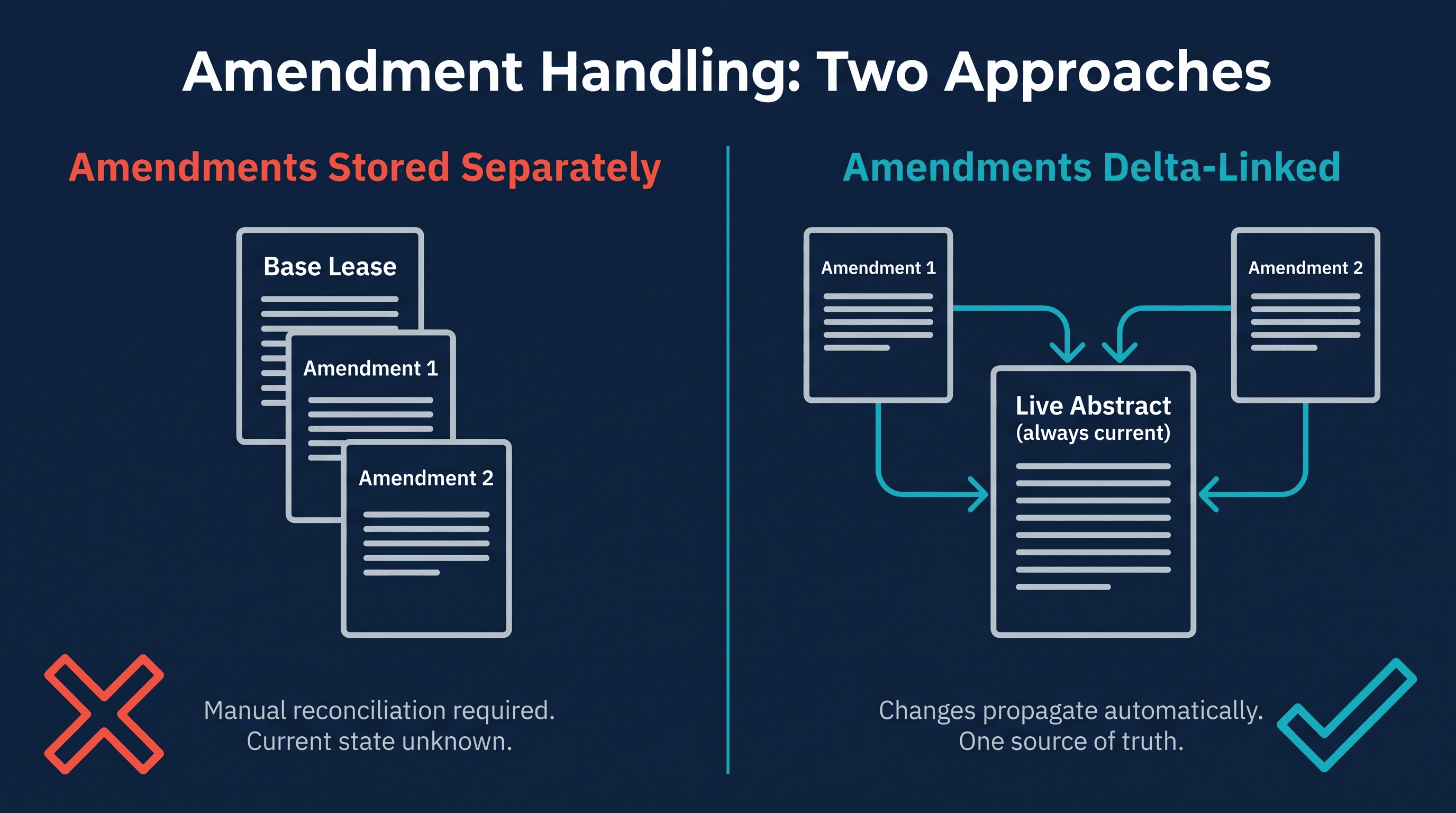
Separate-document storage is not amendment reconciliation. Reliable systems identify changed fields, show old-to-new deltas, and update the live abstract after approval.
Criterion 4: Portfolio Querying Capability
Portfolio querying enables natural-language questions across all leases, with source-grounded responses. It turns abstraction output into an operational intelligence layer.
- Which leases have renewal windows inside the next 18 months
- Where co-tenancy terms may trigger rent impact
- How CAM exposure varies by clause structure and gross-up rules
Criterion 5: CRE-Native Design vs. Generic Contract AI
Generic contract AI can extract standard terms, but CRE-native systems usually perform better on complex lease structures, amendment chains, and CRE-specific clause taxonomy.
Lease Abstraction Software Comparison: 2026 Platform Overview
| Platform | Source Traceability | Field Coverage Depth | Amendment Delta-Linking | Portfolio Querying | CRE-Native Design |
|---|---|---|---|---|---|
| Abstria | Strong | Strong | Strong | Strong | Strong |
| Prophia | Partial to strong | Strong | Partial | Strong | Strong |
| Yardi Smart Lease | Partial | Strong in ecosystem | Partial | Partial | Strong |
Use this as a conversation starter and validate all claims in live demos on your own documents.
How to Run a Structured Vendor Evaluation
- Bring your own complex lease with multiple amendments.
- Click-check at least five extracted fields for exact clause-level traceability.
- Upload an amendment and test whether live abstract values update via deltas.
- Ask a portfolio-level question and inspect source backing.
- Ask whether the platform was built for CRE first or adapted from general contract AI.
Red Flags to Watch for in Vendor Demos
- Only clean, low-complexity demo leases are shown.
- Accuracy is quoted without field-level methodology.
- Traceability links only to page-level references.
- Amendment handling is described as separate-document comparison.
- Portfolio query examples do not include source-backed evidence.
Frequently Asked Questions
What is lease abstraction software and how does it work?
It extracts key lease terms into structured records using OCR and AI, then supports review and operational use with source references.
How accurate is AI lease abstraction software?
Claims vary by platform and test method. Field-level traceability matters more because it enables your team to validate accuracy directly.
Can lease abstraction software handle amendments?
Yes, but true capability means delta-linking and live abstract updates, not separate document storage.
How does it help with CAM reconciliation?
By capturing detailed CAM fields at intake so reconciliations are built on complete, verifiable terms.
The Right Framework Changes the Decision
In 2026, speed and broad extraction are table stakes. Reliability depends on traceability, amendment logic, and CRE-native structure.
If your team cannot verify field origin quickly, the platform introduces structural risk regardless of feature count.
Schedule a demo at abstria.com and run the framework on your own leases