
AI Lease Review for CRE Due Diligence: Compressing Timelines Without Sacrificing Accuracy
A practical acquisition playbook for compressing lease diligence cycles from weeks to days through source-traced, attorney-guided AI review.
A 12-property retail acquisition with 34 tenants can quickly produce 800+ pages of leases, amendments, SNDAs, and related diligence documents. Under conventional workflows, this often drives 30 to 45 day lease review cycles.
AI-assisted lease review changes that timeline by processing in parallel, reconciling amendment chains early, and delivering source-traced outputs that attorneys verify instead of rebuilding from scratch.
Key Takeaways
- Conventional multi-property lease review timelines often extend to 30 to 45 days.
- AI-assisted workflows can compress that timeline to roughly 7 to 10 days with qualified review.
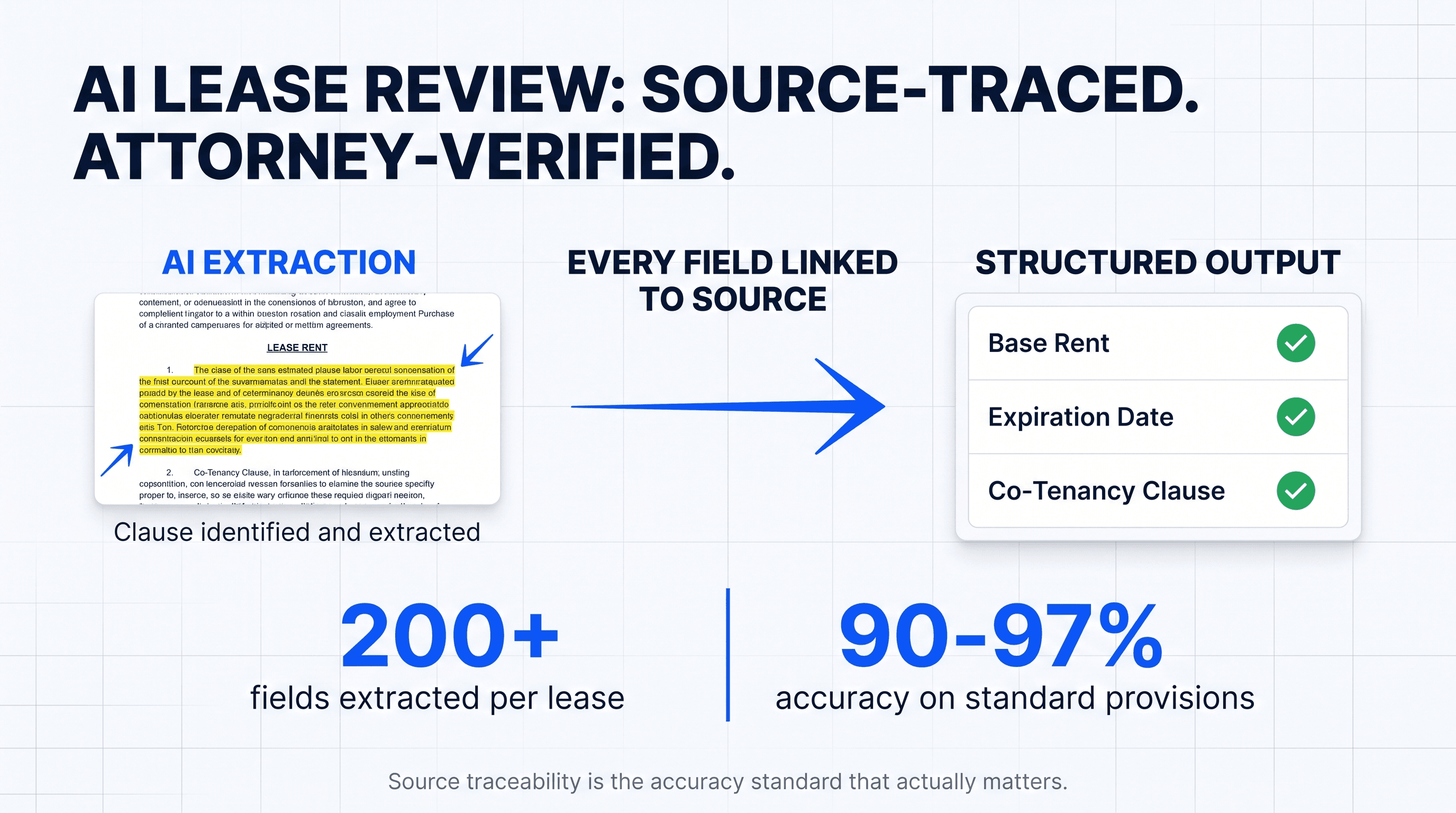
- Source traceability turns accuracy from a claim into a verifiable process.
- Attorney judgment remains essential for high-risk legal provisions and ambiguity.
- The advantage is structural: faster diligence changes negotiation posture and deal throughput.
The 45-Day Problem: What Actually Slows Down Conventional Lease Review
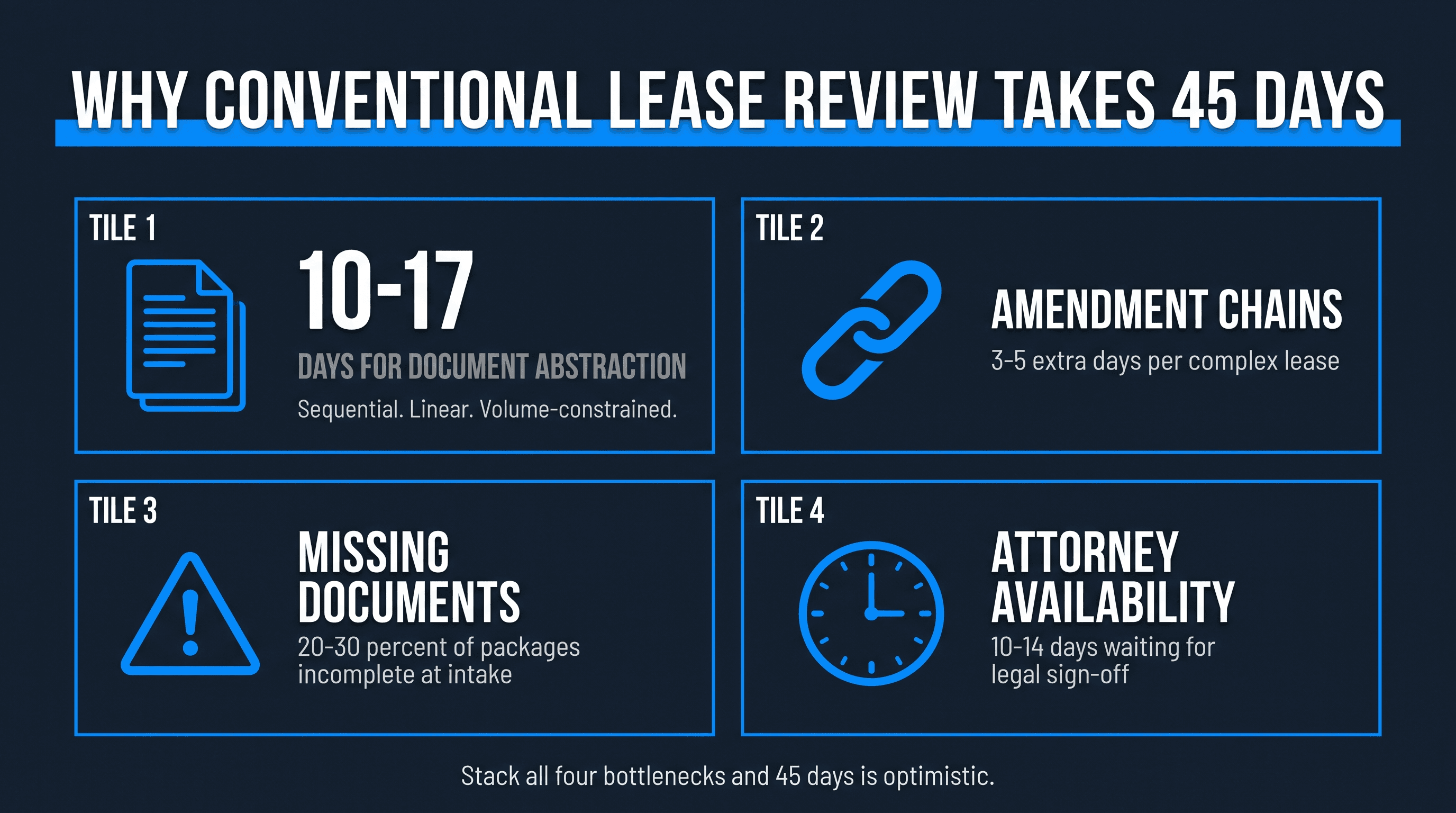
Delays come from four independent bottlenecks: high document volume, multi-amendment reconciliation, incomplete diligence packages, and constrained attorney availability.
- Sequential workloads: manual abstraction scales linearly with document count.
- Amendment chains: each additional amendment increases reconciliation complexity.
- Missing exhibits: incomplete packages trigger midstream request cycles.
- Attorney bandwidth: legal sign-off becomes the structural ceiling.
The Scenario: A 12-Property Portfolio Acquisition
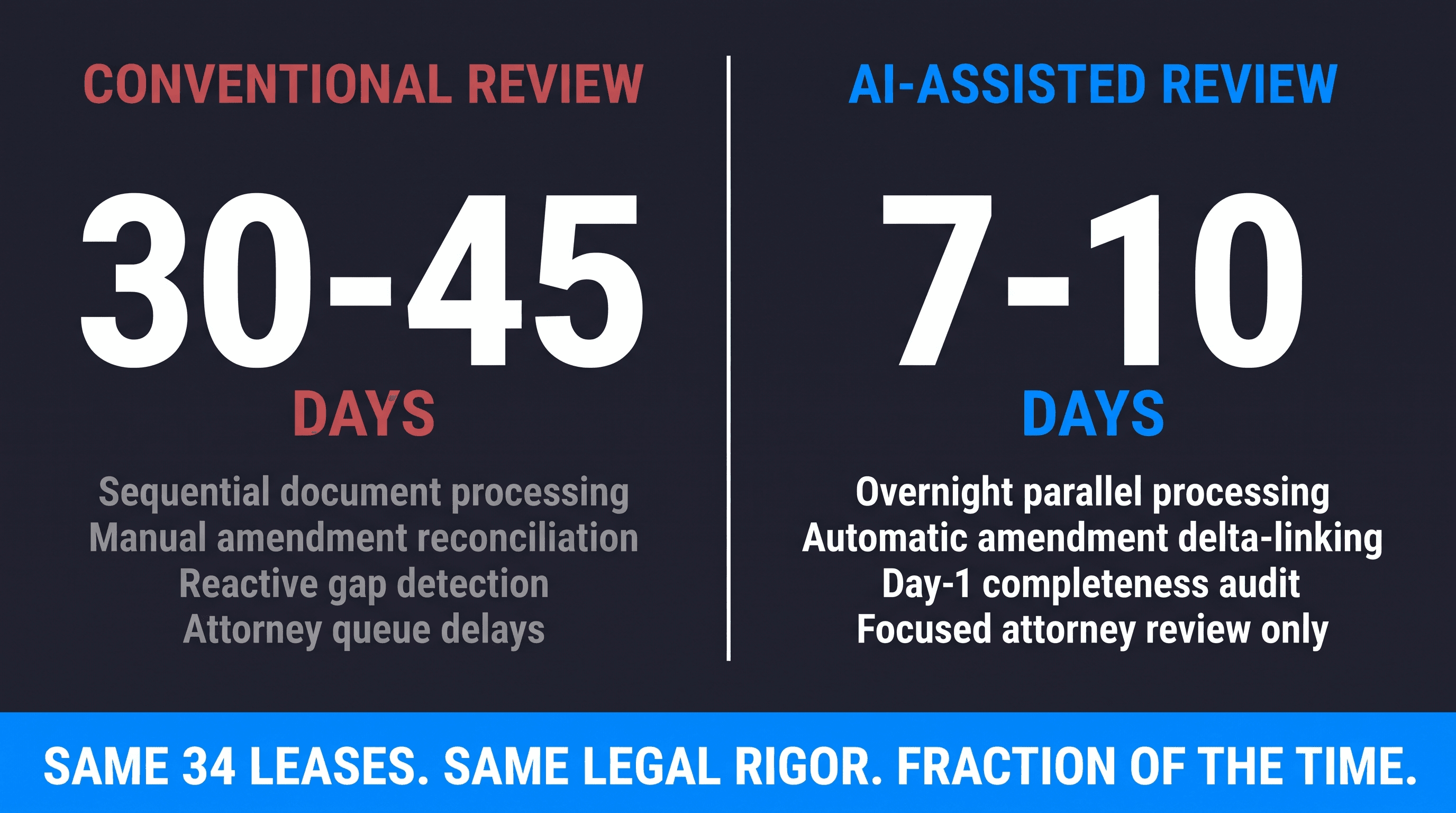
In a 30-day diligence window, conventional teams often approach day 28 with unresolved complex leases still waiting for final legal sign-off. AI-assisted teams can often complete substantive review by day 8 to 10.
Same portfolio, same complexity, different operating model.
How AI Lease Review Handles Each CRE Due Diligence Bottleneck
Volume -> Parallel Processing
AI processes lease libraries in parallel, collapsing linear intake timelines for large portfolios.
Amendment Chains -> Delta-Linking
Amendment delta-linking reconciles changes into one current-operative record with source-backed field lineage.
Incomplete Packages -> Intake Completeness Audit
Cross-reference auditing surfaces missing documents early, so seller requests happen on day one instead of late in the cycle.
Attorney Bottleneck -> Strategic Allocation
Attorneys review flagged high-judgment issues while AI handles first-pass extraction and reconciliation.
The Timeline Comparison
| Phase | Conventional Review | AI-Assisted Review |
|---|---|---|
| Document ingestion and organization | 1-2 days | Same day automated intake |
| Initial abstraction | 10-17 days | Overnight parallel processing |
| Amendment reconciliation | Added days per complex lease | Integrated via delta-linking |
| Attorney review | 10-14 days broad review | 3-5 days focused review |
| Total timeline | 30-45 days | 7-10 days |
Which Risk Categories Still Require Attorney Review
- Co-tenancy defaults: material NOI impact and interpretation risk.
- SNDA and subordination history: lender and counsel interpretation is context-dependent.
- Non-standard ambiguity: bespoke clause language requires legal judgment.
What the Speed Difference Actually Buys You
- More negotiating leverage before diligence deadlines compress decision quality.
- Lower exposure to late-cycle earnest money pressure.
- Higher throughput for parallel deal evaluation.
- Stronger seller confidence in execution certainty.
Frequently Asked Questions
Can AI replace attorneys in commercial real estate due diligence?
No. AI improves extraction and review focus; attorneys remain the decision-makers for high-risk provisions and interpretation.
What documents can AI process in CRE acquisitions?
Typical workflows include base leases, amendments, SNDAs, estoppels, side letters, and seller abstracts, with quality flags where confidence is lower.
Does AI diligence improve at larger portfolio scale?
Yes. Parallel processing architectures usually create larger absolute time savings as document volume increases.
The Bottom Line
The 45-day lease review cycle is a legacy constraint created by sequential manual workflows. AI-assisted due diligence removes those constraints by pairing source-traced extraction with targeted legal review.
See how Abstria runs acquisition lease review at portfolio scale