
AI Lease Abstraction: How It Works and Why CRE Teams Are Switching in 2026
A practical, technical look at OCR, LLMs, and RAG in AI lease abstraction, including where the system is reliable and where review handoff still determines outcome quality.
Commercial real estate teams abstract hundreds and sometimes thousands of lease documents every year. For most of the industry's history, that meant analysts reading dense legal documents, manually copying key terms into spreadsheets, and hoping nothing critical got missed.
AI lease abstraction changes that equation. But not always in the ways vendor pitch decks describe.
The teams switching in 2026 are not assuming AI is infallible. They are choosing platforms that are clear about what the technology handles well and where human oversight remains non-negotiable.
Key Takeaways
- AI lease abstraction works as a pipeline where OCR reads documents, LLMs interpret legal language, and RAG enables portfolio-wide querying.
- Standard lease terms are usually the strongest performance zone on clean documents.
- Non-standard clauses, exhibit dependencies, and handwritten riders remain primary review risk zones.
- Source traceability is a better operating standard than speed because it enables fast verification.
- Agentic systems are shifting value from single-document extraction to portfolio-level reasoning.
Table of Contents
- What Is AI Lease Abstraction, and How Does It Work?
- How Do LLMs, RAG, and OCR Work Together?
- What Can AI Lease Abstraction Handle Reliably?
- Where Does AI Still Need Human Review?
- Why Source Traceability Is the Right Standard, Not Speed
- What Is Agentic AI, and Why Is It Changing Lease Abstraction?
- AI vs. Manual Lease Abstraction: The Real Comparison
- How to Evaluate AI Lease Abstraction Software in 2026
- Frequently Asked Questions
- The Bottom Line
What Is AI Lease Abstraction, and How Does It Work?
AI lease abstraction is automated extraction of structured data from commercial leases using machine learning, NLP, and large language models. Where an analyst manually records rent amounts, option windows, CAM obligations, and termination rights, AI performs a first pass in minutes and links fields back to source text for review.
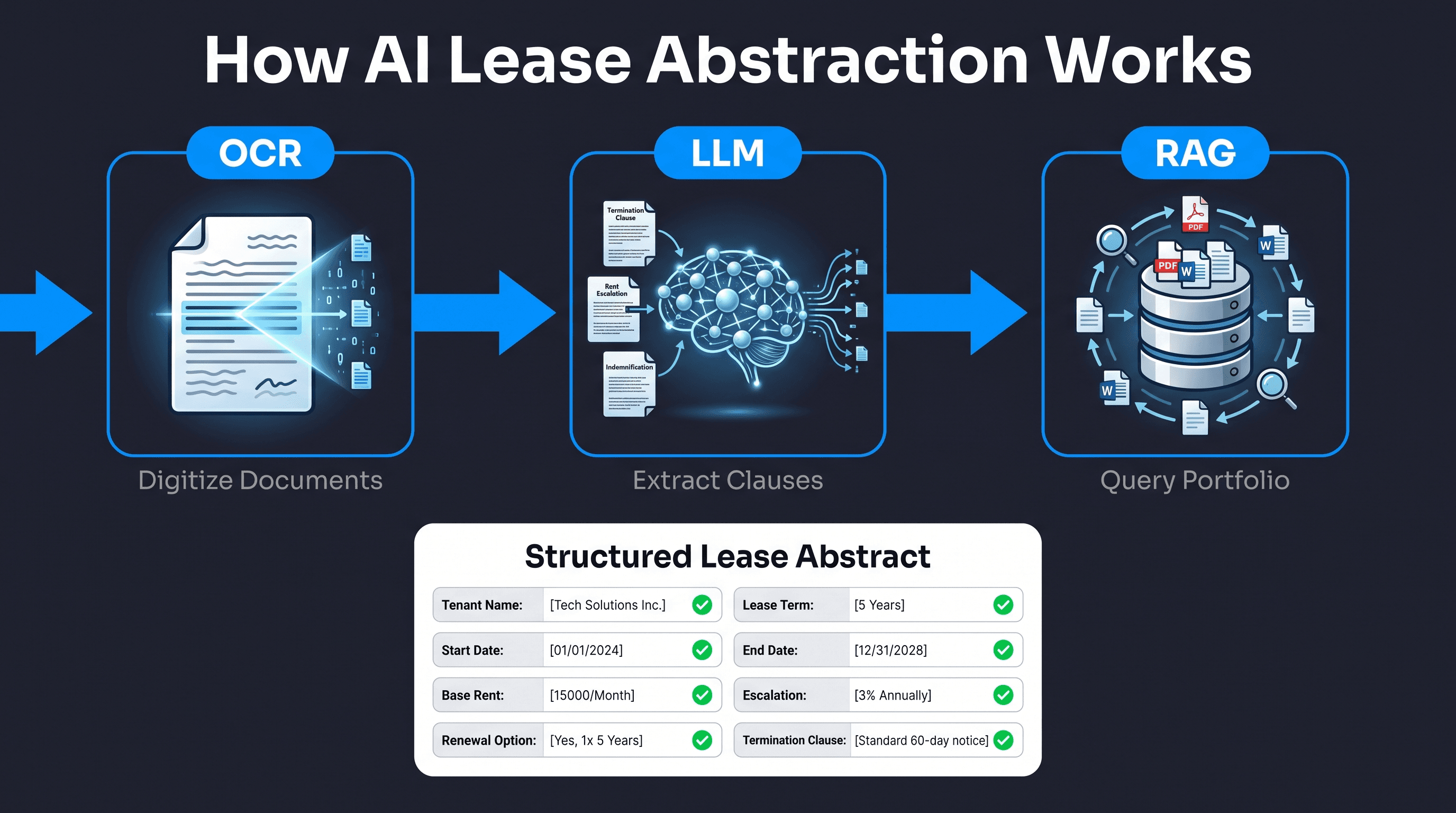
- Document ingestion. PDFs and scans are uploaded and OCR converts non-searchable pages into machine-readable text.
- Clause identification. Models identify relevant clauses across base lease and amendment chains.
- Field extraction. LLMs map language into structured fields and flag lower-confidence outputs.
- Structured output with source links. Every field is attached to clause-level source context for verification.
How Do LLMs, RAG, and OCR Work Together?
The stack works in sequence. OCR creates usable text from scanned pages. LLMs interpret legal language and normalize phrasing variations into consistent fields. RAG indexes the resulting records so teams can query across a full portfolio instead of one file at a time.
The first silent failure point is usually OCR quality. Low-quality scans can produce plausible but incorrect extracted text, which downstream models may treat as valid unless the platform surfaces quality signals and source-trace review.
LLM strength is semantic interpretation. The same legal concept can be expressed in different lease language and still map to one field. RAG then turns those fielded records into a searchable intelligence layer for operational and legal workflows.
What Can AI Lease Abstraction Handle Reliably?
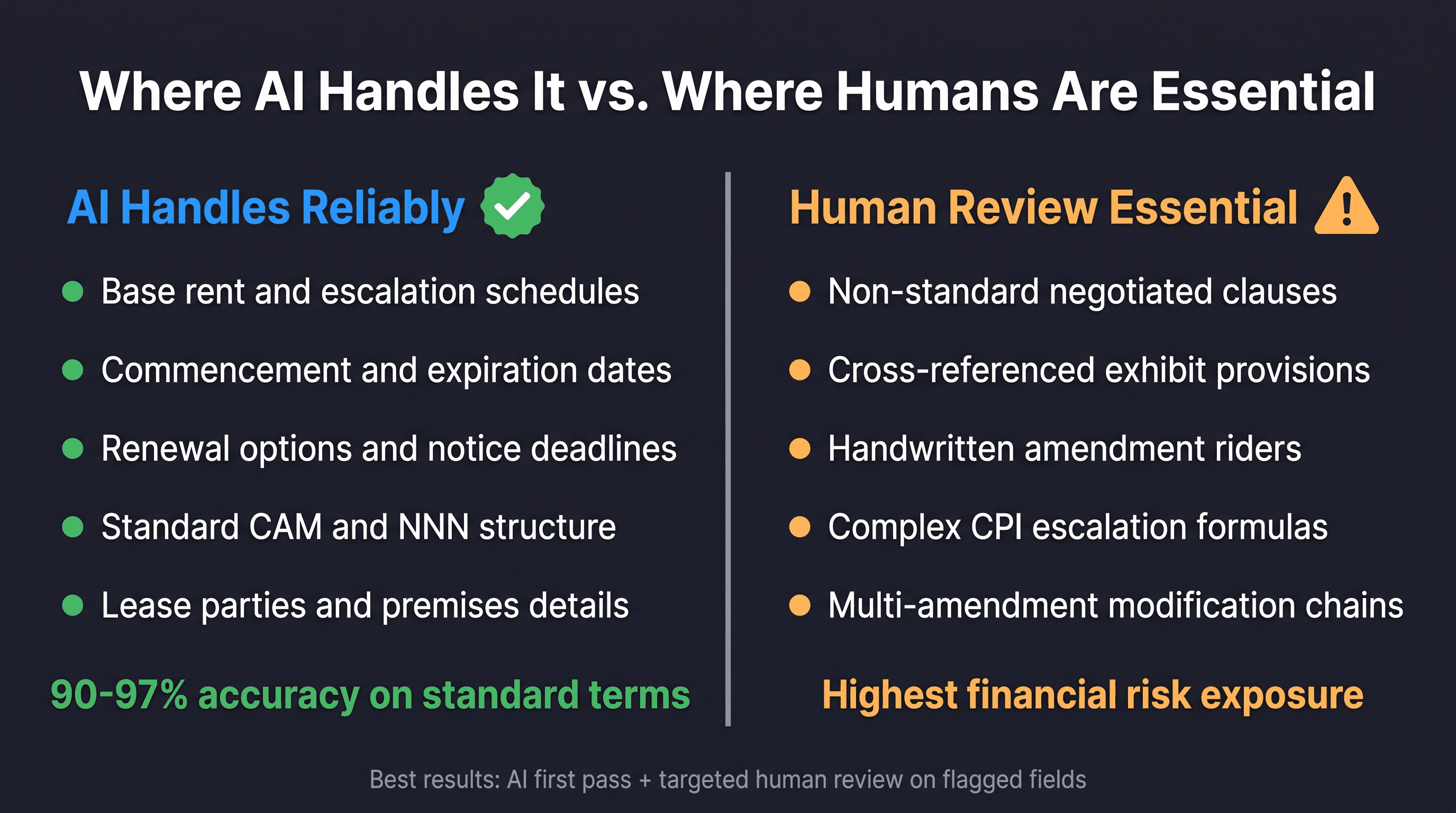
AI performs best on recurring, structured lease terms that appear in predictable locations and with familiar legal patterns. On clean documents, leading CRE-focused systems commonly report 90 to 97 percent extraction accuracy on standard categories.
- Lease parties and entity names
- Premises details such as addresses and square footage
- Core financial terms including base rent and escalation schedules
- Critical dates including commencement, expiry, and notice windows
- Common option structures and plainly stated conditions
- Clearly enumerated insurance and maintenance responsibilities
Where Does AI Still Need Human Review?
The highest-risk fields are often the least standardized fields. That is why strong teams use AI for first-pass extraction and route known risk categories to targeted review.
- Non-standard clauses. Bespoke negotiated language can encode material conditions in atypical phrasing.
- Cross-referenced exhibits. Critical terms may live outside the lease body and must be reconciled.
- Handwritten amendment riders. OCR variability and contextual interpretation degrade reliability.
- Complex formulas. CPI caps/floors, CAM exclusions, and breakpoint logic require precise interpretation.
- Ambiguous modification chains. Multi-amendment reconciliation remains a frequent error source.
Why Source Traceability Is the Right Standard, Not Speed
Speed is easy to demo. Verification quality is what protects decisions. A fast but unverified abstract can propagate error into rent rolls, CAM workflows, renewals, and diligence outputs.
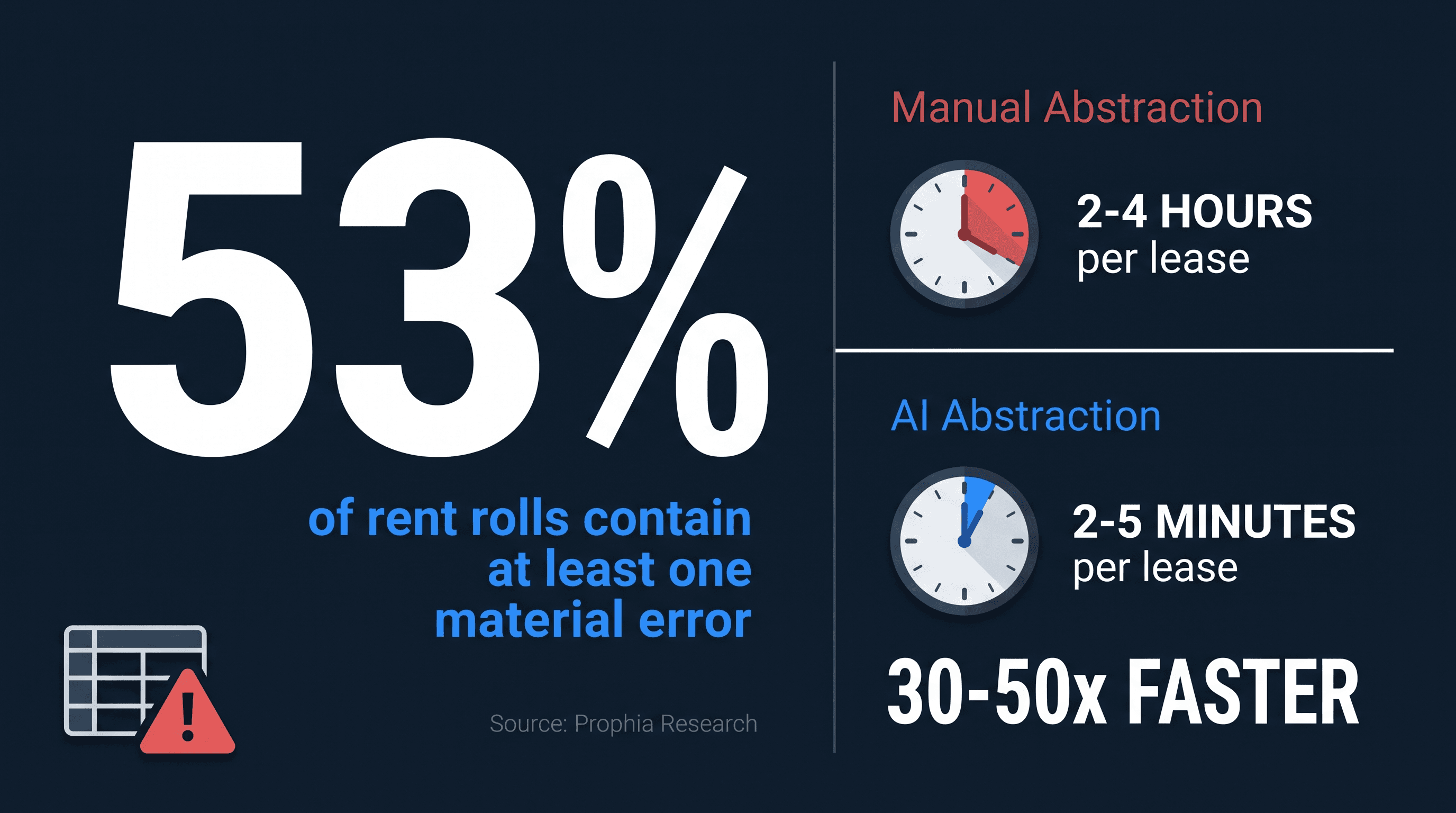
[NEEDS VERIFICATION: Prophia source] Roughly 53 percent of rent rolls contain at least one material error. [NEEDS VERIFICATION: Tango Analytics source] Around 40 percent of CAM reconciliations in U.S. retail centers contain material mistakes.
Source traceability means every extracted field links directly to its governing clause and page in the original PDF. That enables fast verification, defensible audit trails, and targeted correction instead of full document re-review.
What Is Agentic AI, and Why Is It Changing Lease Abstraction?
Earlier tools were document-by-document extractors. Agentic systems maintain state, execute multi-step analysis, and reason across an entire portfolio in one workflow.
- Monitor notice windows across all leases and surface actionable alerts
- Cross-reference CAM provisions portfolio-wide for consistency and dispute risk
- Answer clause-level natural-language questions across hundreds of documents
- Track amendment supersession chains and flag stale abstract values
- Surface concentration risks from clustered dates, options, and obligations
The value shift is from faster extraction to a continuously queryable lease intelligence layer that supports legal and operations decisions in real time.
AI vs. Manual Lease Abstraction: The Real Comparison
| Factor | Manual Abstraction | AI Abstraction (Source-Traced) |
|---|---|---|
| Time per standard lease | 2-4 hours | 2-5 minutes |
| Standard-term accuracy | About 90% with experienced analysts | 90-97% on clean documents |
| Non-standard clause handling | Higher with expert judgment | Requires targeted human review |
| Verification workflow | Manual full-document re-read | Per-field source hyperlink |
| Portfolio querying | Not real-time | Natural-language query across library |
How to Evaluate AI Lease Abstraction Software in 2026
- Source traceability: confirm each field links to exact clause-level source context.
- Amendment handling: verify true delta view and controlled propagation to the live abstract.
- Non-standard clause performance: test on your own complex leases, not sample docs.
- Portfolio query capability: confirm natural-language queries across the full lease library.
- CRE-native depth: validate document types, field coverage, and workflow fit for legal and operations.
Abstria is built around this operating model: source-linked fields, amendment delta tracking, dual-panel verification, and portfolio-level lease query workflows.
Frequently Asked Questions
Can AI completely replace human review in lease abstraction?
No. AI delivers strong first-pass output on standard fields, while non-standard and high-risk provisions still need reviewer judgment.
How accurate is AI lease abstraction compared to manual review?
On standard terms in clean documents, leading systems are commonly in the 90 to 97 percent range. Manual experts remain stronger on unusual negotiated language.
What types of commercial leases benefit most from AI abstraction?
High-volume portfolios with mostly standardized documents gain the most from automation plus targeted review.
What is the difference between AI lease abstraction and generic contract AI?
CRE-native tools are tuned for lease-specific concepts, amendment chains, and operations/legal workflows rather than broad contract extraction.
How does RAG work in commercial lease portfolio analysis?
RAG retrieves relevant records from an indexed portfolio and composes a source-grounded answer, enabling multi-lease analysis in seconds.
How long does it take to implement AI lease abstraction on an existing portfolio?
With cloud deployment and pre-trained CRE models, teams usually begin extraction in days and complete first-pass abstraction quickly with review built in.
The Bottom Line
AI lease abstraction is not valuable because it is fast. It is valuable when the output is verifiable, reviewable, and operationally trustworthy at portfolio scale.
The strongest teams in 2026 are not choosing AI-only or human-only workflows. They are running source-traced AI first pass and focusing expert reviewer time exactly where risk is highest.